Couples want to know exactly what your wedding venue includes before they schedule a tour.
They want to know whether you provide tables and chairs, how many guests your venue can accommodate, whether you have indoor and outdoor spaces, where the wedding party can get ready, and what happens if the weather changes.
If your website makes couples search through several pages to find those answers, you create unnecessary friction. Some visitors may contact you with basic questions, while others may leave your website and continue researching a venue that provides clearer information.
A dedicated amenities page gives couples one place to understand what your venue offers. It can also strengthen your wedding venue SEO, improve lead quality, support your sales process, and help more couples feel ready to schedule a tour.
What Is a Wedding Venue Amenities Page?
A wedding venue amenities page explains the spaces, features, services, and items included with your venue rental.
Depending on your property, the page may include information about:
- Ceremony spaces
- Reception areas
- Bridal suites
- Groom suites
- Tables and chairs
- Restrooms
- Parking
- Climate control
- Bars
- Prep kitchens
- Outdoor spaces
- Rain backup plans
- Rehearsal access
- Setup and cleanup
- Decorations
- Accessibility
- Audio and lighting
- Onsite staff
- Security
- Vendor access
Your amenities page should help couples understand the experience they receive when they book your venue.
It should not simply list features without context. The strongest amenities pages explain how each feature helps the couple, the wedding party, the vendors, or the guests.
For example, instead of writing:
“Bridal suite included.”
You could write:
“Our private bridal suite gives the wedding party a comfortable place to get ready, store personal items, and prepare for the ceremony without leaving the property.”
That explanation gives couples a clearer picture of how they will use the space.
Couples Search for Specific Wedding Venue Amenities
Many couples begin with a broad search such as “wedding venues near me,” but they often narrow their search based on specific needs.
They may search for:
- Wedding venues with bridal suites
- Wedding venues with indoor and outdoor spaces
- Wedding venues with tables and chairs included
- Wedding venues with onsite parking
- Wedding venues with rain backup plans
- Wedding venues with groom suites
- Wedding venues with climate controlled reception spaces
- Wedding venues with catering kitchens
- Accessible wedding venues
- Pet friendly wedding venues
- Wedding venues with overnight accommodations
- Wedding venues with outdoor ceremony spaces
A dedicated amenities page gives your website an opportunity to appear for these detailed searches.
These searches may bring in fewer visitors than a broad phrase, but they often come from couples who already know what they need. That can make the traffic more valuable.
A couple searching for a wedding venue with an indoor rain plan may have already ruled out venues that cannot accommodate their ceremony indoors. If your website clearly explains your backup options, you may attract a more qualified visitor.
An Amenities Page Helps Google Understand Your Venue
Google needs clear information to understand what your venue offers and which searches relate to your business.
A dedicated amenities page gives Google more context about your property.
When you clearly describe your ceremony spaces, reception areas, guest capacity, parking, dressing suites, furniture, and other features, you help search engines understand the full range of your services.
This matters because your homepage cannot explain every detail.
Your homepage should introduce the venue, create interest, and guide couples toward the next step. Your amenities page can provide the deeper information couples and search engines need.
A well written amenities page can also support your other important pages, including:
- Pricing
- Indoor and outdoor spaces
- Floor plans
- Photo gallery
- Frequently asked questions
- Wedding packages
- Contact
- Schedule a tour
Together, these pages create a stronger and more complete website.
A Dedicated Amenities Page Can Improve Lead Quality
Not every inquiry becomes a good fit for your venue.
Some couples may contact you before they understand your guest capacity, included furniture, ceremony options, or vendor policies. Your team may spend time answering questions only to discover that the venue does not meet the couple’s needs.
A clear amenities page helps couples qualify themselves before they reach out.
For example, they may learn that:
- Your venue can accommodate their guest count
- You provide enough parking for their event
- Your rental includes tables and chairs
- You offer separate spaces for the ceremony and reception
- Your property includes private dressing suites
- You have an indoor option for bad weather
- Your venue supports their preferred wedding style
- Your amenities justify the rental price
When couples understand these details before contacting you, they can submit more informed inquiries.
They may also move more quickly toward scheduling a tour because they already know your venue meets several of their most important requirements.
Amenities Help Couples Understand the Value of Your Pricing
Couples often compare wedding venues based on price, but rental rates do not tell the whole story.
One venue may charge less but require the couple to rent tables, chairs, restrooms, lighting, or a tent. Another venue may include those items in the rental.
If your website does not explain what your price includes, couples may compare your venue to a lower priced option without understanding the difference in value.
Your amenities page gives you a place to explain what couples receive.
For example, your rental may include:
- Ceremony chairs
- Reception tables
- Reception chairs
- Setup
- Cleanup
- Onsite parking
- Dressing suites
- Restrooms
- Bar equipment
- Rehearsal time
- Venue staff
- Climate controlled spaces
These details help couples understand why your pricing may differ from another venue.
The goal is not to justify every dollar with sales language. The goal is to give couples enough information to compare venues accurately.
A Dedicated Page Works Better Than a Short Amenities List
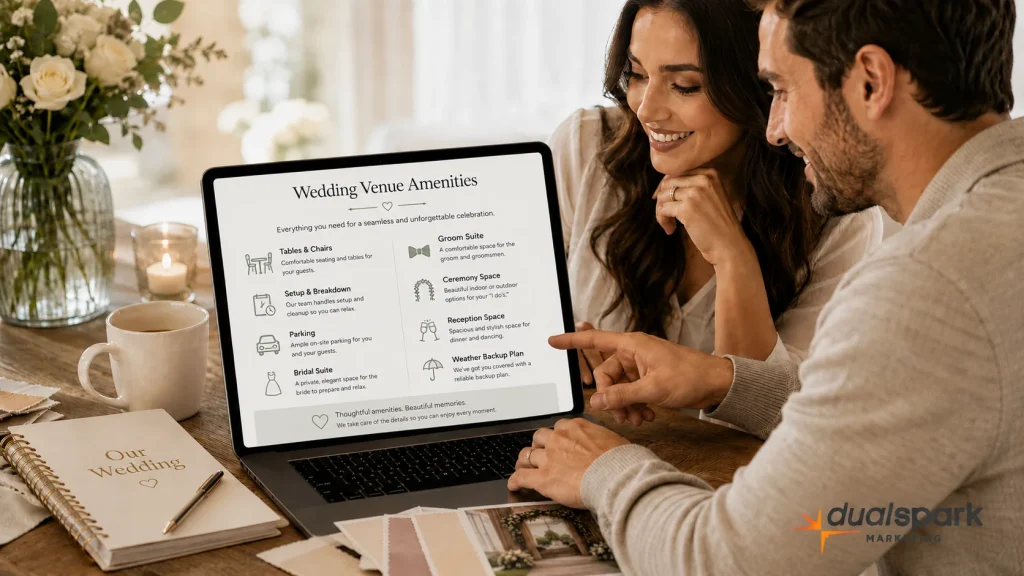
Many wedding venue websites include a small list of amenities on the homepage or pricing page.
That list can help, but it usually does not provide enough detail.
A short list may say:
- Tables and chairs
- Bridal suite
- Parking
- Indoor and outdoor spaces
Couples may still wonder:
- How many tables and chairs do you provide?
- What style are the chairs?
- How early can the wedding party access the bridal suite?
- How many vehicles can the parking area hold?
- Can the indoor space accommodate the full guest count?
- Does the outdoor ceremony space include power?
- Who handles setup and cleanup?
A dedicated page gives you room to answer those questions without overcrowding your homepage.
You can still include a short amenities summary on other pages and link visitors to the full amenities page for more information.
Your Amenities Page Should Show More Than It Tells
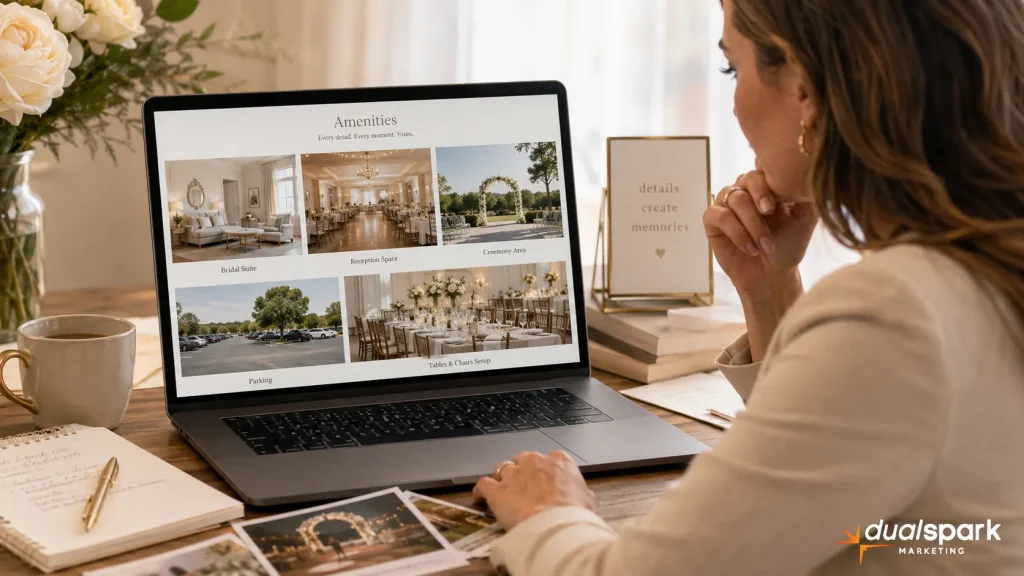
Wedding venues sell an experience, and photos help couples picture that experience.
Do not rely only on text.
Use original images to show:
- Ceremony spaces
- Reception layouts
- Bridal suites
- Groom suites
- Bars
- Outdoor areas
- Tables and chairs
- Restrooms
- Parking
- Prep kitchens
- Lighting
- Decor options
- Rain backup spaces
Whenever possible, show the amenities in use during real weddings.
A photo of an empty bridal suite can help, but a photo of the wedding party getting ready in the suite may communicate the experience more clearly.
A photo of stacked chairs shows inventory. A photo of the chairs arranged for a ceremony helps couples understand how the space can look.
Use images that accurately represent your venue. Avoid stock photos that show features you do not offer.
Organize Your Amenities Into Clear Categories
A long list of amenities can feel overwhelming.
Organize the page into sections so couples can quickly find the information they need.
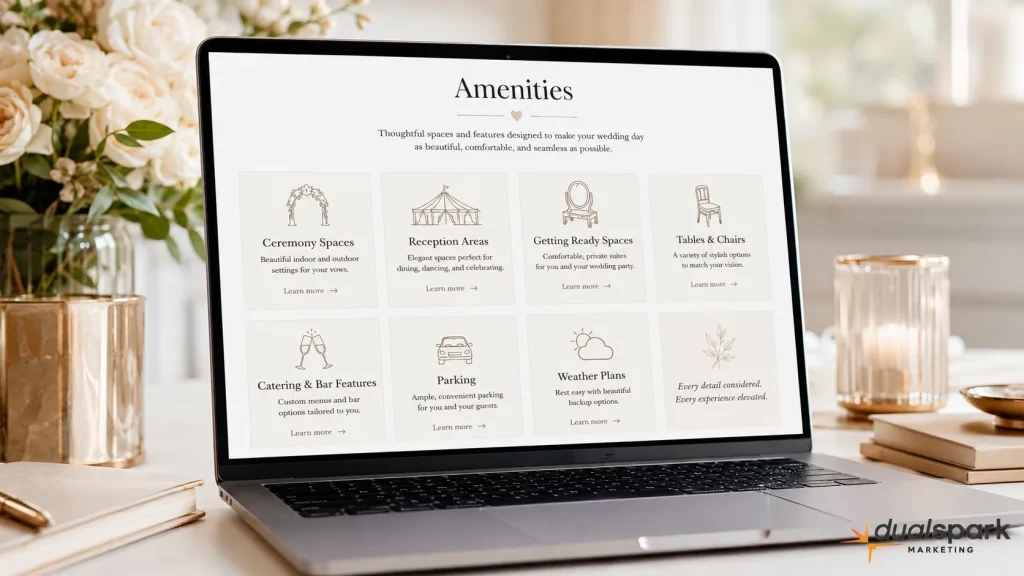
You may use categories such as:
Ceremony Spaces
Explain your indoor and outdoor ceremony options, capacity, layout, power access, aisle options, and weather alternatives.
Reception Areas
Describe the reception space, guest capacity, dance floor, lighting, climate control, and available layouts.
Getting Ready Spaces
Explain what your bridal and groom suites include, when couples can access them, and how many people they can accommodate.
Tables, Chairs, and Furniture
List the furniture included with the rental and explain available styles, quantities, and setup options.
Catering and Bar Features
Describe your prep kitchen, catering access, refrigerators, sinks, bar areas, ice storage, and vendor requirements.
Parking and Guest Access
Explain parking capacity, drop off areas, transportation access, lighting, and accessibility features.
Setup and Cleanup
Tell couples what your team handles, what vendors handle, and when setup can begin.
Weather Backup Options
Explain how your venue handles rain, heat, cold, or severe weather.
Clear categories improve readability and help couples compare your amenities with their needs.
Explain How Each Amenity Benefits the Couple
Do not stop at naming the feature.
Explain why it matters.
For example:
Instead of:
“Onsite parking.”
Write:
“Our onsite parking allows guests to park near the ceremony and reception spaces without relying on street parking or a separate parking lot.”
Instead of:
“Climate controlled reception hall.”
Write:
“Our climate controlled reception space helps keep guests comfortable during warm summer afternoons, cool evenings, and unpredictable weather.”
Instead of:
“Prep kitchen.”
Write:
“Our catering prep area gives approved vendors a dedicated space to organize food service and prepare for the reception.”
Benefits help couples picture how the feature affects their wedding day.
Include Important Limitations and Requirements
Your amenities page should present your venue positively, but it should also set accurate expectations.
If an amenity has a limitation, explain it clearly.
For example:
- Tables and chairs are included for up to a certain guest count
- The prep kitchen does not allow full cooking
- Outdoor music must end at a specific time
- The bridal suite opens at a set hour
- The rain backup space has a different capacity
- Parking attendants may be required for larger events
- Certain decorations require approval
- Vendors must carry insurance
Clear information helps prevent confusion later.
You do not need to publish every contract term on the page, but you should explain the details that may affect whether a couple chooses your venue.
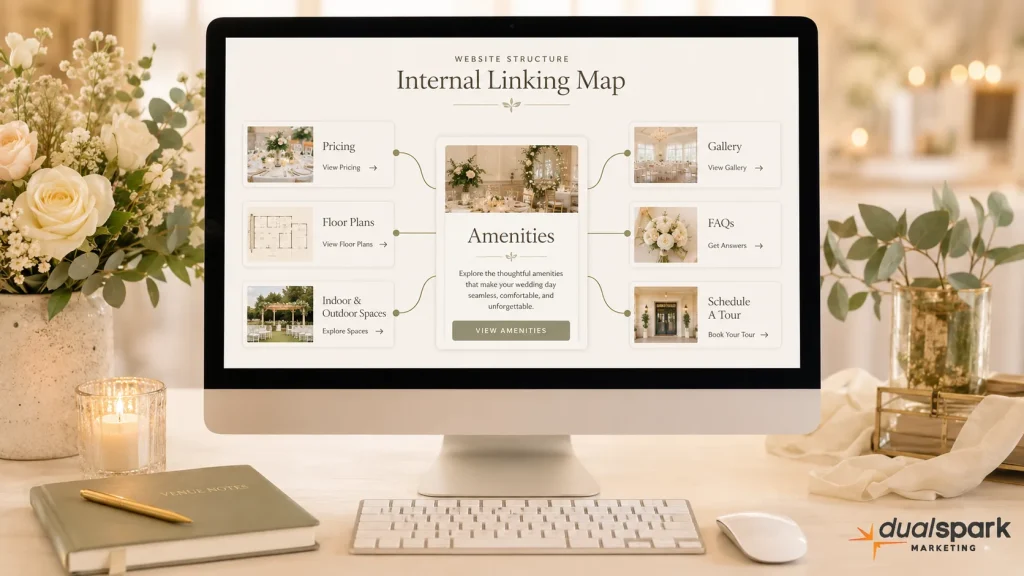
Link Your Amenities Page to Other Important Pages
Your amenities page should help visitors continue exploring your website.
Add internal links where they make sense.
For example:
- Link ceremony spaces to your indoor and outdoor spaces page
- Link guest capacity to your floor plans
- Link included items to your pricing page
- Link visual examples to your gallery
- Link vendor information to your preferred vendors page
- Link common policies to your FAQ page
- Link tour information to your scheduling page
Internal links help couples find more detailed information.
They also help search engines understand the relationship between your pages.
Do not add links only for SEO. Use them when they help the visitor take the next step.
Your Amenities Page Can Support Google Ads
A dedicated amenities page can also improve your paid advertising strategy.
If you run Google Ads for specific searches, you can send visitors to a page that closely matches what they searched for.
For example, someone who searches for “wedding venue with indoor and outdoor ceremony spaces” may respond better to a detailed amenities or spaces page than to a general homepage.
A strong landing experience can help visitors:
- Find relevant information faster
- Stay on the website longer
- Understand what the venue includes
- Compare the venue with other options
- Schedule a tour
- Submit a more qualified inquiry
You can also use your amenities in ad copy when they provide a clear competitive advantage.
Update the Page When Your Venue Changes
Your amenities page should always reflect your current venue.
Update it whenever you add or change:
- Furniture
- Dressing suites
- Ceremony spaces
- Reception spaces
- Parking
- Lighting
- Bar areas
- Catering facilities
- Restrooms
- Accessibility features
- Setup services
- Decor options
- Rental inclusions
An outdated page can create the wrong expectations.
If your website says you include 150 chairs but you now provide 120, your sales team may need to correct that information during the inquiry process.
Review the page at least a few times each year and whenever you make major property improvements.
Common Wedding Venue Amenities Page Mistakes
Listing Features Without Explaining Them
A simple list does not always give couples enough information. Explain how the amenities work and why they matter.
Using Stock Photos
Stock photos can mislead couples when they show spaces or features that do not exist at your venue. Use original images whenever possible.
Hiding Important Details
Do not force couples to contact you for every basic question. Give them enough information to decide whether the venue fits their plans.
Forgetting Capacity Information
Explain how many guests each important space can accommodate.
Leaving Out the Rain Plan
Outdoor wedding couples want to know what happens if the weather changes. Address this clearly.
Failing to Link to Other Pages
Use the amenities page to guide couples toward pricing, floor plans, galleries, FAQs, and tour scheduling.
Allowing the Page to Become Outdated
Review the page whenever your venue changes.
Frequently Asked Questions About Wedding Venue Amenities Pages
What should a wedding venue include on its amenities page?
A wedding venue amenities page should explain the spaces, features, services, and items that couples receive when they book the property. This usually includes ceremony spaces, reception areas, bridal suites, groom suites, tables, chairs, parking, restrooms, climate control, bar areas, catering access, setup, cleanup, accessibility, and weather backup options.
The page should also explain important details such as guest capacity, quantities, access times, restrictions, and whether each item is included in the rental price. A simple list may not answer enough questions. Couples want to understand how each amenity will affect their wedding day, their vendors, and their guests.
Does a wedding venue need a separate amenities page?
Most wedding venues benefit from a dedicated amenities page because couples often want detailed information before they schedule a tour. A separate page gives you enough space to explain what your venue includes without overcrowding the homepage or pricing page.
You can still mention your strongest amenities throughout the website, but the dedicated page should act as the complete resource. It can help couples compare your venue with other options, understand your value, and decide whether the property fits their plans.
Can a wedding venue amenities page help improve SEO?
Yes. A detailed amenities page can support wedding venue SEO by helping your website appear for more specific searches. Couples may search for wedding venues with bridal suites, onsite parking, indoor ceremony spaces, tables and chairs, climate control, or rain backup plans.
When your page clearly explains those features, Google receives more information about what your venue offers. The page can also strengthen your website through internal links to pricing, floor plans, photo galleries, FAQs, and tour scheduling pages.
How can an amenities page help a wedding venue generate better inquiries?
An amenities page helps couples understand what your venue offers before they contact you. They can determine whether the property fits their guest count, budget, wedding style, vendor needs, and weather concerns.
This can reduce inquiries from couples who are not a good fit and help your team spend more time with people who already understand the venue. Better informed couples also tend to ask more useful questions and may feel more confident scheduling a tour.
Should a wedding venue list tables and chairs on its amenities page?
Yes. If your venue provides tables and chairs, explain the quantity, style, condition, and guest count they support. Couples also want to know whether your team handles setup, whether different layouts are available, and whether they need to rent additional furniture.
Tables and chairs can represent a meaningful cost difference between venues. Clearly explaining what you include helps couples compare pricing more accurately and understand the overall value of your rental.
Should a wedding venue explain its rain plan on the amenities page?
Yes. Couples considering an outdoor ceremony want to know what will happen if the weather changes. Your amenities page should explain whether you offer an indoor backup space, a covered option, a tent area, or another weather plan.
You should also explain whether the backup space can hold the full guest count and when the final weather decision is usually made. Clear information can reduce anxiety and help couples feel more confident booking an outdoor venue.
Should a wedding venue amenities page include pricing?
The amenities page does not need to replace the pricing page, but it should explain which features and services are included with the rental. This helps couples understand what they receive for the price.
You can link to your pricing page for current rates, package options, deposits, and payment details. The two pages should work together so couples can compare both cost and value without guessing.
Should wedding venues include photos of every amenity?
Wedding venues should include original photos of their most important amenities whenever possible. Couples want to see ceremony spaces, reception areas, dressing suites, bars, parking, tables, chairs, restrooms, and weather backup spaces.
The photos should accurately represent the venue and show how couples may use each feature. Real wedding images often work especially well because they help visitors picture the space during an actual event.
How detailed should a wedding venue amenities page be?
The page should provide enough detail to answer the questions couples commonly ask before a tour. Include guest capacity, quantities, access times, included services, limitations, and any important rules that affect planning.
You do not need to publish every contract term, but you should avoid vague descriptions that create more questions. Clear, complete answers can improve trust and reduce the amount of basic information your team has to repeat.
Should a wedding venue mention amenities on other website pages too?
Yes. Your homepage, pricing page, wedding spaces page, and FAQ page should mention the amenities most relevant to those topics. However, those shorter references should link to the dedicated amenities page for complete details.
This approach helps couples find information naturally as they move through the website. It also helps search engines understand how your pages relate to one another.
How often should a wedding venue update its amenities page?
Update the page whenever you change your spaces, furniture, parking, capacity, services, rental inclusions, catering access, or weather plans. You should also review the page several times each year to make sure the information and photos remain accurate.
An outdated page can create confusion during tours and sales conversations. Keeping it current helps your website match the actual experience couples receive.
What is the biggest mistake wedding venues make on amenities pages?
The biggest mistake is listing features without explaining what they mean for the couple. Writing “bridal suite,” “parking,” or “tables and chairs” does not tell visitors enough.
Explain how many people the space holds, when it becomes available, what it includes, and how it supports the wedding day. The more useful and specific the information is, the more valuable the page becomes for couples, search engines, and AI-generated answers.
Final Thoughts: Turn Your Wedding Venue Amenities Into More Qualified Tour Requests
Your amenities influence nearly every part of a couple’s wedding day.
They affect comfort, planning, cost, guest experience, vendor access, weather preparation, and the overall flow of the event.
A dedicated amenities page helps you present that value clearly. It gives couples the information they need, helps search engines understand your venue, and supports more qualified tour requests.
Do not make couples piece together your amenities from several pages or wait for a sales call to learn the basics. Give them one clear, detailed resource that shows what makes your venue practical, comfortable, and worth visiting.
At Dual Spark Marketing, we help wedding venues build websites and SEO strategies that turn online searches into qualified inquiries and scheduled tours. A well planned amenities page can become one of the most useful and persuasive pages on your website.