
Most wedding venues spend money on marketing.
Far fewer can clearly explain which marketing channels are actually producing signed contracts and profitable revenue.
You may know how much you spend on Google Ads. You may know how many leads came through your website. You may know how many people visited your pricing page.
But can you answer these questions?
- How many inquiries turned into tours?
- How many tours turned into bookings?
- Which source produced those bookings?
- How much revenue came from each marketing channel?
- What did it cost to acquire each signed contract?
- Which campaigns are worth increasing?
- Which ones are wasting money?
That is where marketing ROI becomes important.
If you only measure clicks, impressions, website traffic, and lead volume, you may be making budget decisions based on the wrong numbers.
A wedding venue marketing strategy should ultimately help generate profitable bookings.
That means you need to follow the money all the way from the first click to the signed contract.
What Does Wedding Venue Marketing ROI Mean?
ROI stands for return on investment.
For a wedding venue, marketing ROI measures how much financial return you generate compared with what you spend on marketing.
A simple example:
You spend $10,000 on marketing.
That marketing helps produce $100,000 in booked venue revenue.
At a basic level, your marketing generated $10 in booked revenue for every $1 spent.
That sounds good.
But that number alone does not tell the whole story.
You also need to look at:
- Cost per inquiry
- Cost per tour
- Cost per booking
- Average booking value
- Gross profit
- Cancellations
- Refunds
- Lead quality
- Attribution
The stronger your tracking becomes, the easier it is to understand whether your marketing is truly profitable.
Start With the Right ROI Formula
A simple marketing ROI formula is:
Revenue Generated From Marketing Minus Marketing Cost, Divided by Marketing Cost
For example:
You spend $20,000 on marketing.
That marketing produces $120,000 in booked revenue.
Your calculation would be:
$120,000 – $20,000 = $100,000
$100,000 ÷ $20,000 = 5
That gives you a 500 percent return on marketing spend.
Another way to look at it is that every $1 you invested produced $6 in total booked revenue.
That is useful, but do not stop there.
Booked revenue is not the same as profit.
Booked Revenue Is Not the Same as Profit
A wedding venue may generate a $12,000 contract, but you do not keep all $12,000.
You may still have expenses for:
- Staff
- Cleaning
- Security
- Utilities
- Insurance
- Rentals
- Bar service
- Catering
- Coordination
- Maintenance
- Vendor costs
- Payment processing
That means a marketing campaign can look profitable based on gross booked revenue while producing a much smaller return after event costs.
For a more accurate picture, look at the gross profit from the bookings your marketing generated.
That gives you a better idea of how much you can afford to spend to acquire new business.
Track Cost Per Inquiry
Cost per inquiry is one of the easiest marketing metrics to calculate.
The formula is:
Marketing Spend ÷ Number of Inquiries
If you spend $3,000 and generate 60 inquiries:
$3,000 ÷ 60 = $50 per inquiry.
That gives you useful information.
But it does not tell you whether those leads are good.
A $50 inquiry that never responds is not necessarily better than a $150 inquiry that signs a $10,000 contract.
That is why cost per inquiry should be the beginning of your analysis, not the end.
Track Cost Per Tour
For most wedding venues, the tour is one of the strongest signs of real buying intent.
A couple willing to visit the property is usually much further along than someone who simply fills out a contact form.
To calculate cost per tour:
Marketing Spend ÷ Completed Tours
For example:
You spend $4,000.
Your marketing produces 20 completed tours.
$4,000 ÷ 20 = $200 per tour.
Now compare that number by marketing source.
You may find that:
Google Ads produces tours for $180.
Organic search produces tours for $75.
A wedding directory produces tours for $450.
Social media produces tours for $300.
That tells you much more than lead volume alone.
Track Cost Per Booking
Cost per booking is one of the most important numbers a wedding venue can track.
The formula is simple:
Marketing Spend ÷ Signed Contracts
If you spend $5,000 and generate five bookings:
$5,000 ÷ 5 = $1,000 per booking.
Now compare that with the value of those contracts.
If the average booking value is $10,000, a $1,000 acquisition cost may be very profitable.
If the average booking value is $3,000, that same $1,000 cost may be harder to justify.
This is why marketing costs need to be compared with real booking value.
Revenue Per Marketing Source Matters
One of the biggest mistakes venues make is lumping all marketing together.
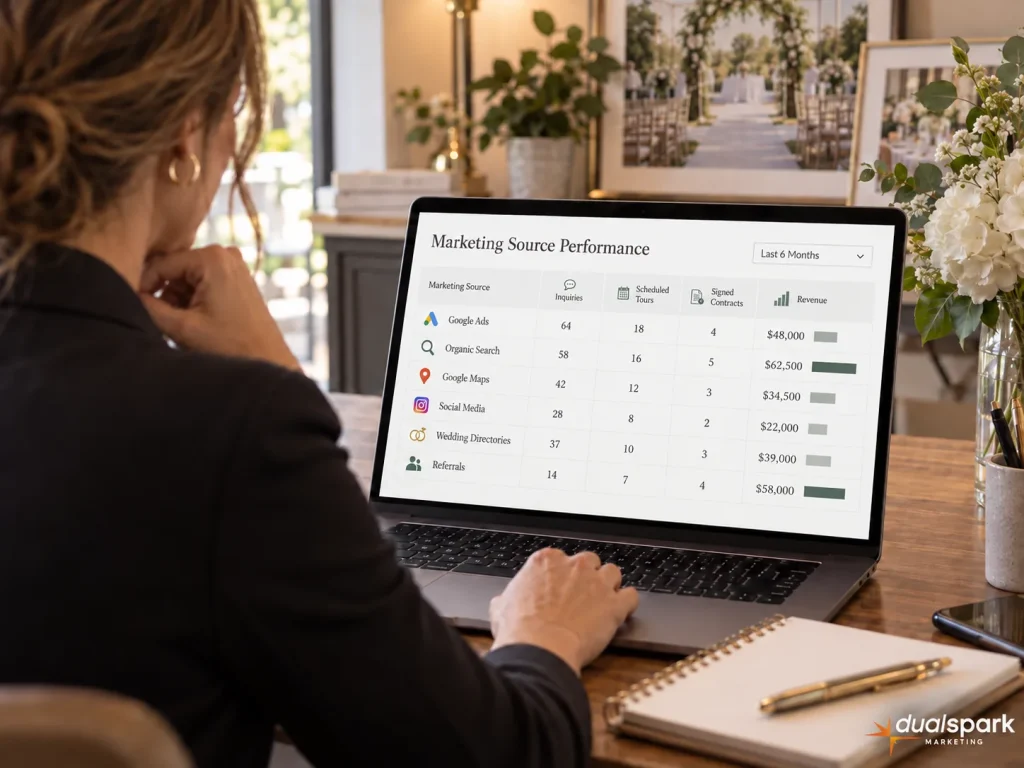
You should know how much revenue came from each source.
For example:
- Google Ads
- Organic search
- Google Maps
- Wedding directories
- Vendor referrals
- Retargeting
- Direct traffic
Suppose you spend $4,000 on Google Ads and generate $50,000 in booked revenue.
You spend $2,000 on social ads and generate $8,000.
You spend $1,500 on a wedding directory and generate $5,000.
Those channels are not producing the same return.
Once you see revenue by source, your budget decisions become much easier.
Why Lead Volume Can Be Misleading
Venue owners often get excited when one source produces a lot of leads.
That can be dangerous.
Imagine two campaigns.
Campaign A:
- 80 leads
- 12 tours
- 3 bookings
Campaign B:
- 30 leads
- 15 tours
- 8 bookings
Campaign A creates more than twice as many leads.
Campaign B produces more than twice as many bookings.
If you only looked at lead volume, you would probably make the wrong decision.
Your goal is not to buy leads.
Your goal is to generate profitable contracts.
Cheap Leads Can Be Expensive
A low cost per lead can look impressive in a report.
But cheap leads can become very expensive if they waste your team’s time.
Unqualified inquiries may include couples who:
- Are outside your budget range
- Want dates you do not have
- Have a guest count you cannot accommodate
- Want services you do not provide
- Never respond
- Are not seriously planning yet
If your team spends hours following up with low-quality leads, there is a real cost.
You could spend that time with couples more likely to book.
Lead quality matters.
Expensive Leads Can Still Produce Strong ROI
The opposite is also true.
A more expensive lead can be extremely valuable.
Suppose one campaign generates leads for $175 each.
That sounds expensive compared with a campaign producing $60 leads.
But if the $175 leads regularly schedule tours and sign contracts, they may be much more profitable.
We would rather see a wedding venue generate 20 strong inquiries than 100 weak ones.
The right question is not:
“Which campaign gives us the cheapest lead?”
It is:
“Which campaign gives us the most profitable bookings?”

Track the Full Funnel
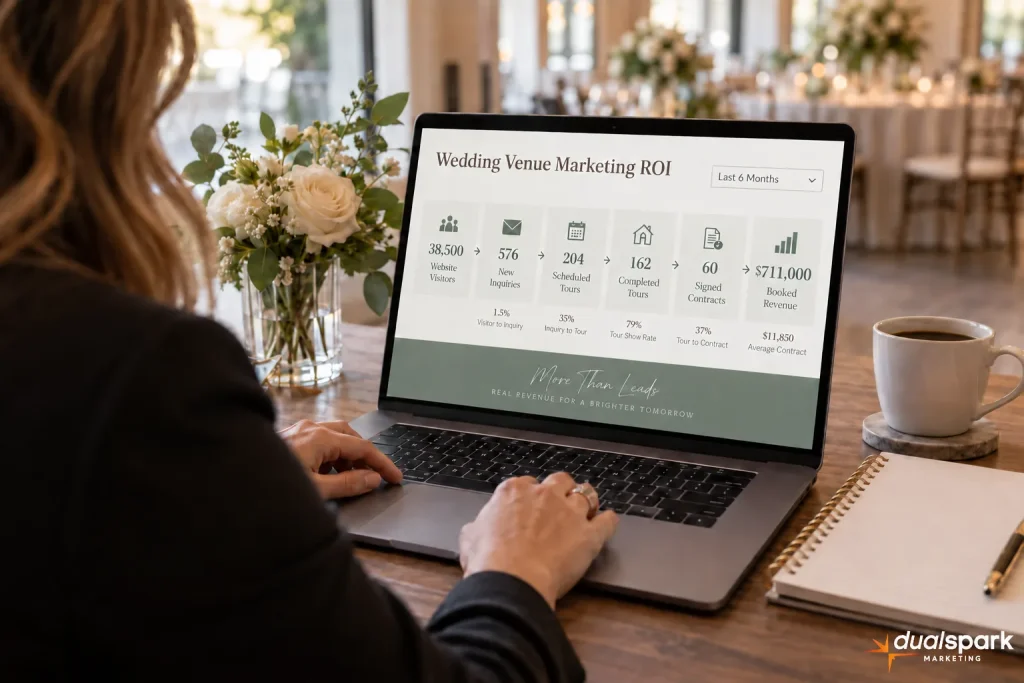
Marketing ROI becomes much easier to understand when you track the entire customer journey.
Your funnel might look like this:
Website Visitor → Inquiry → Scheduled Tour → Completed Tour → Signed Contract → Revenue
Track how many people move through each stage.
For example:
1,000 website visitors
100 inquiries
40 scheduled tours
30 completed tours
10 bookings
Now you can calculate conversion rates at every step.
If traffic is strong but inquiries are low, your website may have a problem.
If inquiries are strong but tours are weak, follow-up may be the issue.
If tours are strong but bookings are low, your sales process may need work.
ROI tracking helps you find where you’re losing money.
Calculate Inquiry to Tour Rate
Your inquiry to tour rate tells you how effectively your team turns leads into appointments.
If you receive 100 inquiries and schedule 30 tours:
30 ÷ 100 = 30 percent.
That gives you a benchmark.
If that number falls over time, review:
- Response time
- Email quality
- Pricing clarity
- Tour scheduling
- Lead quality
- Availability
Marketing can generate the inquiry.
Your sales process has to move the couple forward.
Calculate Tour to Booking Rate
This may be one of the most valuable conversion rates in your entire business.
If 20 couples complete tours and five sign contracts:
5 ÷ 20 = 25 percent.
Now you know that one out of every four completed tours becomes a booking.
If you want 20 additional bookings, you may need roughly 80 completed tours at that conversion rate.
That helps you work backward and determine how much demand your marketing needs to create.
Calculate Revenue Per Tour
You can also measure revenue generated from completed tours.
Suppose:
20 tours produce five bookings.
Those five bookings generate $50,000 in revenue.
$50,000 ÷ 20 = $2,500 in booked revenue per completed tour.
Now compare that with your cost per tour.
If you spend $200 to generate each completed tour and each tour produces an average of $2,500 in booked revenue, the economics may look very strong.
Track Signed Contracts, Not Verbal Commitments
A couple saying:
“We love the venue.”
is not revenue.
A couple saying:
“We are definitely going to book.”
is not revenue.
Track a booking when the contract is signed and the required payment has been received according to your process.
That keeps your reporting consistent.
Otherwise, your numbers can look stronger than reality.
Booked Revenue and Collected Revenue Are Different
Wedding venues often book events far in advance.
A contract may be worth $12,000, but you may only collect a deposit today.
You should distinguish between:
Booked Revenue
The total contracted value of the wedding.
Collected Revenue
The money you have actually received.
Both are useful.
Booked revenue helps you measure future business generated by marketing.
Collected revenue helps you understand cash flow.
Do not confuse the two.
Account for Cancellations
If a marketing campaign generates ten bookings but two later cancel, your real return changes.
You should track:
- Original contract value
- Amount collected
- Amount refunded
- Cancellation fees retained
- Final revenue
That gives you a more accurate long-term picture.
You do not need to wait years to evaluate every campaign, but periodically reviewing cancelled bookings can improve your ROI reporting.
How to Track Google Ads ROI
Google Ads is one of the easiest channels to measure if your tracking is set up correctly.
Track more than form submissions.
Connect ad performance to:
- Calls
- Contact forms
- Date checks
- Tour requests
- Scheduled tours
- Completed tours
- Signed contracts
- Revenue
Google may tell you that a campaign generated 40 conversions.
That does not necessarily mean it generated 40 meaningful opportunities.
Some conversions may be:
- Phone button clicks
- Form starts
- Directions
- Secondary actions
Your internal tracking should tell you which leads actually became revenue.
How to Track SEO ROI
SEO can be harder to measure because you are not paying for each individual click.
Your SEO investment may include:
- Agency fees
- Content
- Website work
- Technical improvements
- Google Business Profile optimization
- Local SEO
- Photography
Then track how many organic visitors become:
- Inquiries
- Tours
- Bookings
- Revenue
SEO ROI often improves over time because strong content and rankings can continue producing traffic long after the initial work is complete.
That is one reason you should not judge SEO based only on one month’s results.
How to Measure Retargeting ROI
Retargeting works differently because the visitor may have discovered your venue through another channel first.
For example:
A couple clicks a Google Ad.
They leave.
They later see a retargeting ad.
They return and submit an inquiry.
Which channel deserves the credit?
Probably both.
That is why you should evaluate retargeting as part of the full funnel, not in isolation.
Look at whether retargeted visitors return, inquire, schedule tours, and eventually book.
Social Media May Assist the Booking
Social media can be difficult to measure because it often influences the decision without being the final source.
A couple may:
- Discover you on Instagram
- Search your name on Google
- Visit your website
- Read reviews
- Return a week later
- Submit a form
Your analytics may credit Google or direct traffic.
Instagram still played a role.
This is called an assisted conversion.
That is why you should ask couples how they first heard about the venue while also using digital attribution.
Neither method is perfect on its own.
Attribution Will Never Be Perfect
Do not expect every booking to fit neatly into one marketing channel.
Wedding decisions involve multiple touchpoints.
A couple may interact with:
- Reviews
- Vendor recommendations
- Retargeting
- Your website
before signing a contract.
Your goal is not perfect attribution.
Your goal is enough reliable information to make better budget decisions.
Use:
- Analytics
- CRM data
- Call tracking
- Form tracking
- UTM parameters
- Lead source fields
- Sales notes
together.
The more sources you combine, the clearer the picture becomes.
Ask Couples How They Found You
This simple question can still be valuable:
“How did you first hear about us?”
Add it to your inquiry process or CRM.
You may discover couples mentioning:
- A friend
- A planner
- The Knot
- A photographer
Compare that information with your analytics.
You may find channels that influence bookings even when the tracking platform does not receive credit.
Know Your Customer Acquisition Cost
Customer acquisition cost tells you how much you spend to gain a new booked client.
The formula is:
Total Marketing and Sales Cost ÷ New Clients Acquired
For a wedding venue, you may calculate this using only marketing costs or include sales-related costs depending on how detailed you want to get.
If you spend $50,000 annually on marketing and generate 50 new wedding bookings:
$50,000 ÷ 50 = $1,000 acquisition cost per booking.
Compare that with your average booking value and profit.
That helps determine whether your growth model is sustainable.
Look at ROI by Campaign, Not Just Channel
Do not assume every Google campaign performs the same.
You may have:
- Brand campaigns
- General wedding venue campaigns
- Barn venue campaigns
- Location campaigns
- Retargeting
- Event campaigns
Some may perform extremely well.
Others may produce weak leads.
The same applies to social media.
Look deeper than the platform name.
The more specific your reporting becomes, the easier it is to move budget toward what works.
Review ROI by Event Type
If you market more than weddings, separate those results too.
You may advertise:
- Weddings
- Corporate events
- Bridal showers
- Rehearsal dinners
- Holiday parties
- Private events
Each event type may have a different:
- Average booking value
- Lead cost
- Sales cycle
- Conversion rate
- Profit margin
A $200 lead might be terrible for a small shower but excellent for a $15,000 wedding.
Context matters.
Review ROI by Date Type
You can also evaluate ROI based on the dates you are trying to fill.
For example:
- Saturdays
- Fridays
- Sundays
- Weekdays
- Off-season dates
You may be willing to spend more to fill an otherwise empty date.
Why?
Because an empty date produces zero revenue.
If spending $800 helps book a Friday that would otherwise remain unused, that may be an excellent investment.
Know When to Increase Spend
Once you identify a channel producing profitable bookings, increasing the budget may make sense.
Before you increase spending, make sure:
- There is additional search demand
- You have available dates
- Your team can handle more leads
- Your tour calendar has capacity
- Your conversion rates are healthy
Do not increase spend blindly.
Scale what is already working.
Know When to Reduce Spend
You should reduce or reallocate spending when a campaign consistently fails to produce profitable results.
Look for patterns such as:
- High lead volume but few tours
- High tour volume but few bookings
- Poor lead quality
- High acquisition cost
- Low booking value
- Weak geographic performance
Do not cut a campaign because of one bad week.
Use enough data to make a reasonable decision.
Reallocate Before Cutting the Entire Budget
If one marketing channel underperforms, you may not need to cut overall spend.
Move the money.
If a directory costs $2,000 per month and produces almost no bookings while Google Ads generates strong contracts, consider shifting part of that money into Google.
If Google reaches its efficient limit, invest more in SEO, retargeting, website conversion, or photography.
Your budget should move based on performance.
What Should a Wedding Venue Review Every Month?
At minimum, review:
- Marketing spend
- Website traffic
- Inquiries
- Cost per inquiry
- Tours scheduled
- Tours completed
- Cost per tour
- Signed contracts
- Cost per booking
- Average booking value
- Booked revenue
- Revenue by source
- Inquiry to tour rate
- Tour to booking rate
Do not wait until the end of the year.
Monthly reviews help you identify problems before they become expensive.
Build a Simple Marketing ROI Dashboard
You do not need an overly complicated reporting system.
A useful dashboard might show:
Google Ads
Spend: $4,000
Inquiries: 40
Tours: 12
Bookings: 5
Revenue: $50,000
Organic Search
SEO Investment: $2,000
Inquiries: 25
Tours: 10
Bookings: 6
Revenue: $60,000
Wedding Directory
Spend: $1,500
Inquiries: 45
Tours: 6
Bookings: 1
Revenue: $9,000
Now you can quickly see which channel is producing the strongest results.
That is much more useful than a report showing 500 clicks and 20,000 impressions.
Common Wedding Venue Marketing ROI Mistakes
Tracking Leads but Not Bookings
Leads do not pay the bills.
Assuming the Cheapest Lead Is the Best Lead
Lead quality can matter more than lead cost.
Ignoring Tour Conversion
Tours are one of the strongest indicators of serious interest.
Tracking Revenue Without Marketing Source
You need to know what produced the booking.
Giving One Channel All the Credit
Couples often interact with several channels.
Ignoring Cancellations
Canceled contracts can affect real ROI.
Focusing Only on Short-Term Results
SEO, reviews, and content may continue generating value over time.
Increasing Budget Without Checking Profitability
More leads do not always mean more profit.
Frequently Asked Questions About Wedding Venue Marketing ROI
What is a good marketing ROI for a wedding venue?
Wedding venue marketing ROI measures the financial return your venue receives from the money you invest in marketing. It helps you see whether channels such as Google Ads, SEO, retargeting, social media, and wedding directories are producing profitable bookings rather than just clicks and inquiries.
For example, if you spend $10,000 on marketing and can connect that investment to $100,000 in booked venue revenue, your marketing generated $10 in booked revenue for every $1 spent. That gives you a much clearer picture of performance than knowing that your ads generated 1,000 clicks or 50 contact forms.
We recommend taking the analysis further by looking at cost per tour, cost per booking, average booking value, and the profit generated from those contracts. Your venue does not make money when someone clicks an ad. You earn when qualified couples move through your funnel and ultimately sign contracts.
How do I calculate marketing ROI for my wedding venue?
There is no universal ROI percentage that every wedding venue should try to achieve. Your ideal return depends on your average booking value, gross margins, operating expenses, competition, marketing strategy, and how aggressively you are trying to grow.
A venue charging $15,000 per wedding may be able to spend considerably more to acquire a booking than a venue with a $4,000 average contract. Both campaigns could be highly profitable even though their acquisition costs look completely different.
Instead of comparing your venue with an arbitrary industry benchmark, we recommend establishing your own numbers. Determine what a typical booking is worth, understand approximately how much profit it produces, and calculate how much you can afford to spend to acquire that client.
Then watch whether that number improves over time. Your own historical performance is often much more useful than a generic ROI target.
What is a good marketing ROI for a wedding venue?
A new wedding venue usually needs to invest more aggressively because it starts without many of the assets that established venues already have.
You may need to build a strong website, professional photo library, Google Business Profile, SEO foundation, paid search campaigns, real wedding content, review strategy, and lead tracking system all at once. Those are not optional extras if you expect couples to find your venue and trust it enough to schedule a tour.
We would also avoid waiting until the calendar looks empty before investing in marketing. A new venue needs time to build awareness, rankings, reviews, and referral relationships. The exact budget will vary by market, but you should treat marketing as part of the cost of launching and growing the venue, not something you add only when bookings slow down.
Should a wedding venue track cost per lead, cost per tour, or cost per booking?
You should track all three because each number tells you something different about your marketing funnel, but cost per booking is ultimately the most important of the three.
Cost per lead shows how efficiently your marketing generates inquiries. Cost per tour tells you whether those inquiries are becoming serious opportunities. Cost per booking tells you how much you actually spent to acquire a signed contract.
This distinction can completely change how you judge a campaign. One campaign might produce leads for $50 while another produces them for $150. The $50 campaign looks better until you discover that very few of those leads tour or book. If the $150 leads consistently become tours and contracts, the more expensive lead source may produce far stronger ROI.
We recommend following every marketing source as far down the funnel as your tracking allows. The cheapest lead is not necessarily the most profitable lead.
How can I tell which marketing channel is generating the most wedding bookings?
Start by tracking the original source of every inquiry and continue recording that lead as it moves through your sales process. Your reporting should connect the marketing source with the inquiry, scheduled tour, completed tour, signed contract, and booking value whenever possible.
Useful tracking tools can include website analytics, UTM parameters, call tracking, form tracking, CRM data, and lead source fields. We also recommend asking couples how they first heard about your venue because digital attribution does not always capture the entire journey.
A couple might discover your venue on Instagram, search your name on Google several days later, read your reviews, return through a retargeting ad, and eventually submit a contact form. One platform may receive the final conversion credit even though several channels helped influence the booking.
You do not need perfect attribution. You need enough reliable information to identify patterns and understand which channels consistently contribute to qualified tours and contracts.
Why can a higher cost per lead produce better marketing ROI?
A higher cost per lead can produce better ROI when those leads are more qualified and more likely to become paying clients.
Suppose one campaign generates 100 inquiries at $40 each but only produces two signed contracts. Another campaign generates 30 inquiries at $125 each but produces eight contracts. The first campaign delivers cheaper leads, but the second campaign generates far more actual business.
This happens because not every inquiry has the same value. A qualified couple may have an appropriate budget, available date, suitable guest count, and genuine interest in touring the venue. Another person may submit a form without being anywhere close to booking.
That is why we would not recommend optimizing your entire marketing strategy around the lowest possible lead cost. Your venue should focus on acquiring the right couples at a cost that still produces profitable bookings.
How do you measure SEO ROI for a wedding venue?
Wedding venue SEO ROI starts by comparing what you invest in organic search with the business generated by visitors who find your venue through unpaid search results.
Your SEO investment might include agency fees, content creation, technical improvements, local SEO, Google Business Profile work, website updates, real wedding posts, location content, and other optimization efforts.
Then track what organic visitors do after reaching your website. Look at organic inquiries, scheduled tours, completed tours, signed contracts, and booked revenue. Those numbers tell you much more than keyword rankings or increases in organic traffic alone.
SEO also needs to be evaluated differently from paid advertising because its value can compound. A useful pricing page, FAQ resource, real wedding article, or location page may continue attracting couples long after you initially create it. That means the cost of acquiring organic traffic can improve as those assets continue working over time.
For that reason, we recommend evaluating SEO over a longer period instead of deciding whether it worked based on a few weeks of data.
How often should a wedding venue review marketing ROI?
We recommend reviewing the core performance numbers at least once each month. That is frequent enough to identify meaningful problems without reacting to every small daily change in lead volume or advertising costs.
Your monthly review should include marketing spend, inquiries, cost per inquiry, tours scheduled, tours completed, cost per tour, signed contracts, cost per booking, average booking value, booked revenue, and revenue by marketing source.
You can then perform a deeper review every quarter. Look for longer-term patterns, compare marketing channels, identify seasonal changes, and decide whether budget should move from weaker campaigns into stronger ones.
Avoid making major decisions because of one slow week. Wedding venue demand naturally changes throughout the year. The goal is to use enough data to make informed decisions while still catching wasted spending early enough to correct it.
Final Thoughts: Stop Guessing and Follow the Money
Wedding venue marketing becomes much easier to manage when you stop judging success by clicks, impressions, and raw lead volume.
Follow each lead through the entire funnel.
Find out where they came from, whether they scheduled a tour, whether they booked, and how much revenue they generated.
That gives you the information you need to invest more confidently.
You may discover that the campaign with the cheapest leads is not your best campaign. You may find that organic search generates fewer inquiries but more contracts. You may learn that one wedding directory looks busy in reports but contributes very little revenue.
At Dual Spark Marketing, we help wedding venues connect SEO, Google Ads, retargeting, website conversion, and lead tracking so marketing performance can be measured by the results that actually matter. The goal is not simply to generate activity. It is to understand which marketing investments produce qualified tours, signed contracts, and profitable revenue.