You can have a beautiful wedding venue website filled with great photos, detailed information, helpful blog posts, and individual pages for your services. But those pages should not operate like separate islands.
They need to work together.
Internal linking is one of the simplest ways to connect the different parts of your website. It helps couples find the information they need while also helping search engines understand which pages are important and how the content throughout your website relates.
For wedding venues, internal linking becomes especially important as your website grows.
You may have pages about your pricing, amenities, ceremony spaces, reception spaces, availability, FAQs, gallery, location, and different types of events. You might also publish real wedding stories, planning resources, and articles targeting questions couples search for on Google.
All of that content creates opportunities to strengthen the rest of your website.
At Dual Spark Marketing, we only work with wedding venues, and internal linking is one of the things we look at when evaluating how a venue’s website is structured for SEO and conversions.
Here is how internal linking works, why it matters, and how you can use it more effectively on your wedding venue website.
What Is Internal Linking?
An internal link is simply a link from one page of your website to another page on the same website.
For example, imagine your homepage includes this sentence:
“Explore our wedding venue pricing and see what is included with your rental.”
If the words wedding venue pricing link to your pricing page, that is an internal link.
You probably already have internal links in your main navigation. Your menu may link visitors to pages such as:
- Pricing
- Amenities
- Gallery
- FAQs
- Availability
- About Us
- Contact
- Schedule a Tour
Those links are important, but internal linking should go beyond your navigation.
Links placed naturally within your page content can help visitors discover related information exactly when they need it.
Why Internal Links Matter for Wedding Venue SEO
Google needs to understand your website before it can determine when and where your pages should appear in search results.
Internal links give search engines additional context about your website.
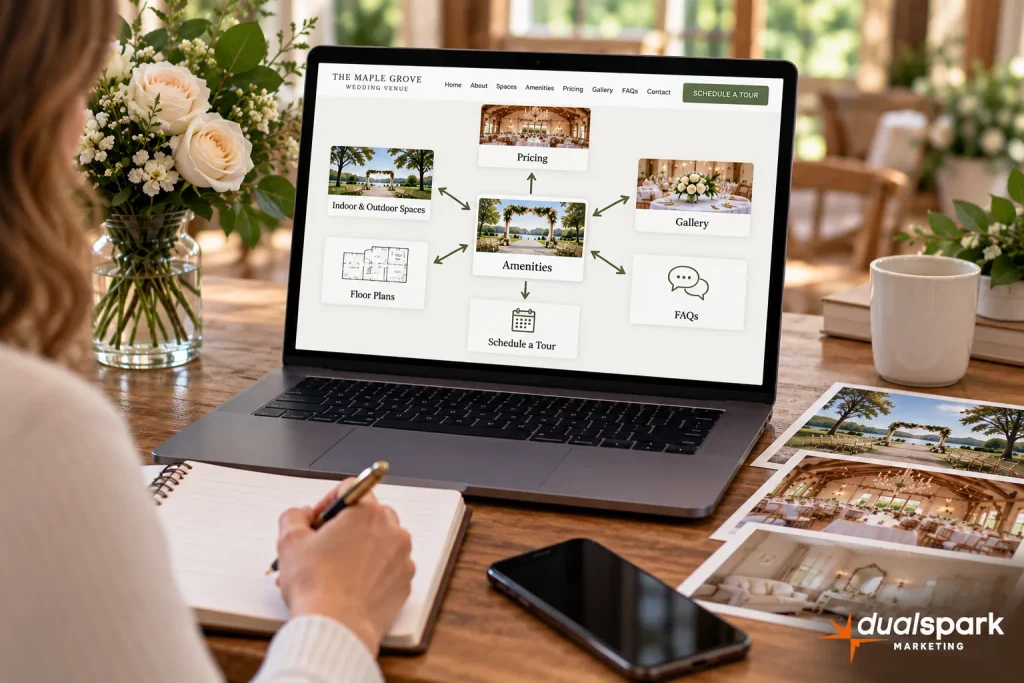
Imagine that your website has separate pages covering:
Wedding Venue Pricing → Amenities → Indoor & Outdoor Spaces → FAQs → Availability → Schedule a Tour
These pages answer different questions, but they are all related to someone considering your venue.
Connecting them creates a clearer website structure.
Internal links can also help search engines discover pages they might not otherwise find easily.
That becomes increasingly important as you add more content to your website.
A wedding venue website with 10 pages is relatively easy to navigate. A website with 50, 100, or more pages and blog posts becomes much more complicated.
Good internal linking helps keep that growing content connected.
Internal Links Help Google Understand Which Pages Are Important
Not every page on your wedding venue website has the same value.
A privacy policy probably isn’t as important to your marketing strategy as your primary wedding venue page.
A three-year-old blog post probably isn’t as important as your pricing or availability page.
Internal links can help communicate these relationships.
If many relevant pages throughout your website naturally point toward an important page, search engines receive additional signals that the destination page plays an important role within your site.
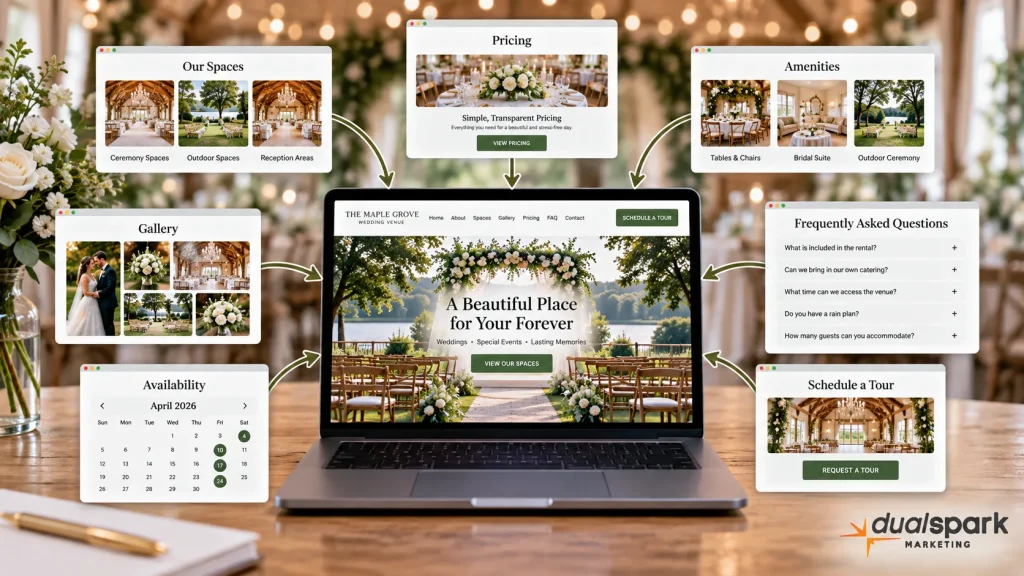
For example, your pricing page might receive internal links from:
- Homepage
- Amenities page
- FAQ page
- Wedding venue page
- Availability page
- Real wedding posts
- Planning articles
That creates multiple paths for visitors and search engines to reach the page.
The goal isn’t to create hundreds of unnecessary links.
The goal is to make your website’s important pages easy to discover.
Internal Linking Can Help Couples Find Answers Faster
SEO isn’t the only reason to use internal links.
Think about how couples actually research wedding venues.
Someone may land on your website after searching for a barn wedding venue near them. Their next question might be:
How much does it cost?
After seeing the price, they might wonder:
What is included?
Then:
Can the venue hold 150 guests?
Then:
Is my wedding date available?
Then:
How do I schedule a tour?
Your internal links can help couples naturally move through those questions.
Instead of forcing them to return to your menu every time they want more information, you can provide the next logical step directly within the content.
That creates a smoother experience and keeps interested couples moving through your website.
Your Most Important Pages Should Not Be Buried
We sometimes see wedding venue websites with useful pages that are surprisingly difficult to find.
Maybe the venue created a great pricing page, but the only link to it appears in the footer.
Or there is a detailed amenities page that isn’t linked from the main wedding venue page.
Sometimes valuable blog posts get published and then disappear into the blog archive.
Those pages exist, but very few visitors ever reach them.
Important pages should have clear internal paths leading to them.
A simple question can help you identify problems:
If a couple entered my website through a completely different page, how easily could they find this page?
If the answer is “not very easily,” you probably have an internal linking opportunity.
Build Connections Between Your Core Wedding Venue Pages
Your core venue pages should naturally support one another.
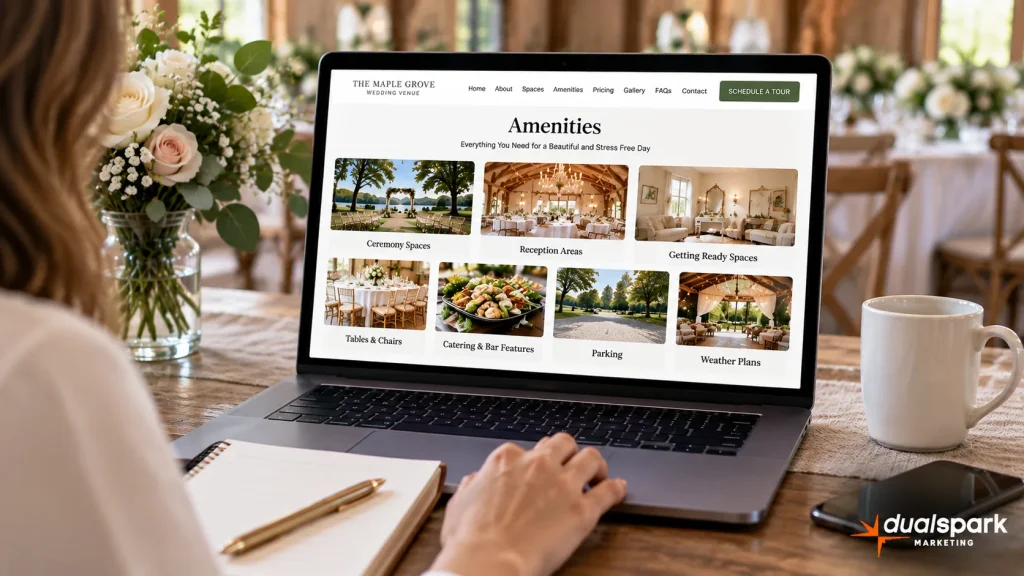
For example, someone reading about your amenities might want to know how those amenities affect your pricing.
You could say:
“Tables, chairs, getting ready spaces, and other amenities are included with many of our rental options. View our wedding venue pricing for more information about what is included.”
Now your amenities page supports your pricing page.
Your pricing page might then say:
“Not sure which dates are still open? Check our wedding venue availability or contact us to ask about your preferred date.”
Now pricing supports availability.
Your availability page can lead to your tour page.
Instead of creating isolated pages, you’ve created a path through the website.
Use Blog Posts to Strengthen Your Main Website Pages
This is one of the biggest missed opportunities we see with wedding venue blogging.
A venue publishes blog posts because someone told them blogging helps SEO.
They publish:
10 Tips for Planning an Outdoor Wedding
Then another article.
Then another.
Eventually they have dozens of blog posts, but none of them lead visitors toward the venue’s important pages.
Your blog should support the rest of your website.
Suppose you publish an article about planning an outdoor wedding.
Within that article, you could naturally link to your:
- Outdoor ceremony space
- Wedding venue page
- Amenities
- Weather plan information
- Gallery
- Pricing
- Availability
The article can attract someone earlier in the planning process and introduce them to the parts of your venue that answer their next questions.
That gives your content a purpose beyond simply generating website traffic.
Real Wedding Blog Posts Create Excellent Internal Linking Opportunities
Real wedding posts can be especially valuable because they allow you to connect several topics naturally.
Imagine you operate a barn wedding venue near Jacksonville, Florida.
You publish a real wedding featuring a couple who held an outdoor ceremony followed by a barn reception.
That post could naturally link to your:
- Barn wedding venue page
- Outdoor ceremony page
- Reception space
- Jacksonville location page
- Gallery
- Amenities
- Pricing page
The links make sense because they add information about what you show or discuss in the wedding story.
You aren’t forcing keywords into the article.
You’re helping the reader explore what caught their attention.
Internal Links Can Strengthen Your Location Pages
Location pages are important for venues trying to attract couples from surrounding cities.
However, simply creating a page targeting every nearby city doesn’t automatically make those pages useful.
Your website needs to connect those pages to relevant content.
For example, suppose your venue is outside Jacksonville but regularly hosts couples from Jacksonville.
A real wedding involving a Jacksonville couple could link naturally to your Jacksonville wedding venue page.
A planning article discussing wedding venues near Jacksonville could also support that page.
Your main wedding venue page might mention the major communities you serve and link to the appropriate location pages.
This creates context around those pages instead of leaving them isolated.
Internal linking won’t eliminate Google’s proximity considerations in local search, but it can help create a clearer website structure around the geographic markets your venue serves.
Anchor Text Helps Explain Where a Link Goes
The clickable words in a link are called anchor text.
You’ve probably seen websites use phrases such as:
Click here
or
Learn more
Those phrases can work for visitors, but they don’t provide much context about the destination.
Whenever it sounds natural, descriptive anchor text is usually more helpful.
Instead of:
“Click here to learn more.”
You could write:
“See our wedding venue pricing and packages to learn what is included.”
The visitor knows exactly what they are about to open.
Descriptive anchor text also gives search engines additional context about the destination page.
That doesn’t mean you should force the exact same keyword into every link.
Keep the language natural.
For example, different links pointing toward your pricing page could say:
“view our pricing”
“wedding venue pricing”
“see what’s included”
“explore our rental options”
“venue packages and pricing”
Natural variation makes sense because you’re writing for actual people, not building links for a search engine.
Don't Overdo Internal Linking
More links do not automatically mean better SEO.
If every other sentence contains a link, your page becomes distracting and difficult to read.
Links should have a reason to exist.
Ask yourself:
Would someone reading this section reasonably want more information about this topic?
If yes, a link may be useful.
If you’re adding the link only because you want another keyword pointing toward a page, it may not improve the experience.
There is also no magic number of internal links that every wedding venue page needs.
A short page might only need a few.
A detailed 2,000-word resource could naturally contain many more.
Let the content determine how many links make sense.
Don't Link the Same Words to Different Pages
Your internal linking should make the website easier to understand, not more confusing.
Suppose you repeatedly use the anchor text Jacksonville wedding venue.
One time it links to your homepage.
Another time it links to a Jacksonville location page.
Another time it links to a blog post.
You’re sending mixed signals.
Try to keep the purpose of important anchor text reasonably consistent.
You don’t have to use identical wording every time, but the destination should make sense based on what the link promises.
Watch for Orphan Pages
An orphan page is a page with no meaningful internal links pointing toward it.
The page exists, but it is disconnected from the rest of the website.
This often happens with old blog posts.
A venue might have published an excellent planning article two years ago. The article remains indexed, but after it falls off the main blog page, very few internal paths lead back to it.
The same thing can happen with:
- Old real wedding posts
- Location pages
- Event pages
- Landing pages
- Planning resources
- Venue feature pages
Reviewing your website periodically can uncover valuable pages that deserve new internal links.
Sometimes you don’t need another piece of content.
You need to make better use of the content you already have.
Update Older Blog Posts With Links to New Content
Internal linking should not only happen when you publish something new.
Every time you create a valuable new page, look backward.
Suppose you just created a comprehensive wedding venue FAQ page.
You probably have older articles that discuss:
- Pricing
- Alcohol policies
- Catering
- Guest capacity
- Weather
- Decorations
- Rehearsals
- Parking
- Wedding timelines
Those older posts could now link to your FAQ page where appropriate.
This is one reason we like building wedding venue websites around topic clusters.
As your website grows, your older content can help support your newer content, and your newer content can strengthen older pages.
Internal Linking Should Support the Couple's Journey
One of the easiest ways to plan internal links is to stop thinking about SEO for a moment.
Think about the couple.
What question will they probably ask next?
Someone reading about your ceremony space may want to see photos.
Someone looking through your gallery may want pricing.
Someone reviewing pricing may want availability.
Someone checking availability may be ready to schedule a tour.
That might create a path like:
Ceremony Spaces → Gallery → Pricing → Availability → Schedule a Tour
Another visitor might follow:
Google Search → Real Wedding Blog → Venue Page → Amenities → Pricing → Schedule a Tour
There isn’t one perfect path.
Couples enter your website at different stages of their search.
Good internal linking gives them several logical paths toward the information they need.
Internal Linking Can Help Turn SEO Traffic Into Inquiries
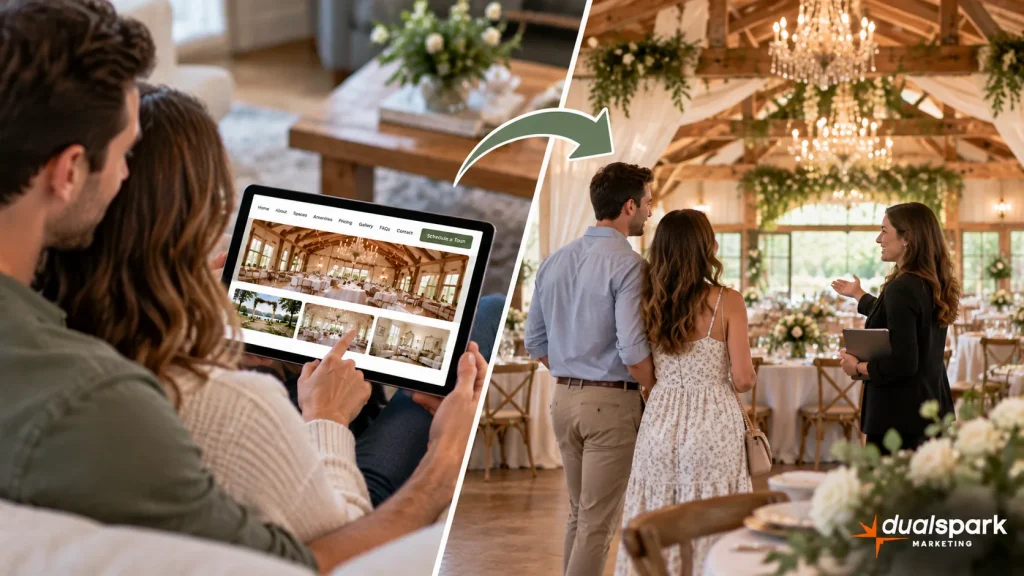
Getting someone onto your website is only the beginning.
Imagine you publish an article that ranks well and generates 500 visits every month.
Great.
What happens next?
If the article answers the visitor’s question and gives them nowhere meaningful to go, many visitors will leave.
But suppose the article naturally introduces your venue and links to relevant pages.
Now visitors can move from informational content toward commercial content.
They might go from:
Blog Post → Wedding Venue Page → Pricing → Availability → Schedule a Tour
That is a much more useful outcome than simply increasing traffic.
At Dual Spark Marketing, we don’t view SEO as a contest to generate the most website visitors.
We want the right visitors to find the venue and take meaningful actions.
Internal linking can help bridge that gap.
Create Internal Links for People First
You may notice a pattern throughout this article.
Almost every good internal linking practice comes back to the visitor.
Does the link help them?
Does the destination answer their next question?
Does the anchor text explain what they will find?
Does the link make the website easier to navigate?
When you build internal links around those questions, you usually create a better structure for search engines.
That is much better than stuffing links into pages simply because an SEO checklist told you to.
A Simple Internal Linking Strategy for Wedding Venues
You don’t need to rebuild your entire website to improve your internal linking.
Start with your most important pages.
For most wedding venues, those could include your primary venue page, pricing, amenities, gallery, availability, FAQs, location pages, and tour or contact page.
Then review your existing content.
Look for places where mentioning one of those topics naturally gives you an opportunity to link to the corresponding page.
Next, review your blog posts.
Identify posts that receive traffic or cover subjects closely related to your main venue pages.
Add useful internal links where they make sense.
Finally, repeat the process whenever you publish something new.
Ask two questions:
What existing pages should link to this new page?
What existing pages should this new page link to?
That simple habit can make a major difference as your website grows.
Frequently Asked Questions About Wedding Venue Internal Linking
What is internal linking for a wedding venue website?
Internal linking is the practice of linking one page of your wedding venue website to another page on the same website. For example, your amenities page might link to your pricing page, your pricing page might link to your availability page, and your availability page might link to your tour request form.
These links help couples move between related information without having to search through your entire website. They also help search engines discover your content and understand relationships between your pages.
For a wedding venue, internal linking is especially useful because couples usually need several pieces of information before they are ready to inquire. Connecting pricing, amenities, photos, capacity, FAQs, availability, and tour information creates a clearer path from initial research to contacting your venue.
Does internal linking actually help a wedding venue rank higher on Google?
Internal linking can support SEO by helping search engines discover pages, understand site structure, identify relationships between content, and recognize which pages appear important within your website.
However, adding internal links does not guarantee higher Google rankings. Rankings depend on many factors, including the quality and relevance of your content, competition, website quality, local signals, backlinks, and the searcher’s location and intent.
Think of internal linking as part of a larger wedding venue SEO strategy. Strong content can be less useful when it is buried or disconnected. Internal links help organize that content so visitors and search engines can understand how your pages work together.
How many internal links should a wedding venue page have?
There isn’t a specific number of internal links that every wedding venue page should have. The appropriate number depends on the length of the page, the topics it covers, and how many related resources would genuinely help the reader.
A short page may only need a few internal links. A detailed wedding planning guide or long-form SEO article may naturally contain many more.
Instead of trying to reach a certain number, focus on usefulness. Add a link when another page can answer a question, provide additional details, show relevant photos, explain pricing, confirm availability, or help the visitor take the next step. Avoid adding links simply to increase the number of links on the page.
What wedding venue pages should receive the most internal links?
Your most important commercial and informational pages should generally be easy to reach throughout your website. For many wedding venues, these include the main wedding venue page, pricing, amenities, ceremony and reception spaces, gallery, FAQs, availability, location pages, and schedule-a-tour or contact pages.
The exact priorities depend on your venue and marketing strategy.
For example, if outdoor ceremonies are a major selling point, your outdoor wedding space page may deserve links from your homepage, gallery, real wedding posts, FAQs, amenities page, and relevant planning articles.
The important thing is to avoid burying valuable pages several clicks deep or leaving them disconnected from related content.
Should wedding venue blog posts link to pricing and availability pages?
Yes, when those links make sense within the context of the article. Blog posts can introduce couples to your venue while they are researching a wedding-related question, and internal links give those visitors an easy way to continue exploring.
For example, a real wedding post could mention the venue’s ceremony space and link to the page describing that space. It could also link to your gallery, amenities, pricing, or availability when those topics are relevant.
You shouldn’t force a pricing or availability link into every blog post. Instead, think about what someone reading the article would logically want to know next. When pricing or available dates are part of that next step, linking to those pages can help move the visitor closer to an inquiry.
What anchor text should wedding venues use for internal links?
Anchor text should clearly describe what someone can expect after clicking the link. Descriptive phrases such as “wedding venue pricing,” “view our ceremony spaces,” “check available wedding dates,” or “explore our venue amenities” usually provide more context than a generic phrase such as “click here.”
You don’t need to use the exact same keyword every time you link to a page. In fact, natural variations often make the writing easier to read.
Focus on clarity. A visitor should be able to look at the clickable words and have a good idea of where the link will take them. That approach creates useful navigation while also helping search engines understand the relationship between your content and the destination page.
Can internal linking help wedding venue location pages rank in nearby cities?
Internal links can help search engines discover location pages and understand how those pages relate to your venue and the geographic areas you serve. For example, relevant real wedding posts, venue pages, planning resources, and other content can link naturally to a nearby-city page when that city is genuinely connected to the content.
However, internal linking cannot guarantee rankings in surrounding cities or overcome every local-search factor. Google may consider factors such as relevance, prominence, competition, search intent, and proximity, particularly for map results.
The goal should be to create genuinely useful location pages supported by relevant content rather than creating dozens of nearly identical city pages and adding keyword-heavy links to them. A location page should provide real value to couples searching for a venue in or near that area.
What is an orphan page, and why is it a problem for wedding venue SEO?
An orphan page is a page that has few or no internal links leading to it from the rest of your website. Visitors may struggle to discover the page, and search engines have fewer paths available to find and understand it.
Wedding venue websites can develop orphan pages over time as new content gets published and older content moves deeper into the site. Old real wedding posts, location pages, event pages, planning resources, and older blog articles are common examples.
If a page is still valuable, look for relevant pages that can link to it naturally. If the page is outdated or no longer useful, determine whether it should be updated, redirected, combined with another page, or removed. Regularly reviewing older content helps prevent valuable pages from becoming disconnected as your website grows.
Final Thoughts: Build a Wedding Venue Website Where Every Page Has a Purpose
Your website shouldn’t be a collection of pages that happen to live under the same domain.
Your pages should work together.
Your blog posts can support your venue pages. Your real wedding stories can support your location pages. Your amenities page can lead couples toward pricing. Your pricing page can lead them toward availability. Your availability page can encourage them to schedule a tour.
Internal linking helps create those connections.
More importantly, it helps couples find the answers they need without making them hunt through your website.
At Dual Spark Marketing, we only work with wedding venues. We build and optimize wedding venue websites around how couples actually search, research, and choose venues. That includes SEO, website structure, internal linking, local search, Google Ads, and conversion tracking.
If your current website is outdated, difficult to use, or not generating enough leads, Dual Spark Marketing can build you a new wedding venue website focused on better SEO, stronger conversions, and a smoother experience for couples from their first visit to their first inquiry.