Couples are changing the way they search for wedding venues.
Someone may still type “wedding venues near me” into Google, but that is no longer the only type of search your website needs to be ready for.
Couples can now ask much more detailed questions.
They might search:
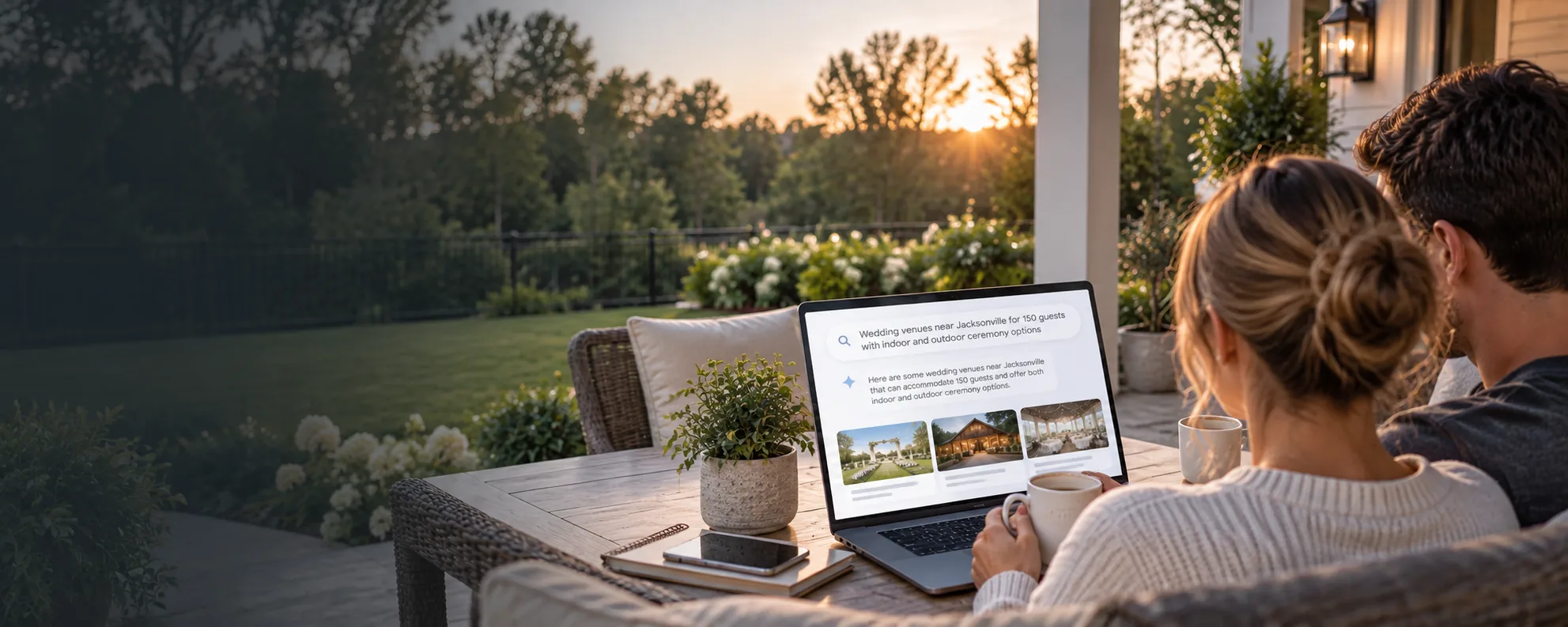
What wedding venues near Jacksonville can accommodate 150 guests and have an indoor ceremony option if it rains?
Or:
Which barn wedding venues near St. Augustine include tables and chairs and have separate getting ready spaces?
Think about how much information is packed into those questions.
The couple is not only looking for a wedding venue. They care about location, capacity, venue style, included amenities, ceremony options, and weather plans.
This is where we believe wedding venues have a major opportunity.
You do not need to completely change your marketing strategy because AI search is growing. You need to make sure your website does a better job of explaining your venue.
At Dual Spark Marketing, we only work with wedding venues, and our approach is pretty simple.
If couples are asking more detailed questions, your website needs to provide better answers.
What Is AI Search for Wedding Venues?
AI search allows people to ask questions in a more natural way.
Instead of breaking a question into a few keywords, someone can describe exactly what they are looking for.
For example, a couple could search:
Wedding venues Jacksonville
But they could also ask:
What wedding venues within an hour of Jacksonville have an outdoor ceremony space, indoor reception space, parking, and room for 125 guests?
The second search gives a search engine much more information about what the couple actually wants.
That creates an important question for your venue:
Does your website clearly provide enough information to show that you match what the couple is looking for?
If your website only says that you offer a beautiful setting for unforgettable weddings, there is not much information to work with.
If your website clearly explains your capacity, location, spaces, amenities, pricing, policies, and wedding options, there is much more information available to understand what your venue actually offers.
That is why we see AI search optimization as an extension of good wedding venue SEO rather than something completely different.
Start With the Questions Couples Actually Ask You
Before worrying about AI, start with your couples.
Think about the questions you answer every week.
What do couples ask on the phone?
What do they ask during tours?
What questions come through your contact form?
What do couples ask before they book?
You probably hear many of the same questions repeatedly.
Questions like:
- How many guests can you accommodate?
- What does the venue cost?
- What is included in the rental?
- Are tables and chairs included?
- Can we choose our own vendors?
- Can we bring our own caterer?
- Do you allow alcohol?
- Is there an indoor option if it rains?
- How much parking do you have?
- When can we access the venue?
- Do you have getting-ready spaces?
- Can we hold both the ceremony and reception there?
- How do we schedule a tour?
Every repeated question tells you something.
Couples need that information.
If the answer is important enough that your staff explains it several times each week, it probably belongs somewhere on your website.
Make Your Website the Best Source of Information About Your Venue
This is one of the biggest opportunities we see for wedding venues.
Nobody should have better information about your venue than your own website.
Yet many venue websites barely explain the property.
They have beautiful photographs and phrases like:
Where your dream wedding becomes reality.
There is nothing wrong with emotional marketing. Weddings are emotional.
But emotional language should not replace useful information.
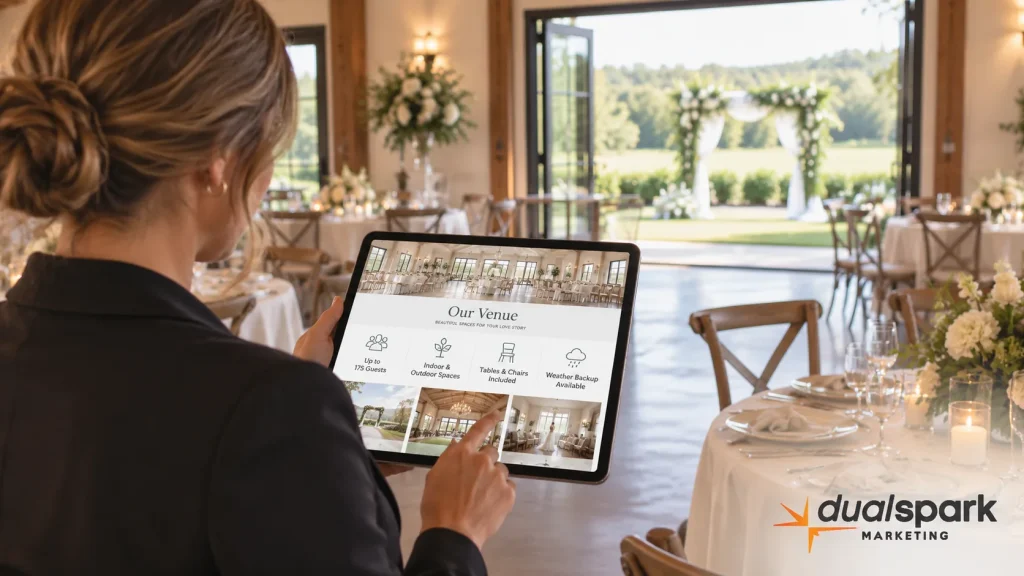
Suppose your reception space holds 175 guests, tables and chairs are included, couples have access to two getting ready spaces, and you offer both indoor and outdoor ceremony options.
Say that.
Those details help couples understand your venue.
They also give search engines much clearer information about when your venue may be relevant to someone’s search.
The best content can do both jobs at once.
Give Important Wedding Venue Information Its Own Page
Your homepage cannot answer every question.
We do not want it to.
The homepage should introduce your venue, show couples what makes it special, establish where you are located, and encourage visitors to explore.
Then your other pages can provide the details.
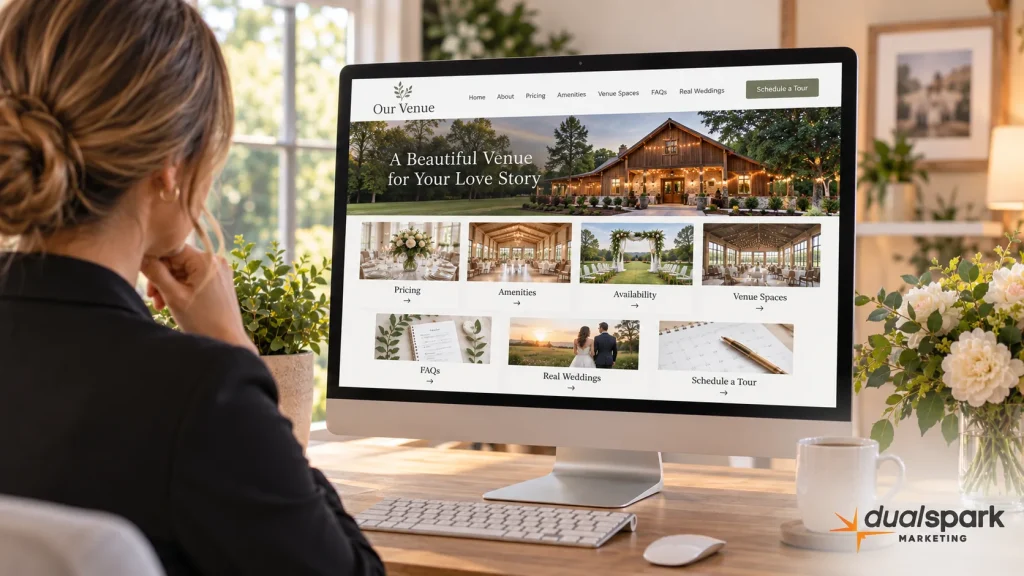
For many wedding venues, we recommend building strong pages around topics such as:
- Pricing
- Amenities
- Availability
- Ceremony spaces
- Reception spaces
- Indoor and outdoor wedding options
- Capacity and floor plans
- Frequently asked questions
- Gallery
- Real weddings
- About the venue
- Schedule a tour
Think of these pages as pieces of a larger picture.
Your pricing page explains what couples can expect to spend.
Your amenities page explains what they receive.
Your spaces pages show where the wedding happens.
Your availability page helps them take the next step.
Your FAQ page answers the questions that do not need an entire page.
Together, those pages create a much more complete picture of your venue.
Stop Making Couples Guess What You Offer
We see this problem on wedding venue websites all the time.
A venue has great features but barely mentions them.
Maybe you provide tables and chairs.
Maybe you have separate getting ready suites.
Maybe you have plenty of onsite parking.
Maybe couples can choose their own vendors.
Maybe you have a great indoor backup plan for outdoor ceremonies.
Those can all influence whether someone contacts you.
Do not assume couples will ask.
Tell them.
Instead of:
We provide everything you need for your special day.
Explain what you actually provide.
For example:
Your venue rental includes tables and chairs for up to 150 guests, access to our indoor reception space, outdoor ceremony area, separate getting ready spaces, and onsite parking.
Now the visitor has information they can use.
Specific answers are almost always more helpful than vague marketing statements.
Make Your Guest Capacity Clear
Capacity sounds simple, but it is one of the most important details on your website.
Imagine someone planning a 175 person wedding.
They love your photos.
They read your About page.
They look through several galleries.
Twenty minutes later, they still cannot figure out whether everyone will fit.
That is frustrating.
Make your capacity easy to find.
If capacity changes based on layout, explain that too.
For example:
Our reception space can accommodate up to 175 seated guests. Your final layout may change depending on the space needed for a dance floor, DJ, buffet, sweetheart table, and other reception features.
Then link to your floor plans.
Now you have answered the basic question and provided an easy way for the couple to learn more.
Give Couples Useful Pricing Information
We have talked about dedicated pricing pages before because they can play an important role in both SEO and lead quality.
That becomes even more useful when people search with detailed questions.
Not every venue can publish one exact price.
That’s fine.
You can still explain:
- Starting prices
- Package ranges
- Weekday pricing
- Weekend pricing
- Seasonal differences
- What’s included
- Optional upgrades
- What can change the final price
The goal is not necessarily to give someone a final quote online.
The goal is to help them understand whether your venue is reasonably within their budget.
That can save your staff time while helping you receive more qualified inquiries.
Build an Amenities Page That Actually Explains Your Amenities
An amenities page should do more than list:
Tables. Chairs. Parking. Bridal Suite.
Give couples context.
What kind of tables?
How many chairs?
How many guests can you seat?
Are the tables and chairs included in the rental?
What is inside the getting ready space?
Is parking onsite?
Where does cocktail hour happen?
What happens if weather changes an outdoor ceremony?
These are the details that turn an amenities page into a useful resource.
They also give you natural opportunities to connect visitors to related pages.
Someone reading about your indoor weather option may want to see your indoor wedding spaces.
Someone looking at tables and chairs may want to see your floor plans.
Someone researching your getting ready spaces may want to view the gallery.
Help them continue exploring.
Create an FAQ Page That Answers Real Questions
We are big believers in detailed FAQ pages for wedding venues.
Not because you need to cram keywords into 50 questions.
Because couples have questions.
Your FAQ page should answer them.
Start with your staff.
Ask everyone who answers phones, emails, contact forms, or gives tours:
What questions do you answer over and over again?
Those are probably your best FAQs.
Instead of answering:
Do you allow outside catering?
with:
Yes.
Explain the policy.
Tell couples whether they can choose any caterer, need to select from an approved list, or have other requirements.
That additional information could eliminate another phone call or email.
It also makes the answer far more useful for conversational and voice searches.
Use Real Weddings to Show What Is Possible at Your Venue
Real wedding content is one of our favorite opportunities for wedding venue SEO because it gives you something completely unique.
Nobody else hosted that exact wedding at your property.
Instead of uploading 40 photos and calling the page:
Sarah & Michael’s Wedding
tell the story.
You can include information such as:
- Approximate guest count
- Ceremony location
- Reception location
- Reception layout
- Wedding season
- Design style
- Getting ready spaces used
- Cocktail hour location
- Catering setup
- Indoor and outdoor areas used
This helps future couples picture how their wedding could work at your venue.
It also creates more detailed information about your property.
A couple researching a 125 guest outdoor wedding may discover a real wedding showing exactly how another couple hosted something similar.
That is useful content.
Use Your Own Photos and Videos
Wedding venues have a huge visual advantage.
Use it.
Show couples:
- Outdoor ceremonies
- Indoor ceremonies
- Reception layouts
- Getting ready spaces
- Cocktail areas
- Tables and chairs
- Parking
- Venue entrances
- Rain plans
- Different guest counts
- Daytime weddings
- Evening receptions
- Different seasons
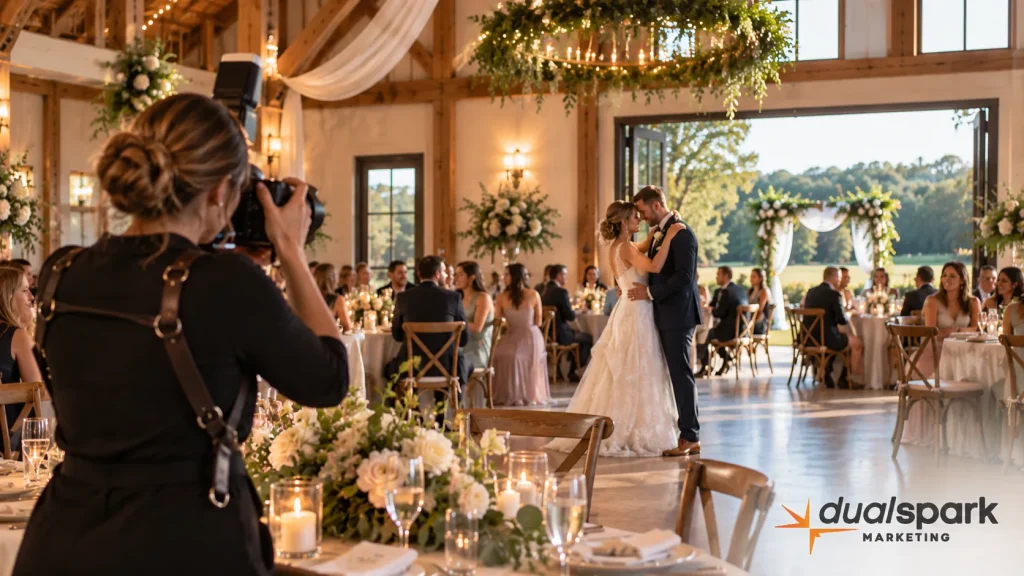
Your written content should explain the venue while your photography proves it.
If you say you can accommodate 175 guests, show what a reception with a larger guest count looks like.
If you say your indoor space works as a weather backup, show it set up for a ceremony.
Do not make couples imagine everything.
Help them see it.
Tell Couples Who They Will Be Working With
Your About page deserves more attention than it usually gets.
Couples are trusting your venue with an important day.
They want to know who is behind the business.
Introduce them.
Tell couples:
- Who owns the venue
- Who manages weddings
- Who gives tours
- Who helps after booking
- How the venue got started
- How long you have hosted weddings
- What couples can expect from you
And use real photos.
We would much rather see an actual photograph of the venue owner or coordinator than another stock image of a smiling wedding planner holding a clipboard.
Your people are part of what makes your venue unique.
Keep Your Venue Information Consistent
This one sounds simple until you start checking an older website.
Your homepage says 200 guests.
Your amenities page says 175.
A blog post from four years ago says 150.
Your old pricing page says chairs cost extra, but they are now included.
That creates confusion.
Review important information throughout your website, including:
- Guest capacity
- Pricing
- Amenities
- Ceremony options
- Reception spaces
- Address
- Phone number
- Hours
- Catering policies
- Alcohol policies
- Parking
- Availability information
- Tour information
When something changes at the venue, your website needs to change with it.
We want couples and search engines receiving the same accurate information no matter which page they find first.
Connect Related Pages With Internal Links
Your pages should not operate like separate islands.
Connect them.
If someone is reading about your amenities, give them a natural path to your pricing page.
If they are viewing pricing, help them check availability.
If they are looking at a real wedding, link them to the ceremony or reception space shown in the photos.
If an FAQ discusses guest capacity, link to your floor plans.
You could create a path like:
Ceremony Spaces → Amenities → Pricing → Availability → Schedule a Tour
That is good website navigation.
It is also good SEO.
We covered this topic in more detail in our article about how internal linking helps wedding venue websites rank higher on Google.
The important thing is to make each link useful.
Do not add links just because you think you need more links.
Ask:
Where would someone naturally want to go next?
Then help them get there.
Do Not Forget About Local Search
Your physical location still matters.
AI does not change that.
Couples need to know where your venue is and whether that location works for their wedding.
Give them useful local information.
That might include:
- Your actual city
- Nearby cities you regularly serve
- Approximate drive times
- Nearby hotels
- Airports
- Major roads
- Popular areas for rehearsal dinners
- Transportation considerations
- Nearby attractions for guests
The key word here is useful.
Do not create a page for every town within 100 miles and change nothing except the city name.
If you create a location page, give someone from that area a reason to read it.
Explain the relationship between that community and your venue.
Make Sure Important Information Is Written on the Page
Photos are incredibly important for a wedding venue website.
But a photograph cannot always replace an explanation.
Suppose you have a beautiful photograph showing your outdoor ceremony space.
A couple can see that it exists.
But the photograph may not tell them:
- How many guests it accommodates
- Whether chairs are included
- How far it is from the reception space
- Whether power is available
- What happens if it rains
Use both.
Show it and explain it.
The same applies to videos, galleries, brochures, and downloadable PDFs.
If something is important to a couple’s decision, make sure the website itself explains it.
Use Schema as Support, Not a Shortcut
Schema markup is code that can provide search engines with additional information about content on your website.
We use appropriate schema as part of a complete SEO strategy.
But we do not view it as some secret shortcut into AI search.
Think of it this way:
Schema can help label information.
It cannot make weak information useful.
If your website does not clearly explain your capacity, amenities, pricing, spaces, or location, adding more code behind the page does not fix the real problem.
Build useful pages first.
Then make sure the technical side of your website supports them.
Do Not Chase Every New AI SEO Trick
As AI search grows, you are going to hear about a lot of new tactics.
Some will eventually become useful.
Others will disappear.
You may hear that you need a special file for AI.
Someone else may tell you that you need hundreds of question pages.
Another company may tell you that you need completely different content for AI search.
We would not rebuild your entire marketing strategy every time a new tactic appears.
We would ask a simpler question:
Will this make your website more useful, understandable, or accessible to couples and search engines?
If the answer is no, it probably should not be your first priority.
Your pricing page, amenities, FAQs, venue spaces, real weddings, internal links, local SEO, website speed, photos, and conversion process deserve attention before chasing an unproven shortcut.
Do Not Create Hundreds of AI Generated Pages
AI makes it possible to create a huge amount of content quickly.
That does not mean you should.
Imagine a venue outside Jacksonville creating separate pages for:
Wedding Venue Jacksonville
Wedding Venue Jacksonville Beach
Wedding Venue Orange Park
Wedding Venue Middleburg
Wedding Venue Ponte Vedra
Wedding Venue St. Augustine
Wedding Venue Palm Coast
Location pages can absolutely have value.
The problem comes when every page says essentially the same thing and only swaps out the city.
That’s not useful.
The same applies to blog posts.
Publishing 100 generic articles about wedding colors, wedding dresses, flowers, and engagement photos does not automatically make your venue more relevant.
We would rather create fewer pages with stronger information that actually connects to your venue and the couples you want to attract.
How to Make Your Wedding Venue Website Easier for AI Search to Understand
You do not need to become an AI expert.
Start by auditing your website from a couple’s point of view.
Ask yourself:
- Can someone immediately tell where our venue is?
- Can they find our guest capacity?
- Can they understand our pricing?
- Do they know what the rental includes?
- Can they see our ceremony options?
- Can they understand our reception space?
- Do we explain what happens if it rains?
- Can they find information about tables and chairs?
- Do we explain our getting ready spaces?
- Do we have useful FAQs?
- Do we show real weddings?
- Can couples find our availability information?
- Are related pages connected?
- Is our information current?
- Do we use original photos?
- Is our Google Business Profile accurate?
- Can someone easily schedule a tour?
Now look at every question you answered with no, not really, or it’s kind of hard to find.
Those are your opportunities.
You do not have to start by asking how to optimize your website for a machine.
Start by making it easier for a couple to understand.
Optimize for Couples First
This is the part we do not want wedding venue owners to lose sight of.
You are not trying to book an AI system.
You are trying to book weddings.
A couple still needs to look at your venue and think:
This could be the place.
Your website needs to help them reach that point.
They need to understand what the venue looks like.
They need to know whether everyone will fit.
They need to understand the cost.
They need to know what is included.
They need to picture the ceremony.
They need to picture the reception.
They need to trust the people behind the venue.
And eventually, they need an easy way to check their date or schedule a tour.
If improving your website for AI search also improves all of those things, you’re moving in the right direction.
Frequently Asked Questions About AI Search for Wedding Venues
How Can I Make My Wedding Venue More Likely to Be Found Through AI Search?
Start by making your website a complete source of information about your venue. Clearly explain where you are located, how many guests you can accommodate, what your venue costs, what comes with the rental, what ceremony and reception spaces you offer, and what couples should expect when they book.
Then go deeper. Answer common questions about catering, alcohol, vendors, parking, weather plans, getting ready spaces, rehearsals, setup, and availability.
We also recommend creating dedicated pages for important topics rather than trying to squeeze everything onto the homepage. Connect those pages with internal links so related information is easy to find.
No single change guarantees an AI search platform will mention your venue. The stronger approach is to make your website clear enough that couples and search systems can easily understand what you offer and who your venue may be a good fit for.
Is AI Search Optimization Different From Regular Wedding Venue SEO?
There are differences, but we do not believe wedding venues need two completely separate strategies.
Traditional wedding venue SEO might target searches such as “wedding venues near Jacksonville.” AI and conversational searches can become much more specific, such as asking for a venue near Jacksonville that accommodates 150 guests, includes tables and chairs, and offers an indoor backup option.
That makes detailed content even more valuable.
The same foundation still matters. Your website needs useful pages, strong local information, internal links, original content, quality photos, clear navigation, and accurate venue details.
We see AI search as another reason to improve your overall wedding venue SEO rather than something that replaces it.
If your website does a great job answering the questions couples ask, you are building content that can work across multiple ways people search.
What Information Should I Put on My Wedding Venue Website for AI and Voice Search?
Start with the information couples ask for before scheduling a tour.
That usually includes guest capacity, pricing, included amenities, indoor and outdoor spaces, tables and chairs, catering policies, alcohol rules, parking, getting ready spaces, vendor requirements, weather options, availability, and how to schedule a tour.
Write the answers naturally.
Think about how you would explain something to a couple standing in front of you during a venue tour. Use that same approach on your website.
You should also provide information that helps couples understand how your venue works in real life. Real wedding examples, floor plans, reception layouts, photographs, and detailed descriptions of your spaces can all help.
The goal is not to predict every possible voice or AI search. Build enough useful information that your website can answer many different questions naturally.
Should My Wedding Venue Have a Detailed FAQ Page?
Yes, we recommend a detailed FAQ page for most wedding venue websites because couples tend to ask many of the same questions before booking.
Start with actual questions from emails, phone calls, tours, contact forms, and social media.
Then provide useful answers.
If someone asks whether tables and chairs are included, do not stop at “Yes.” Tell them what is included, how many guests you can accommodate, and anything else they need to know.
If someone asks about rain, explain the backup plan.
If they ask about catering, explain how your policy works.
Detailed FAQs can help couples find answers without waiting for someone from your venue to respond. They also give you natural content that matches the longer, conversational questions people increasingly use when searching online.
Does My Wedding Venue Need Special Schema for AI Search?
We would not look for a special type of schema that promises to get your wedding venue into AI results.
Schema can still be an important part of your technical SEO. It can provide additional structure around information on your website and help search engines better understand certain types of content.
But schema supports your content. It does not replace it.
If your amenities page does not actually explain your amenities, adding more code behind the page will not suddenly make the content useful.
We recommend getting the basics right first. Build strong pages, provide accurate venue information, answer common questions, create useful internal links, and keep your website technically healthy.
Then use appropriate schema to support that foundation.
Should We Create Separate Pages for Every AI Search Question Couples Might Ask?
No. That could quickly turn your website into hundreds of thin pages that provide very little additional value.
You do not need one page for “wedding venues with tables and chairs” and another for “wedding venues that include tables and chairs.”
Those questions can be answered naturally on a strong amenities page.
Group related information together.
Pricing questions belong on your pricing page. Amenity questions belong on your amenities page. Capacity information can connect with your floor plans. General policies can live within your FAQs.
Create a new page when a topic deserves enough information to stand on its own.
A smaller website with strong, useful pages can create a much better experience than hundreds of pages built around slightly different versions of the same question.
Can Using AI to Write Content Hurt My Wedding Venue's SEO?
AI can be a useful tool, but the final content still needs to provide real value.
The problem comes when venues use AI to produce large amounts of generic content that could belong to any wedding venue.
Your website should contain information only you can provide.
Talk about your property, your spaces, your policies, your amenities, your location, your staff, and real weddings that happened at your venue.
Always review AI assisted content before publishing it. You do not want a tool guessing your capacity, pricing, policies, included amenities, or other important details.
We see AI as something that can make parts of the content creation process faster.
It should not replace your actual knowledge of your venue.
How Will I Know if AI Search Is Actually Helping My Wedding Venue?
Do not judge success only by whether your venue appears in an AI generated answer.
We care more about what happens after someone discovers you.
Look at the actions that move a couple closer to booking:
- Pricing page visits
- Availability checks
- Contact forms
- Phone calls
- Tour requests
- Qualified inquiries
- Booked weddings
You can also start asking couples how they found you. Their answers may change as people become more comfortable using AI tools during wedding planning.
Ultimately, we do not want AI visibility just so you can say your venue appeared somewhere.
We want the right couples to discover your venue, understand what makes it a good fit, and take the next step toward scheduling a tour.
Final Thoughts: Make Your Wedding Venue the Best Answer
AI search may change how couples find information, but it does not change what they need from your website.
They need answers.
They need to see your venue.
They need to understand what is included.
They need to know whether they can afford it.
They need to know whether their guests will fit.
They need to understand what happens if the weather changes.
And when everything looks right, they need an easy way to check their date and schedule a tour.
That is where we would focus.
Do not build your website around the latest AI trick.
Build the most complete, helpful, and accurate online resource about your wedding venue.
That can help you across traditional Google Search, local SEO, voice search, conversational search, and the growing number of AI powered ways couples research wedding venues.
At Dual Spark Marketing, we only work with wedding venues. We build wedding venue websites and SEO strategies designed to help your venue get found, answer the questions couples are already asking, generate more qualified inquiries, and turn more of those inquiries into scheduled tours.
If your current website is not doing enough to help couples find, understand, and choose your venue, contact Dual Spark Marketing. We can build you a wedding venue website designed to generate more qualified inquiries and help turn more website visitors into venue tours.