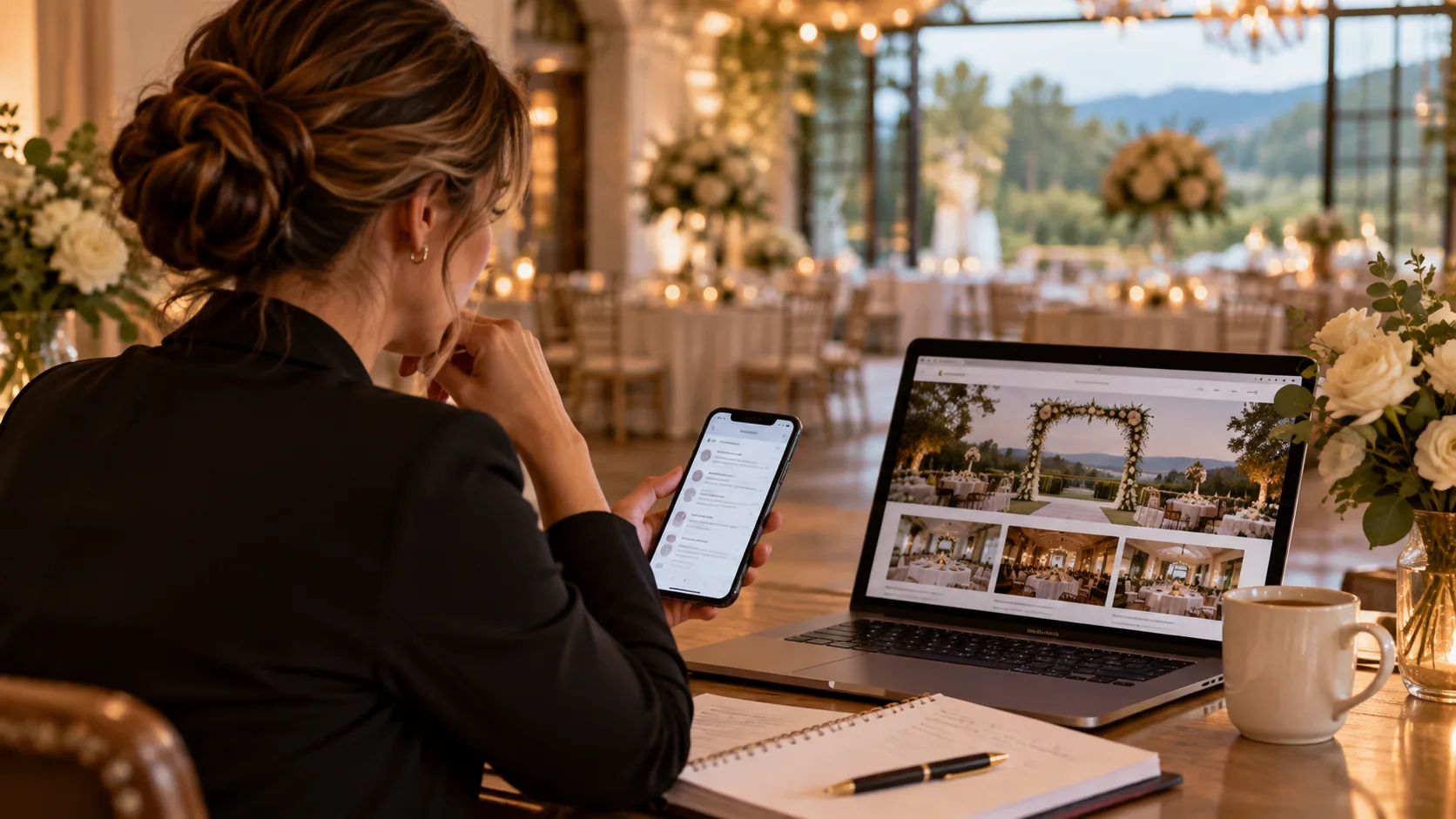
Every wedding venue owner wants more bookings. You invest in your website, professional photography, social media, and advertising to attract engaged couples. When someone finally fills out your contact form, sends an email, or requests pricing, you have an opportunity to turn that interest into a scheduled tour and eventually a confirmed wedding.
But what happens when your venue takes six hours, twelve hours, or even two days to respond?
That couple might already be talking to another wedding venue.
Your wedding venue inquiry response time can directly influence how many couples schedule tours, how many conversations turn into bookings, and how much revenue your venue generates.
At Dual Spark Marketing, we believe attracting inquiries is only part of a successful wedding venue marketing strategy. What happens after someone contacts your venue matters just as much.
If your venue consistently generates inquiries but struggles to turn those inquiries into scheduled tours, your response process could be costing you more bookings than you realize.
Couples Don’t Wait Around for Wedding Venues to Respond
Think about how couples search for wedding venues.
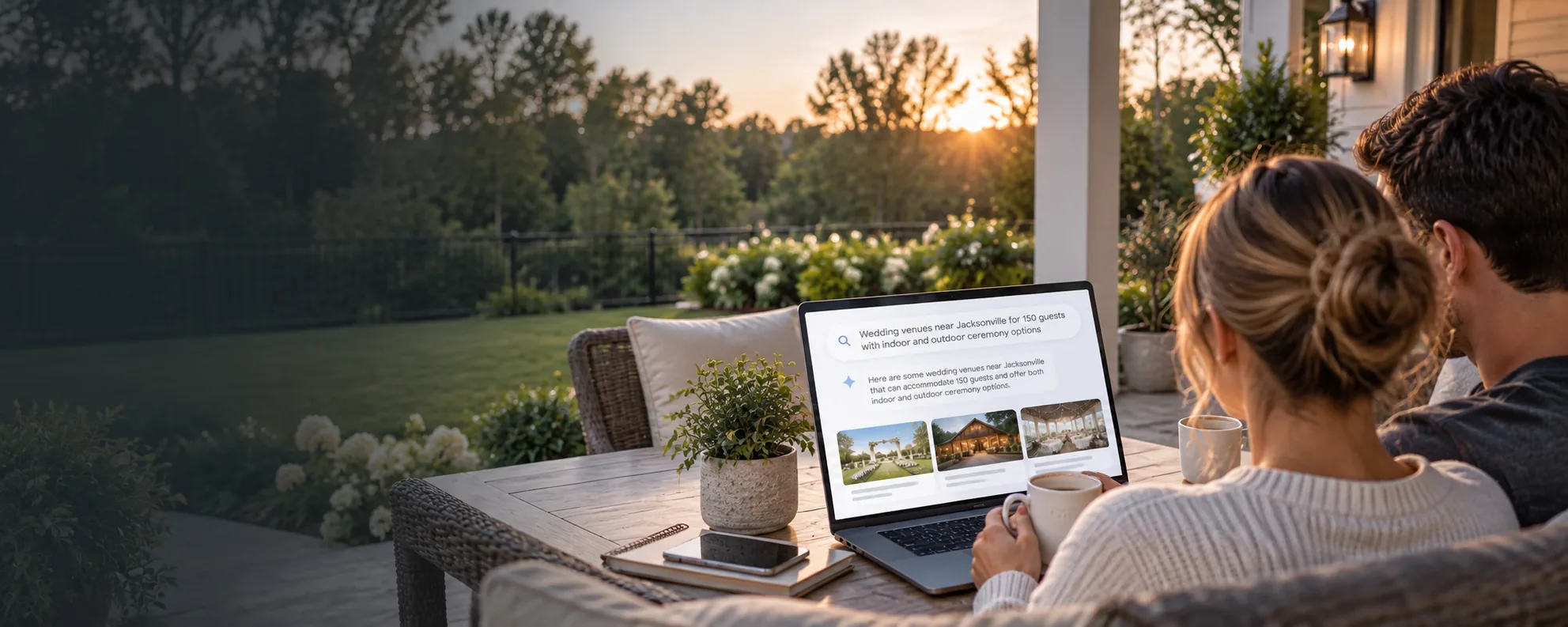
They might spend an evening browsing Google, comparing wedding venue websites, looking through photo galleries, reviewing pricing information, and narrowing their options.
Once they find several venues they like, they start reaching out.
A couple might submit an inquiry to your venue at 7:30 p.m. on a Tuesday. During that same evening, they could contact three or four other venues in your area.
Now imagine what happens next.
One venue responds within fifteen minutes, answers their initial questions, and provides a link to schedule a private tour.
Another responds an hour later with pricing information and available tour dates.
Your venue responds the following afternoon.
By the time your message arrives, the couple might already have two venue tours scheduled.
Your property could have been their favorite. Your pricing might have fit their budget perfectly. Your venue might even offer better amenities than the competition.
Unfortunately, the couple never had the opportunity to discover those advantages because another venue started the conversation first.
Wedding venues aren’t just competing on appearance, pricing, and amenities. They’re also competing on how quickly they respond to interested couples.
And when couples have several attractive options, a delayed response can make your venue easier to overlook.

Why Wedding Venue Inquiry Response Time Matters More Than You Think
When someone submits an inquiry through your website, they’re taking an important step in their wedding planning process.
They’ve moved beyond casually browsing photos and started considering your venue as a potential location for their wedding.
That interest creates an opportunity for your sales process to begin.
However, interest doesn’t remain at the same level indefinitely.
A couple who feels excited about your venue today might become distracted by other wedding planning decisions tomorrow. They might discover another property, schedule a tour elsewhere, or begin discussing different wedding dates.
The longer your venue waits to respond, the more opportunities couples have to move in another direction.
Fast Responses Keep the Conversation Moving
When your venue responds quickly, you can answer questions while the couple is actively thinking about your property.
You can discuss their preferred wedding date, explain your packages, answer questions about guest capacity, and encourage them to schedule a tour.
Instead of waiting for the couple to remember why they contacted you, your response continues a conversation they’re already interested in having.
Quick Communication Helps Build Trust
Planning a wedding involves countless decisions, and couples want to feel confident about the vendors they choose.
Your initial response gives them an early impression of how your venue communicates.
A prompt, helpful reply demonstrates that your venue pays attention to inquiries and values potential clients.
A delayed response can create uncertainty.
If a couple waits two days to receive basic pricing information, they might wonder how difficult communication will become once they book their wedding.
That doesn’t mean every couple will reject a venue because of one slow email. However, when they’re comparing several properties, responsiveness can influence which venue makes them feel most comfortable.
Every Inquiry Has a Limited Window of Opportunity
Unlike many businesses, wedding venues have a limited number of available dates.
You can’t sell the same ceremony and reception space to multiple couples for the same Saturday.
When a qualified couple contacts your venue about an available date, you have an opportunity to move that inquiry toward a booking.
If the couple books another venue while waiting for your response, you lose that opportunity.
And if the date remains unbooked, your venue still has to find another couple interested in that specific day.
This makes your inquiry response process especially important during popular wedding months and high-demand booking periods.
The Real Cost of Responding Too Slowly to Wedding Inquiries
Many wedding venue owners focus on the number of inquiries their marketing generates.
They review website traffic, Google Ads performance, social media engagement, and contact form submissions.
Those numbers matter, but they don’t tell the entire story.
A venue can generate plenty of inquiries and still struggle to increase bookings if too many potential clients disappear before scheduling a tour.
Let’s look at a hypothetical example.
Imagine your wedding venue receives 40 inquiries per month.
That’s 480 inquiries annually.
Now suppose your average wedding booking generates $8,000 in venue revenue.
If your venue loses just two additional bookings per month because couples never receive a timely response or meaningful follow-up, that represents:
24 missed weddings annually
$8,000 in average revenue per booking
$192,000 in potential annual booking revenue
These figures illustrate a possible financial impact, not an industry average or a prediction of what faster responses will produce.
The important takeaway is that even a relatively small number of missed bookings can have a substantial financial impact.
And that doesn’t account for potential additional revenue from upgrades, rentals, or other services your venue offers.

More Advertising Won't Fix a Broken Inquiry Process
More Advertising Won’t Fix a Broken Inquiry Process
Suppose your venue spends $2,000 per month on Google Ads.
Your campaigns generate consistent traffic and qualified inquiries, but your staff takes a full day to respond to many of those leads.
Increasing your advertising budget might generate additional inquiries.
However, if your response process remains unchanged, you could simply create more opportunities for potential clients to lose interest.
Before investing more money into attracting couples, make sure your venue can respond effectively to the inquiries it already receives.
The goal isn’t simply to generate more wedding venue leads. The goal is to turn more of those leads into actual bookings.
Why Wedding Venues Struggle to Respond Quickly
Most wedding venue managers understand the importance of responding to inquiries.
The challenge is finding time to do it consistently.
Running a wedding venue involves far more than answering emails.
You’re coordinating weddings, managing vendors, conducting property tours, preparing event spaces, communicating with booked couples, and handling daily operations.
During busy wedding weekends, responding to new inquiries can easily fall to the bottom of your priority list.
Unfortunately, that’s often when interested couples are researching venues.
1. Inquiries Arrive Outside Normal Business Hours
Couples frequently research wedding venues after work, during evenings, and on weekends.
Your venue might receive an inquiry at 9:00 p.m. on Friday while your staff is preparing for Saturday’s wedding.
If nobody checks the inquiry inbox until Monday morning, that couple could wait more than two days for a response.
Meanwhile, another venue might have already answered their questions and scheduled a tour.
Your staff doesn’t need to work around the clock, but your venue should have a process for handling inquiries that arrive outside normal office hours.
2. Too Many People Share Responsibility for Inquiries
When multiple employees monitor the same inbox, inquiries can slip through the cracks.
One employee assumes another person already responded.
Someone opens a message but forgets to follow up.
Another employee saves an inquiry to address later, only to get pulled into an urgent event-related task.
Without a clear process, even a well-staffed venue can struggle to respond consistently.
Assigning responsibility for new inquiries helps eliminate confusion and reduces the chances of potential bookings getting overlooked.
3. Your Venue Receives Inquiries From Multiple Sources
Not every couple contacts your venue through the same channel.
Some submit forms through your website. Others call, send emails, or reach out through social media.
You might also receive inquiries through wedding directories and other advertising platforms.
When those messages arrive in different places, your staff has to monitor several channels throughout the day.
The more disconnected your communication channels become, the easier it is to miss an inquiry.
4. Staff Members Wait Until They Have Every Answer
Sometimes wedding venue managers delay responding because they want to provide complete information.
They might need to verify a date, confirm pricing, review package details, or check with another employee.
Accurate information matters, but you don’t need every answer before starting the conversation.
A helpful initial response can acknowledge the couple’s inquiry, address what you already know, and explain when you’ll provide the remaining details.
That keeps communication moving instead of leaving the couple wondering whether anyone received their message.
Your First Response Should Do More Than Say Thank You
Responding quickly matters, but the quality of your response matters too.
An automatic email that simply says, “Thank you for contacting us. Someone will be in touch soon,” confirms that the inquiry reached your venue.
That’s useful, but it doesn’t answer the couple’s questions or help them move forward.
Your first meaningful response should make it easy for the couple to continue exploring your venue.
Acknowledge Their Wedding Details
If the couple provided their wedding date, guest count, or other details, acknowledge that information.
This makes your response feel personal rather than generic.
For example, if someone asks about hosting a wedding for 125 guests in October, address those details instead of sending an unrelated sales message.
Couples often contact wedding venues because they want to know whether the property fits their budget, guest count, and preferred wedding date.
If you have that information available, provide it.
Don’t make couples exchange several emails just to learn your starting prices or whether your venue can accommodate their guest list.
The easier you make it to evaluate your venue, the easier it becomes for interested couples to take the next step.
Encourage Them to Schedule a Tour
A response shouldn’t end with a vague invitation to contact you again.
Give the couple a clear opportunity to visit your property.
If your venue offers online tour scheduling, include a direct booking link.
If you schedule tours manually, offer specific available times.
For example:
“We’d love to show you around the property. We have tour openings Thursday afternoon and Saturday morning. Would either work for you?”
That approach makes the next step simple.
A successful inquiry response should move the couple closer to scheduling a tour, not create another unnecessary step in the conversation.
How Quickly Should Wedding Venues Respond to New Inquiries?
Ideally, your venue should respond to new inquiries within minutes during staffed business hours.
If that isn’t realistic, aim to respond meaningfully within the first hour.
These are practical operational goals, not guarantees that a particular response time will produce a booking.
The key is to establish a consistent process that prevents inquiries from sitting unanswered for hours or days.
Within 15 Minutes: An Excellent Goal
Responding within fifteen minutes gives your venue an opportunity to connect with couples while they’re actively researching properties.
You can answer questions, provide helpful information, and encourage them to schedule a tour before they move on to other tasks.
Within One Hour: A Strong Operational Target
Not every wedding venue has a dedicated sales employee monitoring inquiries throughout the day.
For smaller venues, responding within an hour during business hours can be a realistic and effective goal.
The key is making sure someone takes responsibility for new inquiries.
Same Day: Better Than Waiting Until Tomorrow
If your venue can’t respond within an hour, prioritize answering inquiries before the end of the business day.
Avoid letting messages pile up overnight when staff could reasonably address them sooner.
After Hours: Set Clear Expectations
You don’t need to have someone answering emails at midnight.
Instead, use an automated acknowledgment that confirms the inquiry was received and explains when the couple can expect a personal response.
If possible, provide immediate access to useful information, such as your pricing page, wedding packages, FAQs, or tour scheduling calendar.
This allows couples to continue exploring your venue while they wait.
Just remember that an automated acknowledgment isn’t the same as a meaningful response.
How Wedding Venues Can Respond Faster Without Hiring More Staff
Improving response times doesn’t necessarily require additional employees.
In many cases, better organization and a few adjustments to your existing process can make a noticeable difference.
1. Send Instant Notifications for New Inquiries
Your venue shouldn’t depend on someone remembering to check an inbox throughout the day.
Configure your website’s inquiry forms to notify the appropriate staff member immediately.
Depending on your system, notifications might arrive through email, text messages, or a customer relationship management platform.
The goal is to make new inquiries visible as soon as they arrive.
2. Use Response Templates Without Sounding Robotic
Writing every inquiry response from scratch takes time.
Create a few professional templates for common situations, including pricing requests, date availability questions, tour scheduling, and general wedding information.
Then personalize each response using the couple’s name and relevant wedding details.
This helps your staff respond quickly while maintaining a friendly, conversational tone.
Avoid sending the exact same generic message to every couple regardless of what they asked.
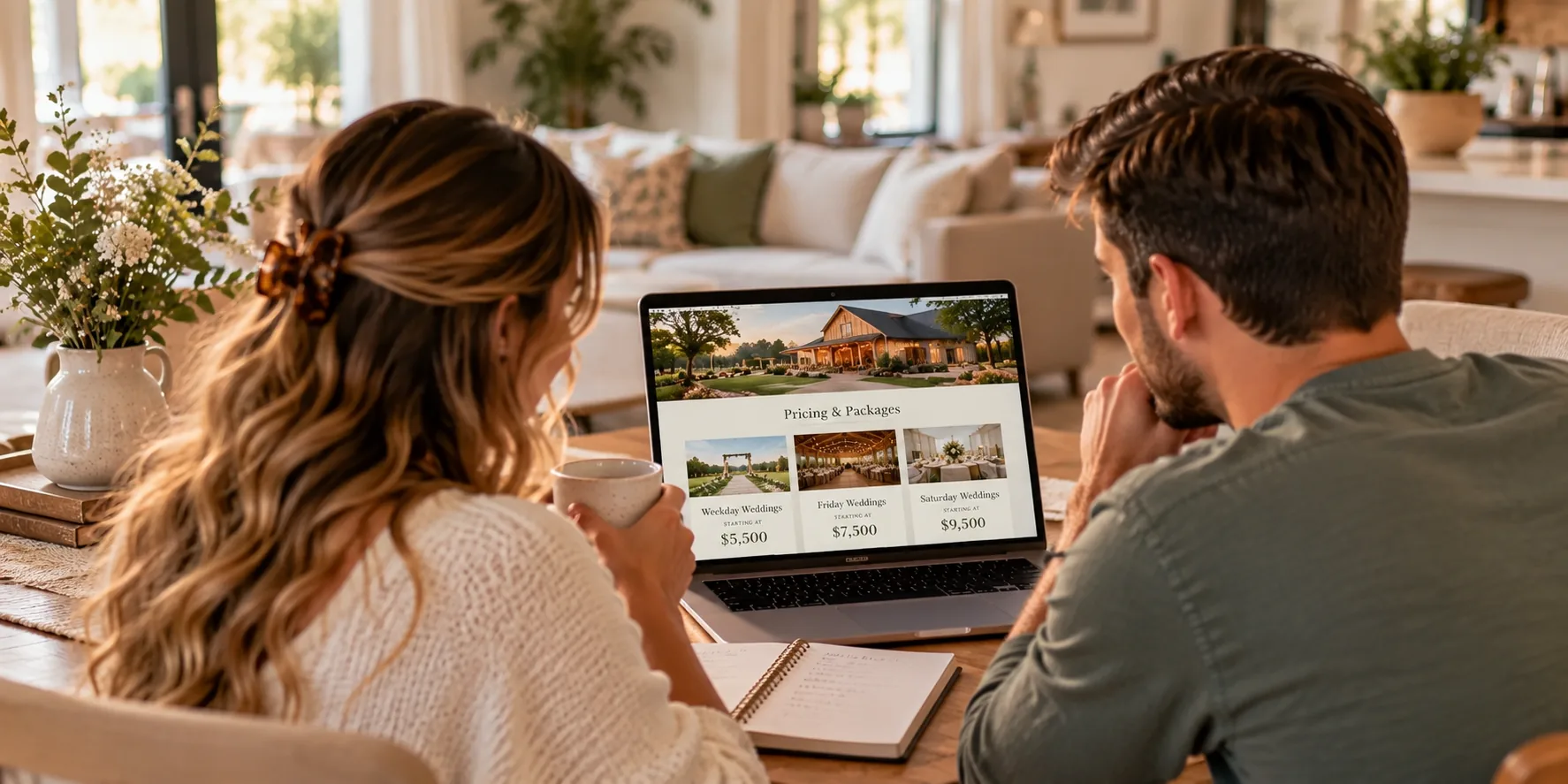
3. Make Pricing Information Easy to Find
One of the most common questions couples ask wedding venues involves pricing.
If your website provides little or no pricing information, potential clients may need to contact your venue simply to determine whether it fits their budget.
That creates additional work for your staff and delays the decision-making process.
A well-organized wedding venue pricing page can answer many initial questions before couples submit an inquiry.
You don’t necessarily need to publish every package detail or custom pricing option.
Even starting prices, package ranges, and explanations of what’s included can help couples determine whether your venue is a good fit.
When interested couples already understand your general pricing, your staff can spend more time helping them schedule tours and evaluate available dates.
4. Allow Couples to Schedule Tours Online
One of the easiest ways to reduce unnecessary communication is to let couples schedule their own venue tours.
Consider the traditional process.
A couple submits an inquiry asking to visit your property.
Your venue responds the next morning and asks which days work best.
The couple replies several hours later.
Your staff checks the calendar and suggests two available times.
The couple finally confirms a tour the following day.
That entire process could take two or three days.
Now imagine the couple visits your website, reviews your pricing information, and schedules an available tour immediately.
They receive confirmation without waiting for someone to manually coordinate the appointment.
Online tour scheduling removes unnecessary delays between a couple’s initial interest and their first visit to your venue.
It also allows couples to take action during evenings and weekends when your staff may be unavailable.
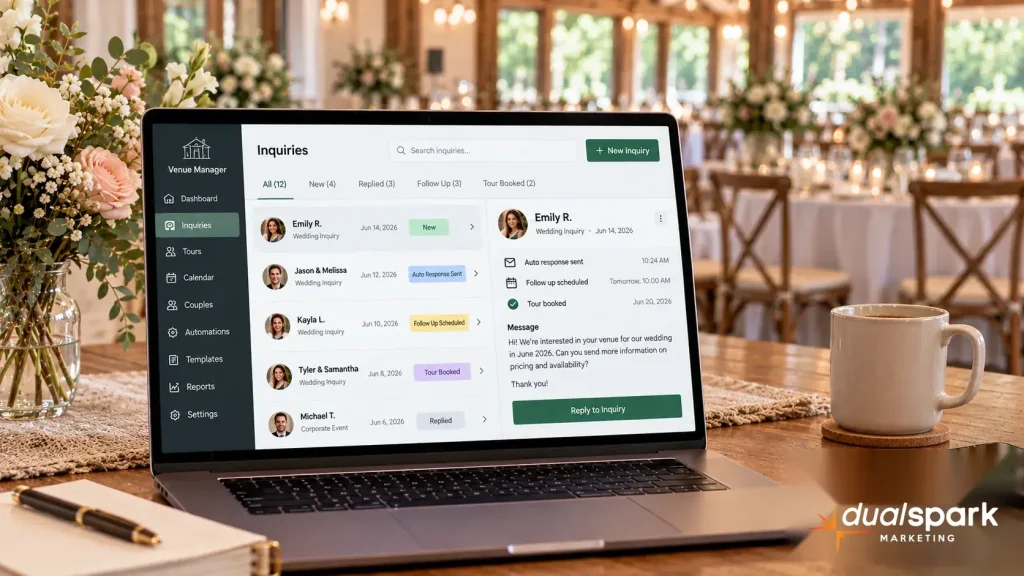
5. Keep All Inquiries Organized in One Place
A centralized inquiry management system helps your staff track conversations and avoid overlooking potential bookings.
Instead of relying on scattered emails, spreadsheets, and handwritten notes, organize each inquiry with its relevant details.
Your system should make it easy to identify new inquiries, conversations awaiting a response, scheduled tours, and couples who need follow-up communication.
You don’t need complicated software to improve organization.
You need a process that your staff can follow consistently.
6. Assign Someone to Monitor New Leads
Every inquiry should have a clear owner.
If your venue has a dedicated sales manager, that person might handle all incoming wedding inquiries.
For smaller venues, responsibility might rotate between employees based on the schedule.
Whatever approach you choose, make sure everyone understands who responds to new inquiries and what happens when that person is unavailable.
Clear accountability helps prevent missed messages and unnecessary delays.
Don't Confuse Fast Responses With Effective Follow-Up
Responding quickly to the initial inquiry is only the beginning.
What happens when the couple doesn’t respond?
Many wedding venues send one email and assume the couple isn’t interested if they don’t hear back.
But a lack of response doesn’t always mean the couple has rejected your venue.
They might be discussing pricing, comparing dates, coordinating schedules, or simply dealing with other responsibilities.
A thoughtful follow-up can restart the conversation.
Follow Up Without Pressuring Couples
If a couple hasn’t responded to your initial message, consider sending a friendly follow-up after a day or two.
Ask whether they received the information and whether they have any additional questions.
If they still haven’t responded, another message several days later might help.
You can share helpful information about your venue, explain what’s included in your packages, or offer another opportunity to schedule a tour.
Keep your communication relevant and respectful.
The goal is to make it easier for interested couples to move forward, not overwhelm them with repeated sales messages.
Make Every Follow-Up Useful
Avoid sending multiple emails that simply ask whether the couple is still interested.
Give them a reason to continue the conversation.
You might highlight an amenity they asked about, explain your indoor ceremony options, or provide information about guest accommodations.
If they previously expressed interest in touring your venue, remind them how easy it is to schedule a visit.
And when a couple tells you they’ve chosen another venue or no longer wants to receive messages, respect that decision.
How to Tell Whether Slow Responses Are Costing Your Venue Bookings
You can’t improve a process if you don’t know how it’s performing.
Start by reviewing how your venue currently handles new inquiries.
Look at the last 30 to 60 days of inquiry activity.
For each inquiry, identify when the couple contacted your venue, when your staff first responded, whether the couple replied, and whether they scheduled a tour.
Then look for patterns.
Are inquiries submitted during weekends taking longer to receive responses?
Do couples who receive same-day replies schedule more tours than those who wait until the following day?
Are certain inquiry sources producing more unanswered messages?
Do some staff members consistently respond faster than others?
These questions can reveal opportunities to improve your sales process.
Track These Five Wedding Venue Inquiry Metrics
Average First Response Time
Measure how long it takes your venue to send a meaningful response after receiving an inquiry.
Track the median response time as well, since a few unusually long delays can distort your average.
Inquiry Response Rate
Determine what percentage of new inquiries receive a response.
Every legitimate inquiry deserves attention, even when your venue can’t accommodate the requested date.
Inquiry-to-Tour Conversion Rate
Measure how many inquiries result in scheduled venue tours.
For example, if your venue receives 50 inquiries and schedules 15 tours, your inquiry-to-tour conversion rate is 30%.
Tour-to-Booking Conversion Rate
Track how many completed tours result in confirmed wedding bookings.
If your venue conducts 20 tours and books 8 weddings, your tour-to-booking conversion rate is 40%.
Inquiry-to-Booking Conversion Rate
Measure how many total inquiries eventually become confirmed weddings.
This helps you evaluate the performance of your entire sales process, from the initial inquiry through the signed contract.
Together, these metrics provide a clearer picture of how effectively your venue turns marketing opportunities into revenue.
A Faster Response Process Can Improve Your Wedding Venue Marketing Results
Wedding venue marketing shouldn’t stop when someone fills out your contact form.
Your website, SEO strategy, Google Ads campaigns, and social media presence work together to attract potential clients.
But your inquiry management process determines what happens after those couples express interest.
Consider two venues receiving the same number of qualified inquiries.
Both have attractive properties, competitive pricing, and professional websites.
The first venue responds inconsistently, manually coordinates every tour, and rarely follows up with couples who stop replying.
The second venue responds promptly, provides helpful pricing information, makes tour scheduling convenient, and tracks every inquiry through the booking process.
Even if both venues attract similar couples, their booking results could look very different.
That’s why improving your inquiry response process should be part of your overall wedding venue marketing strategy.
You don’t always need more website visitors or a larger advertising budget.
Sometimes, the best opportunity for growth comes from doing a better job with the inquiries you’re already generating.
What Wedding Venue Owners Should Do First
If you suspect slow responses are affecting your bookings, don’t try to change everything overnight.
Start with your existing inquiry process.
Review how quickly your venue responds during normal business hours, evenings, and weekends.
Identify who receives notifications when someone submits an inquiry.
Make sure your website provides enough information for couples to determine whether your property fits their needs.
Then evaluate how easily visitors can schedule a tour.
If couples have to exchange several emails just to arrange a visit, consider simplifying that process.
Finally, establish a consistent follow-up procedure so interested couples don’t disappear simply because your staff forgot to reconnect with them.
Small improvements across these areas can create a smoother experience for couples and help your venue make better use of its marketing opportunities.
Stop Losing Wedding Bookings Before Couples Ever Visit Your Venue
Your wedding venue might have everything a couple wants.
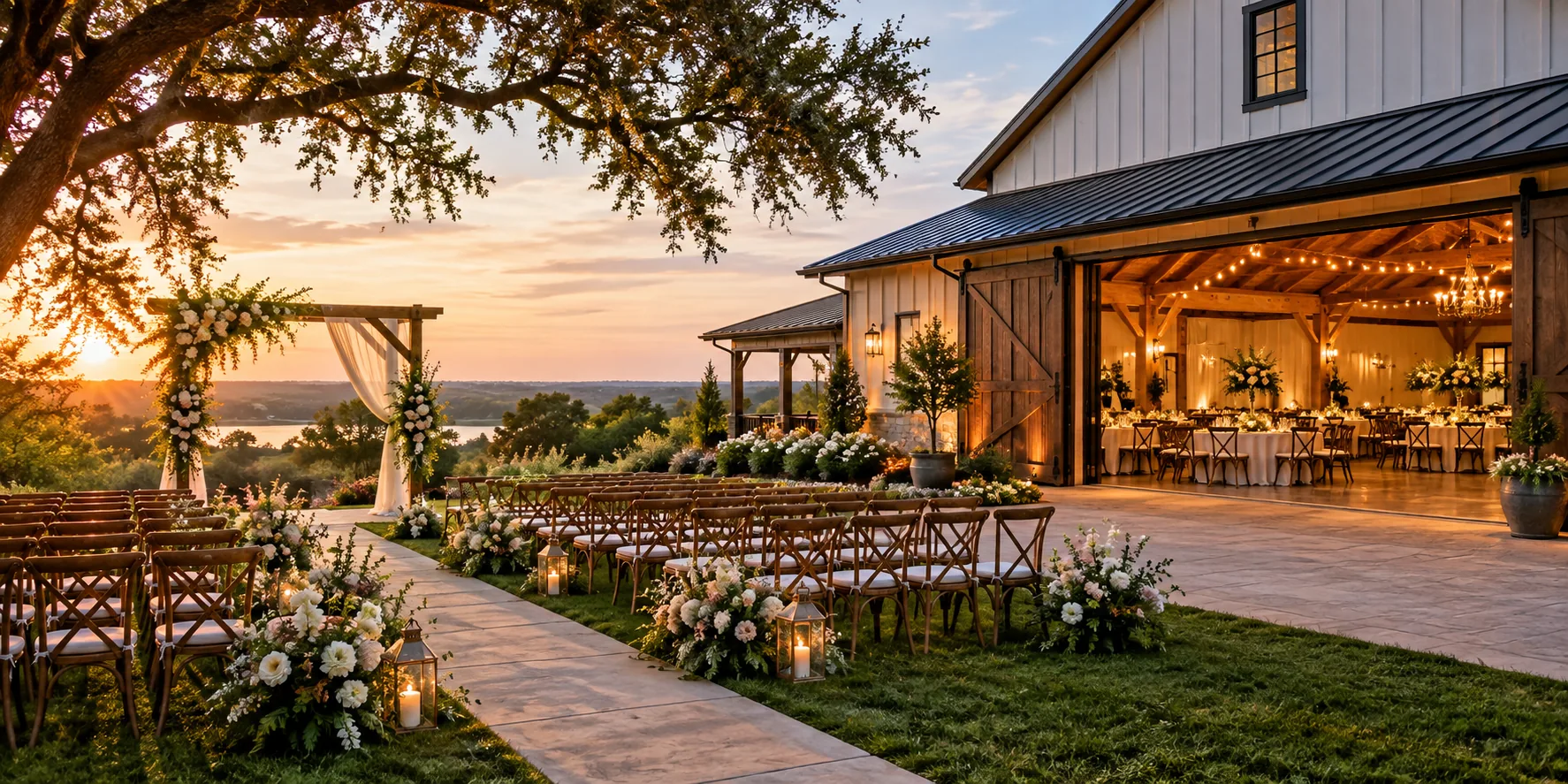
Beautiful ceremony spaces, attractive reception areas, competitive packages, convenient amenities, and an experienced staff can all help make your property an excellent choice.
But those advantages won’t matter if couples move forward with another venue before you respond.
Every inquiry represents someone who has already shown interest in your property.
They’ve visited your website, explored your venue, and taken the time to contact you.
Don’t let that opportunity disappear because their message sat unanswered.
Respond promptly, provide useful information, simplify tour scheduling, and follow up consistently.
Most importantly, remember that generating wedding venue inquiries and converting those inquiries into bookings are two different parts of the same marketing strategy.
Your venue needs both to grow.
Frequently Asked Questions About Ceremony & Reception Space Pages
How quickly should a wedding venue respond to a new inquiry?
Wedding venues should aim to respond to new inquiries within 15 minutes during normal business hours whenever possible. If that isn’t realistic, responding within one hour is a strong goal. The faster your venue responds, the better your opportunity to connect with couples while they’re actively researching wedding locations and comparing their options.
Most engaged couples don’t contact just one wedding venue. They often reach out to several properties to compare pricing, availability, amenities, and wedding packages. If another venue responds quickly and offers an opportunity to schedule a tour, that couple may move forward before your staff even opens their inquiry.
Wedding venue owners should establish a consistent response process that includes immediate inquiry notifications, clear staff responsibilities, and automated acknowledgments outside business hours. While you don’t need employees answering messages around the clock, couples should know their inquiry was received and when they can expect a personal response.
The goal is to start a meaningful conversation before the couple loses interest or schedules a tour with another venue.
Why do wedding venues lose potential bookings when they take too long to respond?
Wedding venues lose potential bookings because delayed responses give interested couples more time to explore competing properties, schedule tours elsewhere, and make decisions without considering your venue. When couples contact multiple venues, the first property to provide helpful information and convenient tour options may gain an advantage.
Imagine a couple contacting four wedding venues on a Sunday evening. Two venues respond that night with pricing details and available tour appointments. Another responds Monday morning, while the fourth waits until Tuesday afternoon. By then, the couple might already have several tours scheduled and may not feel the need to add another property to their list.
Slow communication can also create doubts about how your venue operates. Couples want confidence that their wedding venue will communicate clearly throughout the planning process. If getting an initial response takes several days, they may question how responsive your staff will be after signing a contract.
Even an exceptional property can lose booking opportunities when its inquiry process creates unnecessary delays. Fast, helpful communication allows your venue to demonstrate professionalism, build trust, and encourage couples to take the next step toward booking.
What should wedding venues include in their first response to an inquiry?
A wedding venue’s first response should acknowledge the couple’s inquiry, address their specific wedding details, answer their most important questions, and provide a clear opportunity to schedule a tour. The message should feel personal, helpful, and welcoming rather than like an automated sales pitch.
Start by referencing the couple’s preferred wedding date, estimated guest count, or questions they submitted. If they’ve asked about pricing, provide relevant package information or a direct link to your pricing page. If they want to know whether your venue can accommodate 150 guests, answer that question instead of sending a generic description of your property.
Your response should also make the next step easy. Rather than ending with “Let us know if you have any questions,” encourage the couple to visit your venue. Include an online tour scheduling link or suggest specific appointment times that work with your calendar.
Wedding venue managers should avoid making couples exchange multiple emails just to receive basic information. The more useful your initial response becomes, the easier it is for interested couples to determine whether your venue meets their needs.
A strong first response doesn’t simply acknowledge an inquiry. It helps turn that initial interest into a scheduled wedding venue tour.
Can automated inquiry responses help wedding venues increase bookings?
Yes, automated inquiry responses can help wedding venues capture more booking opportunities by immediately acknowledging new inquiries and giving couples useful information while they wait for a personal response. Automation is especially valuable during evenings, weekends, and busy wedding days when staff members may not be available to answer messages.
For example, a couple might submit an inquiry at 9:00 p.m. after spending the evening comparing wedding venues. Instead of waiting until the following morning, they could immediately receive confirmation that your venue received their request, along with links to wedding packages, pricing information, frequently asked questions, and available tour appointments.
This allows the couple to continue exploring your property without waiting for someone to manually respond. If your website also offers online tour scheduling, interested couples can reserve an appointment while their excitement about your venue is still fresh.
However, wedding venues shouldn’t rely entirely on automation. Generic responses that provide no meaningful information or personal follow-up can leave couples feeling overlooked. Your staff should still review each inquiry, answer specific questions, and establish a personal connection.
The most effective approach combines immediate automated communication with timely, personalized follow-up from your venue’s staff. This creates a smoother experience for couples while reducing the administrative workload involved in managing new inquiries.
How can wedding venues increase bookings without spending more money on advertising?
Wedding venues can create more booking opportunities without increasing their advertising budgets by improving how they respond to inquiries, schedule tours, and follow up with interested couples. Before investing more money into generating leads, venue owners should make sure they’re converting as many qualified inquiries as possible into scheduled tours and confirmed weddings.
Consider a wedding venue that receives 50 inquiries each month but only schedules 10 tours. Rather than immediately increasing its Google Ads budget, the owner should investigate why 40 inquiries never resulted in appointments.
Some couples may have been outside the venue’s budget or guest capacity requirements. Others may have contacted the venue about unavailable dates. However, some may have lost interest because staff members responded too slowly, failed to answer important questions, or made scheduling a tour unnecessarily complicated.
Improving these areas can help your venue make better use of its existing marketing investment. Publishing helpful pricing information, providing immediate inquiry notifications, offering online tour scheduling, and creating a consistent follow-up process can all reduce obstacles that prevent interested couples from moving forward.
Venue owners should also track inquiry-to-tour and tour-to-booking conversion rates to identify where potential clients are dropping out of the sales process.
Generating more wedding venue leads isn’t always the answer. Sometimes, improving how your venue handles the inquiries it already receives offers a better opportunity to increase bookings.
Why do couples stop responding after contacting a wedding venue?
Couples stop responding to wedding venue inquiries for several reasons, including slow communication, pricing concerns, unavailable wedding dates, complicated tour scheduling, or simply choosing another property. A lack of response doesn’t necessarily mean the couple was never interested in your venue.
Wedding planning involves numerous decisions, and couples often contact multiple vendors at the same time. Someone who submitted an inquiry on Monday might spend Tuesday reviewing packages, Wednesday discussing their budget, and Thursday touring another property. If your venue waits several days to respond, the couple may already have moved further along with another option.
Sometimes the problem involves the information your venue provides. If a couple asks about wedding packages and receives a generic message requesting a phone call, they may decide to contact a venue that publishes clearer pricing information. Others may lose interest when scheduling a tour requires several rounds of emails.
Wedding venue managers can reduce these issues by responding promptly, answering questions directly, and making the next step convenient. If a couple doesn’t reply, send a thoughtful follow-up that provides additional value rather than repeatedly asking whether they’re still interested.
For example, you might share details about your ceremony options, explain what’s included in your packages, or remind them that they can schedule a private tour online.
The easier you make it for couples to get information and take the next step, the fewer unnecessary obstacles stand between their initial inquiry and a potential booking.
Should wedding venues offer online tour scheduling instead of manually booking appointments?
Wedding venues should strongly consider offering online tour scheduling because it allows interested couples to reserve appointments immediately without waiting for staff members to exchange emails or confirm availability. This can reduce scheduling delays and make it easier to turn website visitors into actual venue tours.
Traditional tour scheduling often involves several steps. A couple submits an inquiry, waits for a response, provides their availability, and then waits again while a venue manager checks the calendar. If the suggested appointment doesn’t work, the process starts over.
Online tour scheduling removes much of that unnecessary communication. Couples can review available appointment times, choose a date that works for them, and receive immediate confirmation. Your staff can then prepare for the visit using information collected during the scheduling process, such as the wedding date, guest count, and specific questions.
This approach is particularly helpful for smaller wedding venues where owners and managers handle sales inquiries while also coordinating events and daily operations.
An effective scheduling system should prevent double bookings, block unavailable dates, send confirmation emails, and make rescheduling straightforward. Automated reminders can also help couples remember their appointments and reduce avoidable scheduling confusion.
Online tour scheduling doesn’t replace personal service. It removes unnecessary administrative steps so your staff can spend more time building relationships with couples who are ready to visit your property.
How can wedding venue owners measure whether slow inquiry responses are affecting bookings?
Wedding venue owners can evaluate the impact of slow inquiry responses by tracking how quickly staff members answer new inquiries and comparing those response times with tour scheduling and booking results. Reviewing these numbers helps identify whether potential clients are losing interest before they ever visit the property.
Start by reviewing inquiries received during the past 30 to 60 days. Record when each inquiry arrived, when your venue first provided a meaningful response, whether the couple replied, and whether they scheduled a tour.
Next, compare inquiries that received responses within the first hour against those that waited several hours or until the following day. Look for differences in tour scheduling rates, while accounting for factors such as unavailable dates, budget mismatches, and inquiry quality.
Venue owners should also monitor their inquiry-to-tour conversion rate, tour-to-booking conversion rate, and overall inquiry-to-booking conversion rate.
For example, if your venue receives 60 inquiries and schedules 18 tours, your inquiry-to-tour conversion rate is 30%. If 9 of those completed tours result in confirmed bookings, your tour-to-booking conversion rate is 50%.
These numbers help reveal where your sales process performs well and where improvements may be needed.
Tracking inquiry sources can provide additional insight. Couples arriving through Google Ads, organic search, wedding directories, or social media may have different expectations and booking intentions.
When wedding venue owners understand how inquiries move through the booking process, they can make better decisions about response times, staffing, follow-up procedures, and marketing investments.
What If a Wedding Venue Uses the Same Space for Both the Ceremony and Reception?
If you use the same space for both parts of the wedding, you may not need separate ceremony and reception pages. One detailed page can explain how you transform the space throughout the wedding day.
Show couples what the space looks like during the ceremony and after the reception setup. Explain when the transformation happens, who handles it, and where guests go during the transition.
This process can become a selling point when you explain it clearly. Instead of leaving couples wondering how one room handles both parts of the wedding, show them exactly how the experience works.
Final Thoughts: Turn More Wedding Venue Inquiries Into Bookings With Dual Spark Marketing
At Dual Spark Marketing, we specialize in helping wedding venues attract more qualified couples through effective digital marketing strategies.
But we also understand that generating inquiries is only part of the equation.
Your website needs to make it easy for couples to find information, understand what makes your venue special, and take the next step toward scheduling a tour.
From wedding venue website design and search engine optimization to Google Ads and conversion-focused improvements, we help venues build a stronger online presence that supports their booking goals.
If your wedding venue is generating inquiries but struggling to turn them into scheduled tours and confirmed weddings, it might be time to take a closer look at your digital marketing and inquiry process.
Contact Dual Spark Marketing to learn how we can help your wedding venue attract more qualified inquiries and create more opportunities to turn interested couples into booked weddings.