Most wedding venues do not have a lead problem. They have a funnel problem.
You can generate website traffic, inquiries, phone calls, and even tours without turning enough of those opportunities into signed contracts. When that happens, the problem often sits somewhere between the first search and the final booking decision.
A wedding venue marketing funnel gives you a clear way to look at that entire process.
Instead of treating SEO, Google Ads, your website, contact forms, tours, email follow-up, and sales as separate pieces, you connect them into one system. Each step should move a potential couple closer to the next decision.
The goal is not simply to generate more leads.
The goal is to attract the right couples, answer their questions, build trust, get them to schedule a tour, and give them enough confidence to sign a contract.
What Is a Wedding Venue Marketing Funnel?
A marketing funnel is the path a potential client follows from the moment they discover your venue to the moment they book.
For a wedding venue, that journey may look something like this:
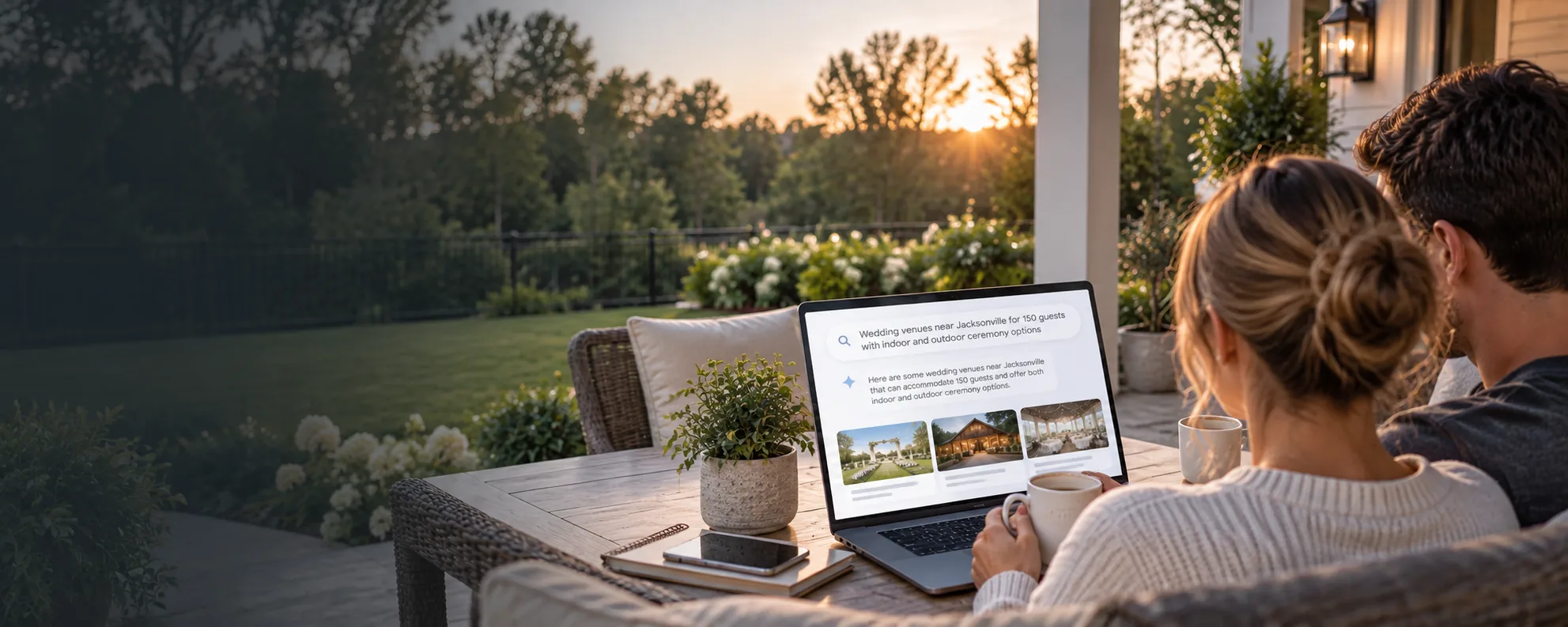
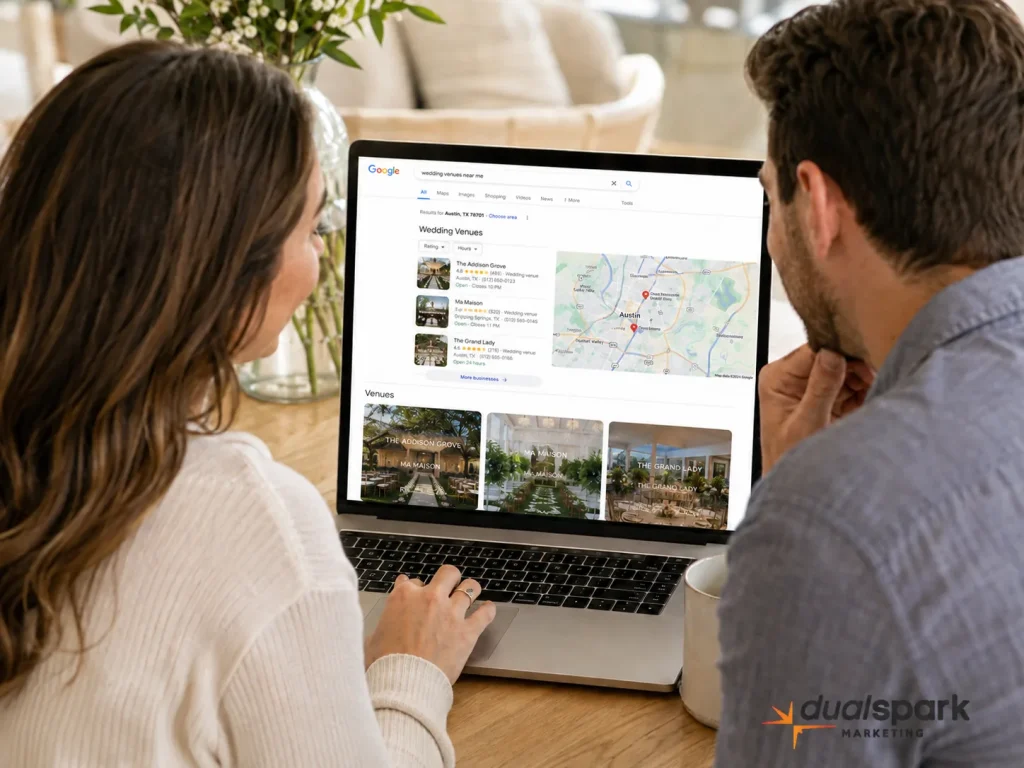
- Search Google for wedding venues
- Discover your venue
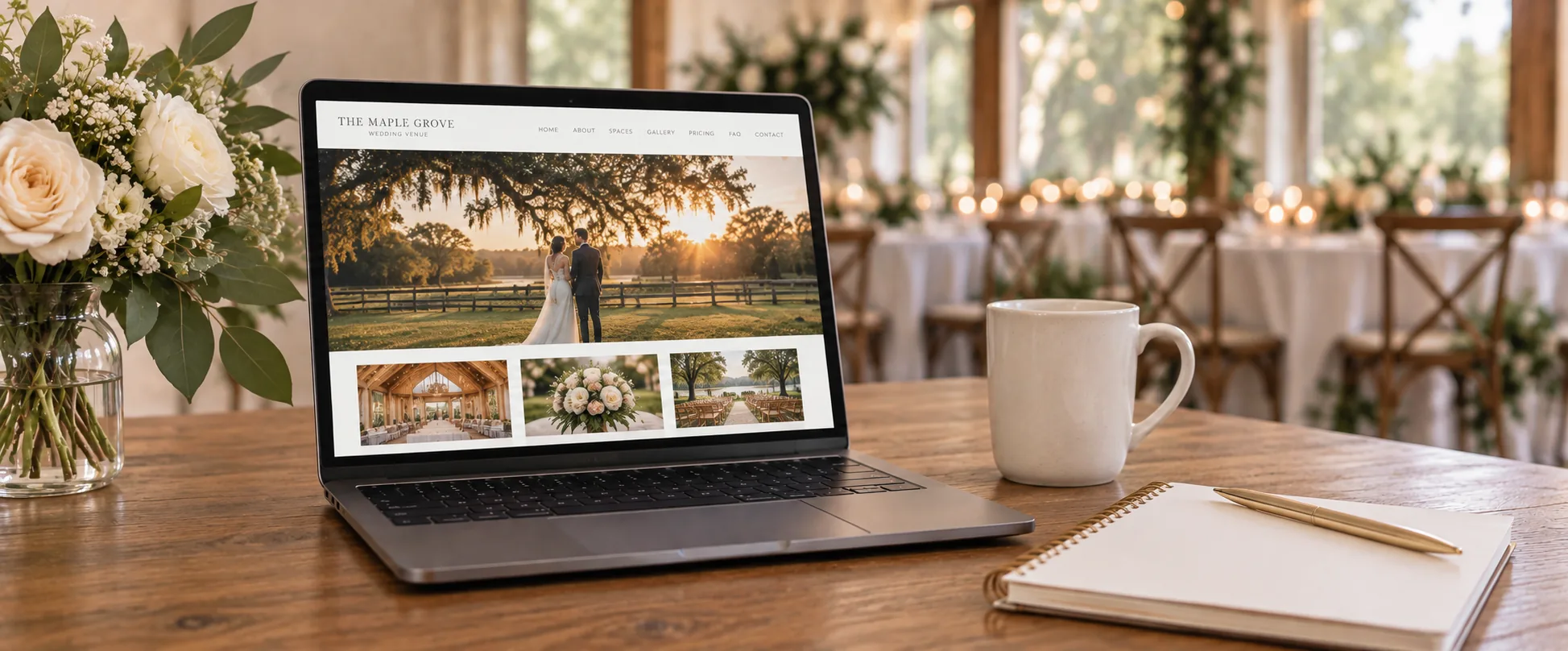
- Visit your website
- Look at photos
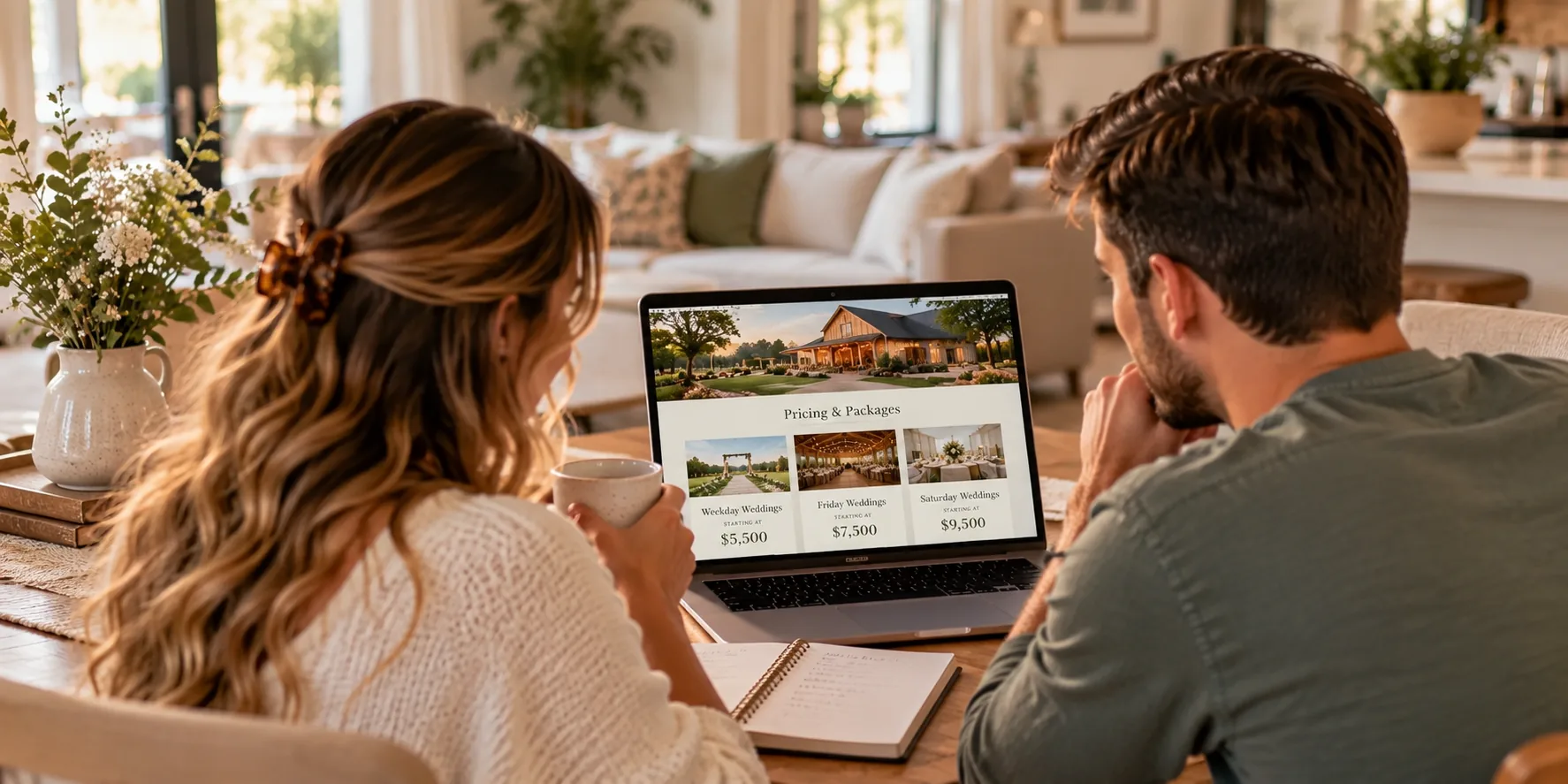
- Review pricing or packages
- Check amenities
- Read FAQs
- Look at available dates
- Submit an inquiry
- Receive a response
- Schedule a tour
- Visit the venue
- Receive follow-up communication
- Compare options
- Sign a contract
That process may happen in a few days or take several months.
Some couples move quickly. Others visit your site multiple times, follow you on social media, check reviews, compare pricing, and return weeks later.
Your marketing funnel needs to support both types of shoppers.
Stage 1: Get Found When Couples Start Searching
The funnel starts before anyone visits your website.
A couple needs to discover your venue first.
For most venues, that discovery can happen through several channels, including:
- Google organic search
- Google Maps
- Google Ads
- Social media
- Wedding directories
- Vendor referrals
- Past couple referrals
- Local wedding publications
The strongest marketing strategy does not depend entirely on one channel.
Your goal at this stage is visibility.
You want your venue to appear when someone searches for the property type, location, event, or wedding experience you offer.
For example, couples may search for phrases related to:
- Wedding venues near them
- Barn wedding venues
- Outdoor wedding venues
- Waterfront wedding venues
- Affordable wedding venues
- All inclusive wedding venues
- Small wedding venues
- Large wedding venues
- Wedding venues with accommodations
- Wedding venues with indoor and outdoor spaces
The more clearly your website explains what you offer, the easier it becomes to attract relevant visitors.
Traffic only helps when the right people reach your website.
Stage 2: Make a Strong First Impression
Once someone lands on your site, you have to earn their attention.
Couples may open several venue websites at once. If your website feels outdated, confusing, slow, or difficult to navigate, they may leave before learning much about your property.
Your homepage should quickly answer a few basic questions:
- What type of venue is this?
- Where is it located?
- What does it look like?
- What types of weddings can it host?
- What makes it different?
- What should I do next?
Do not make couples search through several pages just to understand your venue.
Use strong photography, clear navigation, useful headlines, and obvious calls to action.
You do not need to tell your entire story above the fold.
You simply need to give visitors enough confidence to keep exploring.
Stage 3: Help Couples Decide Whether Your Venue Fits
This is where many wedding venue websites lose potential clients.
A couple likes the photos, but they cannot find enough practical information to decide whether the venue fits their wedding.
They want answers.
They may want to know:
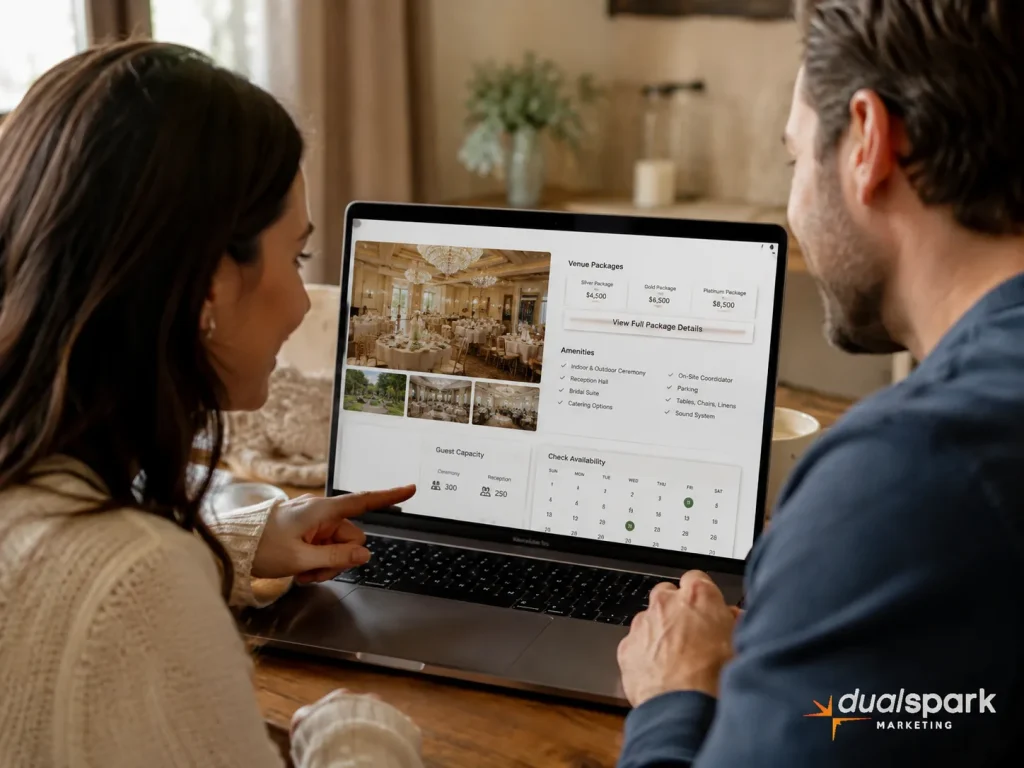
- How many guests can you accommodate?
- What does the rental include?
- What does it cost?
- Are tables and chairs included?
- Can they bring their own vendors?
- Is there an indoor backup plan?
- Can they hold the ceremony and reception onsite?
- Is alcohol allowed?
- Is catering included?
- What dates are available?
- How long do they have access to the property?
Your website should help them answer as many of these questions as possible.
Useful pages may include:
- Pricing
- Amenities
- Availability
- FAQs
- Floor plans
- Gallery
- About page
- Policies
- Event types
- Real weddings
- Indoor spaces
- Outdoor spaces
When couples can find useful information without immediately contacting you, they can qualify themselves.
That can improve the quality of the inquiries you receive.
Stage 4: Build Trust Before Asking for the Inquiry
Couples are not only evaluating the property.
They are evaluating your business.
They want to know whether your team will respond, stay organized, answer questions, and deliver on your promises.
Trust can come from several parts of your website.
Reviews are one of the strongest examples.
Use testimonials that mention:
- Communication
- Professionalism
- Responsiveness
- Planning support
- Venue condition
- Staff
- Tour experience
- Wedding day experience
Real wedding content also helps.
When couples see actual weddings at your venue, they can see how the property looks when it is fully set up.
Your About page can introduce the team.
Your FAQs can demonstrate expertise.
Your policies can show transparency.
Every one of those pages can reduce uncertainty.
Stage 5: Make the Inquiry Easy
Once a couple decides they are interested, do not make the next step difficult.
Your contact form should be simple.
You need enough information to understand the inquiry, but you do not need to collect every planning detail before the first conversation.
Useful fields may include:
- Name
- Phone number
- Preferred wedding date
- Flexible dates
- Estimated guest count
- Event type
- Message
You can collect more information later.
Long forms can feel like work.
If a couple has to answer 20 questions just to ask whether a date is available, you may lose them before they submit.
Keep the first conversion simple.
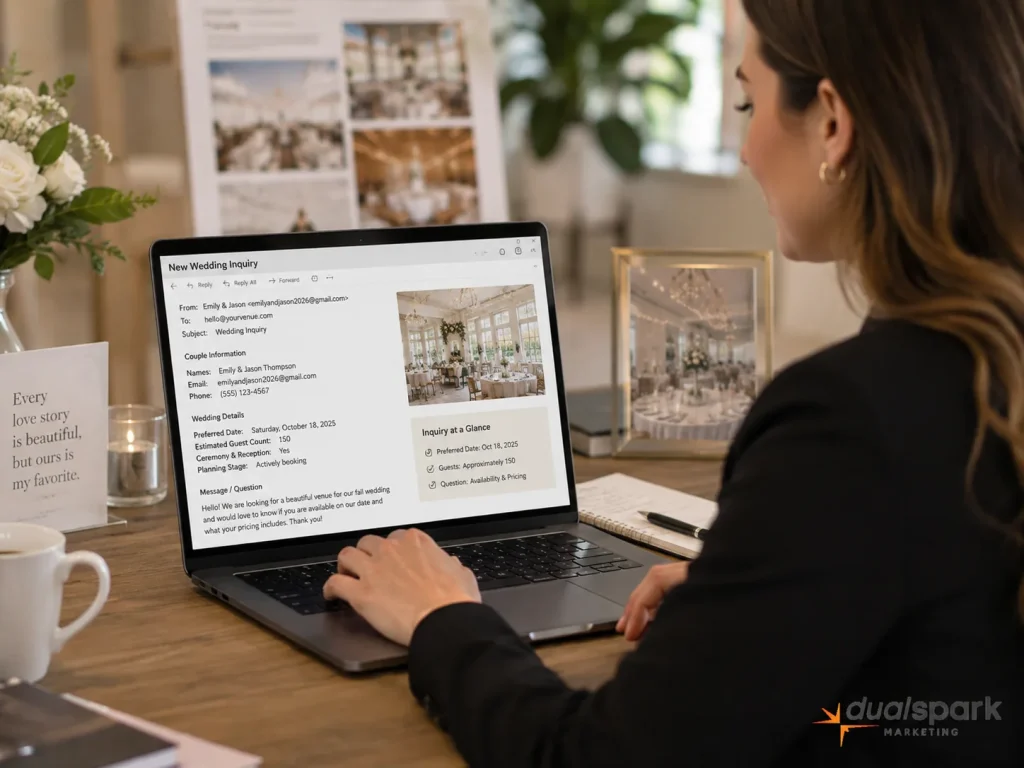
Stage 6: Respond Quickly and Answer the Actual Question
Submitting the inquiry is not the end of the funnel.
It is the beginning of your sales process.
A slow or weak response can waste all the marketing work that came before it.
If someone asks whether October 17 is available, answer the question.
Do not send a generic response that ignores what they asked.
Your first response should usually:
- Thank them for reaching out
- Address their question
- Confirm or discuss the date
- Provide the information they requested
- Explain the next step
- Encourage a tour
The goal is not to send the longest email possible.
The goal is to keep the conversation moving.
Stage 7: Give Couples a Clear Reason to Schedule a Tour
An inquiry has value.
A scheduled tour usually has much more.
Your marketing funnel should move people toward the tour because that is often where the venue becomes real.
Photos can create interest.
A tour can create emotion.
Couples can walk the ceremony space, imagine guests arriving, picture the reception layout, see the getting ready areas, and understand how the property flows.
Do not make tour scheduling difficult.
Use clear calls to action such as:
- Schedule a Tour
- Book a Private Venue Tour
- Choose a Tour Time
- Come See the Venue
If possible, give couples an easy way to choose an available appointment without sending several emails back and forth.
Stage 8: Prepare Before the Couple Arrives
The tour should not begin when the couple walks through the door.
Your team should prepare before they arrive.
Review the inquiry.
Know:
- Their names
- Preferred wedding date
- Guest count
- Wedding style
- Questions they already asked
- Any concerns they mentioned
This makes the tour feel personal.
If the couple mentioned that an indoor weather backup is important, make sure you show it.
If they need space for 200 guests, explain how the layout works.
If they are concerned about budget, explain what the package includes.
The more relevant the tour feels, the easier it becomes for the couple to picture booking your venue.
Stage 9: Give a Tour That Focuses on the Couple
Do not turn the tour into a memorized speech.
Ask questions.
Learn what matters to the couple.
A strong tour may include questions such as:
- What are you picturing for your wedding day?
- How many guests are you expecting?
- Are you planning an indoor or outdoor ceremony?
- What matters most when choosing a venue?
- Have you toured other venues yet?
- What questions can I answer for you?
Then connect your venue to their priorities.
If they care about convenience, explain what is included.
If photography matters, show the best photo locations.
If they worry about weather, show the indoor backup.
If they want a relaxed planning experience, explain how your team helps.
Sell the experience that fits the couple, rather than listing every feature.
Stage 10: Make Pricing Easy to Understand
Confusing pricing creates hesitation.
After the tour, couples should understand what they are paying for.
Clearly explain:
- Rental fee
- Packages
- Deposits
- Payment schedule
- Taxes
- Service fees
- Add-ons
- Required services
- Optional upgrades
Avoid surprising couples later with costs they did not understand during the sales process.
Transparency builds trust.
If you have several packages, explain the major differences clearly.
Do not make couples decode a complicated spreadsheet to figure out what their wedding might cost.
Stage 11: Follow Up After the Tour
Many venues lose bookings because they fail to follow up consistently.
A couple may love your venue and still need time.
They might be:
- Touring other properties
- Waiting on family
- Reviewing their budget
- Checking dates
- Talking with a planner
- Comparing packages
Silence does not always mean they are not interested.
Create a follow-up process.
A simple sequence could include:
Follow-Up 1: Shortly After the Tour
Thank them for visiting and provide anything you promised.
Follow-Up 2: A Few Days Later
Ask whether any questions came up after reviewing the information.
Follow-Up 3: Later
Provide something useful, such as a real wedding, FAQ, floor plan, or planning resource.
Follow-Up 4: Final Check-In
Ask whether they are still considering the venue and let them know you are available if they need help.
Do not send the exact same “just checking in” email repeatedly.
Each message should have a purpose.
Stage 12: Create Honest Urgency
Couples sometimes need a reason to make a decision.
That does not mean you should use fake pressure.
If another couple is seriously considering the same date, explain your booking policy.
If popular dates are filling, say so.
If an offer expires, clearly explain the deadline.
You can say:
“Your date is currently available, but we cannot hold it without a signed contract and deposit.”
That gives the couple useful information without trying to scare them.
Honest urgency helps people understand the consequences of waiting.
Stage 13: Make the Contract Process Simple
When a couple says yes, do not create unnecessary friction.
Make the contract process clear.
Explain:
- What they need to sign
- Deposit amount
- When payment is due
- How they can pay
- What happens after booking
- Who they should contact with questions
If possible, use digital contracts and payment systems.
The easier you make the final step, the less likely you are to lose momentum.
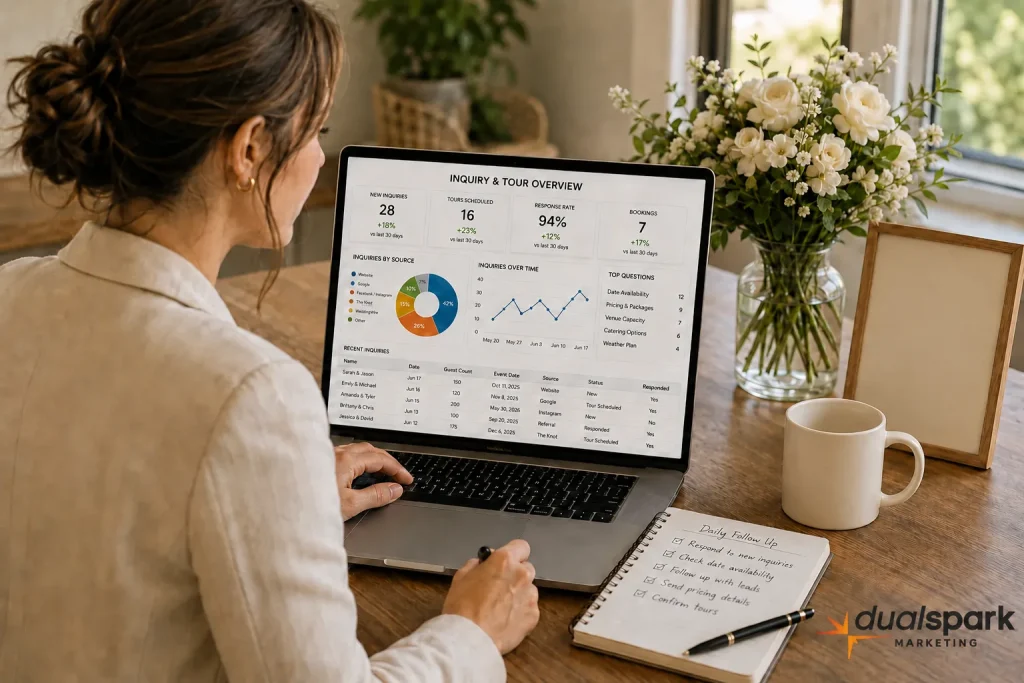
Stage 14: Track the Entire Funnel
You cannot improve what you do not measure.
Do not stop tracking at the inquiry.
You should know how people move through each stage.
Track:
- Website visitors
- Inquiries
- Phone calls
- Tour requests
- Tours scheduled
- Tours completed
- Contracts signed
- Revenue
Then connect those results back to the marketing source.
For example:
Google Ads might generate 40 inquiries and 10 bookings.
Organic search might generate 20 inquiries and 8 bookings.
A wedding directory might generate 60 inquiries and 3 bookings.
If you only look at lead volume, you might think the directory is your best source.
Once you track bookings, the picture changes.
Calculate Your Conversion Rates
Conversion rates can help you find weak points.
If you receive 100 inquiries and 40 schedule tours, your inquiry-to-tour rate is 40 percent.
If 30 of those couples complete tours and 10 book, your completed-tour-to-booking rate is about 33 percent.
These numbers do not need to match another venue.
You should use them to compare your own performance over time.
If website traffic increases but inquiries do not, look at your website.
If inquiries increase but tours do not, look at follow-up.
If tours increase but contracts do not, look at the tour experience, pricing, positioning, or post-tour follow-up.
The funnel helps you find where the problem actually exists.
Do Not Treat Every Lead the Same
Some inquiries are much more qualified than others.
A couple looking for a venue next month with 400 guests may not be a fit if you are booked or only accommodate 150.
Another couple may have a flexible date, appropriate guest count, and budget that fits your packages.
Your team should understand the difference.
This is why lead quality matters.
Your marketing should attract people who are more likely to fit your venue, not simply produce the largest possible number of form submissions.
Use Retargeting to Bring Visitors Back
Not every visitor will inquire during the first visit.
That is normal.
A couple may visit your website, look at pricing, close the browser, and return a week later.
Retargeting can help your venue stay visible after they leave.
Depending on the platforms you use, you may be able to show ads to previous visitors to your website.
You could promote:
- Tour scheduling
- Real wedding photos
- Availability
- Reviews
- Packages
- Open houses
The goal is to remind interested couples that your venue is still worth considering.
Build Internal Links That Support the Funnel
Your website pages should work together.
Do not make every page stand alone.
For example:
Your gallery can link to real weddings.
Your real weddings can link to pricing.
Your pricing page can link to availability.
Your availability page can link to tour scheduling.
Your FAQs can link to policies.
Your About page can link to contact information.
Internal links help couples continue their research without returning to the main navigation every time.
A well connected website can guide visitors naturally toward conversion.
Use Your Content to Answer Questions Before They Become Objections
Marketing content should help your sales process.
If couples repeatedly ask the same question, consider answering it on the website.
If they worry about weather, create content about your backup plan.
If they ask whether outside vendors are allowed, explain your vendor policy.
If they ask what different guest counts look like, show floor plans.
If they wonder what is included, improve your amenities or pricing pages.
Every useful answer can remove another reason for someone to leave your site.
Find the Weakest Part of Your Funnel First
You do not need to rebuild everything at once.
Start where you lose the most people.
For example:
If you get very little traffic, focus on visibility.
If traffic is strong but inquiries are low, improve the website.
If inquiries are strong but tours are low, fix follow-up.
If tours are strong but bookings are weak, evaluate the sales experience.
If bookings are strong but acquisition costs are too high, improve marketing efficiency.
Fixing the weakest stage can often produce better results than simply buying more traffic.
Common Wedding Venue Marketing Funnel Mistakes
Focusing Only on Traffic
More visitors will not fix a website that does not convert.
Measuring Only Leads
A lead does not automatically become a tour or booking.
Hiding Too Much Information
Couples may leave if they cannot find basic pricing, capacity, amenities, or availability information.
Using Long Contact Forms
Do not make the first conversion harder than necessary.
Responding Too Slowly
Interested couples may contact several venues at once.
Sending Generic Follow-Up
Personal communication usually works better than repeated “just checking in” emails.
Ignoring Tour Conversion Rates
If people tour but do not book, adding more traffic may not solve the real issue.
Using Fake Urgency
Trust is more valuable than pressure.
Failing to Track Lead Sources
You need to know which marketing channels produce actual revenue.
Frequently Asked Questions About Wedding Venue Marketing Funnels
What is a wedding venue marketing funnel?
A wedding venue marketing funnel is the full process that moves a potential couple from discovering your venue to signing a contract. It includes every major step in between, such as finding you on Google, visiting your website, reviewing photos and pricing, submitting an inquiry, scheduling a tour, receiving follow-up communication, and deciding whether to book.
The reason the funnel matters is that marketing does not stop when someone fills out a contact form. An inquiry is only one stage of the process. If your website generates plenty of leads but very few couples schedule tours, the funnel has a weakness. If tours are strong but bookings are low, the problem may be happening later in the process.
Looking at your marketing as a funnel helps you understand where couples are dropping out. That makes it easier to improve the right stage instead of assuming you simply need more traffic or more leads.
What are the main stages of a wedding venue marketing funnel?
The main stages usually include discovery, website research, inquiry, follow-up, tour scheduling, venue tour, post-tour follow-up, decision, and booking.
The discovery stage is where couples first find your venue through Google search, Google Maps, paid ads, social media, wedding directories, vendor referrals, or other marketing channels. The research stage happens when they visit your website and start looking at photos, pricing, amenities, FAQs, reviews, availability, and other details.
The inquiry stage begins when the couple contacts you. From there, your response time, communication, tour scheduling process, and tour experience all become part of the funnel. After the tour, your follow-up and pricing clarity can influence whether the couple continues moving forward.
The final stage is the signed contract and deposit. A strong funnel makes each step feel natural and gives couples a clear reason to keep moving toward the next one.
Why should wedding venues track more than leads?
Wedding venues should track more than leads because lead volume by itself does not tell you whether your marketing is actually producing revenue. A lead can come from someone who is not qualified, has the wrong guest count, wants a date you do not have available, or never schedules a tour.
The more useful question is what happens after the lead arrives.
You should know how many inquiries turn into tours, how many tours actually happen, how many of those couples book, and which marketing sources produce the most contracts. This gives you a much clearer picture of performance.
For example, one marketing source may produce 50 leads but only two bookings. Another may produce 20 leads and six bookings. If you only looked at lead volume, you might invest more money in the weaker source.
Tracking the full funnel helps you understand lead quality, not just lead quantity.
How can a wedding venue get more couples to schedule tours?
The easiest way to generate more tours is to remove friction between the inquiry and the appointment. Couples should not have to exchange several emails just to find a time to visit.
Start by responding quickly and answering the question they actually asked. If they contacted you about a specific date, address that date first. If they asked about pricing, give them useful pricing information instead of forcing them to schedule a tour just to learn the basics.
Then make the next step obvious. Use clear language such as “Schedule a Private Tour” or “Choose a Tour Time.” If your system allows couples to select from available appointments, that can make the process even easier.
Your website should also prepare couples before they inquire. Clear pricing, strong photos, reviews, amenities, availability information, and FAQs can give them enough confidence to schedule a tour instead of continuing to shop.
How can a wedding venue improve its inquiry-to-booking rate?
Improving your inquiry-to-booking rate usually requires looking at the entire funnel rather than making one small change.
Start with lead quality. If your marketing attracts couples who do not fit your guest capacity, pricing, location, or available dates, your booking rate will naturally suffer. Your website and advertising should clearly communicate who the venue is a good fit for.
Next, review your response process. Slow replies, generic emails, unclear pricing, and weak tour invitations can cause good leads to disappear.
Then look at the tour itself. Your team should understand what matters to the couple and connect the venue to those priorities. After the tour, follow up with useful information instead of relying on one email and hoping they respond.
Small improvements at several stages can create a much stronger overall booking rate than simply generating more leads.
Should wedding venues show pricing before someone schedules a tour?
In many cases, showing at least some pricing information before the tour can improve lead quality and save your team time. Couples usually want to know whether the venue fits their budget before they invest time in scheduling and attending a tour.
You do not necessarily need to publish every possible package, upgrade, or custom option. However, giving couples a realistic starting price, package range, or clear explanation of what is included can help them decide whether the venue is worth exploring further.
Hiding all pricing may increase the number of inquiries, but those inquiries are not always better. If many couples contact you only to discover that the venue is outside their budget, your team spends time on leads that were unlikely to book.
The goal should be to attract qualified couples, not simply produce the highest possible number of form submissions.
How long should a wedding venue follow up with a lead?
There is no single follow-up timeline that works for every couple because wedding planning timelines vary. Some couples make a decision within days, while others may spend several weeks researching and touring venues.
A good follow-up process should stay helpful without becoming repetitive or aggressive.
After the first inquiry, make sure the couple receives the information they requested and a clear invitation to schedule a tour. If they do not respond, follow up again with something useful, such as availability, a real wedding example, a floor plan, FAQs, or pricing details.
After a tour, continue the conversation based on the couple’s timeline. If they said they are touring three other venues that week, follow up after they have had time to compare.
The key is to avoid sending the same “just checking in” message over and over. Every follow-up should give the couple a reason to reengage.
What is the most important metric in a wedding venue marketing funnel?
Signed contracts and revenue are ultimately the most important results because they show whether your marketing is helping grow the business. However, you should also track the steps that lead to those contracts so you can understand where the funnel is working and where it is weak.
Important metrics include inquiry volume, inquiry-to-tour rate, scheduled tours, completed tours, tour-to-booking rate, cost per tour, cost per booking, and revenue by marketing source.
For example, if your website generates plenty of inquiries but very few tours, the issue may be your follow-up or tour scheduling process. If many couples tour but very few book, the issue may be pricing, positioning, the sales experience, or what happens after the tour.
The most useful approach is to track the entire path from first click to signed contract. That gives you the information you need to make better marketing decisions instead of relying on one number.
Final Thoughts: Build a System That Leads Couples Toward the Contract
Wedding venue marketing works best when every part of the process supports the next one.
SEO, Google Ads, social media, reviews, your website, contact forms, email follow-up, tours, and sales should not operate as separate pieces. They should work together to move the right couples from their first search to a signed contract.
Start by looking at your current funnel. Find where couples are dropping out, fix that stage, and then move to the next one.
You may discover that you do not need twice as many leads. You may simply need to do a better job converting the opportunities you already have.
At Dual Spark Marketing, we help wedding venues build marketing systems designed around qualified inquiries, scheduled tours, and actual bookings. We connect website strategy, local SEO, paid search, conversion tracking, and lead generation so you can see how your marketing works from the first click all the way to the signed contract.