Couples usually have dozens of questions before they feel ready to schedule a wedding venue tour. They want to know what your rental includes, how many guests you can accommodate, whether they can choose their own vendors, what happens when it rains, and how much time they receive at the venue.
When your website answers those questions clearly, you make it easier for couples to decide whether your venue fits their plans. You also give Google more useful information about your business.
A detailed FAQ page can help your wedding venue appear for more searches, attract couples who understand what you offer, and reduce the number of repetitive questions your team receives.
However, an effective FAQ page should do more than list a few short questions with one sentence answers. It should provide genuinely helpful information that supports your SEO strategy and guides couples toward scheduling a tour.
What Is a Wedding Venue FAQ Page?
A wedding venue FAQ page answers the questions couples commonly ask before booking a tour or signing a contract.
The page may address topics such as:
- Venue capacity
- Rental hours
- Pricing and deposits
- Indoor and outdoor spaces
- Rain plans
- Catering rules
- Alcohol policies
- Required vendors
- Decorations
- Rehearsal access
- Parking
- Accessibility
- Setup and cleanup
- Payment schedules
- Venue tours
Your FAQ page should help couples understand how your venue operates before they contact you.
Some venues place a small FAQ section near the bottom of their homepage or pricing page. That can help, but a dedicated FAQ page gives you more room to provide complete answers and address a wider range of topics.
Wedding Venue FAQs Match the Questions Couples Search for Online
Couples do not always search Google using short phrases such as “wedding venue near me.” Many searches take the form of complete questions.
A couple may search for:
- Can I bring my own caterer to a wedding venue?
- Do wedding venues allow outside alcohol?
- How many hours do you get at a wedding venue?
- What happens if it rains at an outdoor wedding venue?
- How far in advance should I book a wedding venue?
- Do wedding venues include tables and chairs?
- Can a wedding venue accommodate 150 guests?
- Are wedding rehearsals included with venue rentals?
A well-written FAQ page gives your website an opportunity to answer these specific searches.
Instead of forcing every page to target broad keywords, your FAQ page can address the detailed questions couples ask throughout the planning process. This helps your website appear for a wider range of relevant searches.
These searches may not receive as much traffic individually as a broad phrase such as “wedding venue,” but the people asking them often have a specific concern and may be closer to choosing a venue.

FAQ Pages Help Google Understand Your Wedding Venue
Google needs clear information to understand what your venue offers, where it is located, and which couples may find it relevant.
A detailed FAQ page gives Google additional context about your business.
For example, your answers may naturally mention:
- Your maximum guest capacity
- The cities and communities you serve
- Your indoor and outdoor ceremony spaces
- Your reception areas
- Included tables and chairs
- Bridal and groom suites
- Catering options
- Alcohol policies
- Parking availability
- Rehearsal access
- Setup and cleanup services
- Climate-controlled spaces
- Accessibility features
This information helps Google build a more complete understanding of your venue.
Your FAQ page should not repeat the phrase “wedding venue” unnaturally in every answer. Instead, answer each question clearly and include useful details that couples genuinely need.
When you focus on helping couples, your content usually becomes more useful for search engines as well.
FAQs Can Help Your Venue Appear in Voice and AI Searches
People increasingly search by speaking complete questions into their phones or asking AI tools for recommendations.
A person may ask:
- Which wedding venues near Jacksonville allow outside catering?
- Are there barn wedding venues that include tables and chairs?
- What wedding venues near St. Augustine have a rain backup plan?
- Which local venues can accommodate 125 guests?
- Do wedding venues allow couples to bring their own vendors?
Search engines and AI systems need clear, direct information before they can confidently include a business in an answer.
An FAQ page gives you a place to answer these conversational questions using natural language.
The strongest FAQ answers usually begin with a direct response and then provide helpful context.
For example:
“Yes, we allow couples to choose from our approved catering partners. This gives you several menu and pricing options while helping us maintain consistent service and food safety standards.”
That answer works better than:
“Contact us for catering information.”
The first answer gives couples and search engines useful information. The second creates another obstacle.
Complete Answers Can Improve Lead Quality
Not every inquiry is a good inquiry.
Some couples contact a venue before they understand its capacity, pricing structure, vendor policies, or available amenities. Your team may spend time responding only to discover that the venue does not fit their needs.
A detailed FAQ page helps couples qualify themselves before they submit a form or call your venue.
For example, a couple may learn that:
- Your venue can accommodate their guest count
- Their preferred date falls within your booking window
- Your rental includes the items they need
- Your alcohol policy fits their plans
- Their preferred caterer meets your requirements
- Your venue has a suitable rain plan
- Your pricing falls within their expected budget
When couples already understand these details, they can submit more informed inquiries.
This does not mean your FAQ page should discourage people from contacting you. It should remove uncertainty and help the right couples feel more confident about taking the next step.

FAQ Pages Reduce Repetitive Questions
Wedding venue teams often answer the same questions every week.
Couples repeatedly ask about pricing, deposits, capacity, rental hours, vendors, alcohol, decorations, and rain plans. These are important questions, but answering each one individually takes time.
A thorough FAQ page gives your team a reliable resource to share.
When a couple asks a question, your staff can provide a personal response and direct them to the complete FAQ page for additional information.
The page can also help:
- New team members learn venue policies
- Tour guides provide consistent answers
- Sales staff avoid giving conflicting information
- Couples review details after a tour
- Vendors understand venue requirements
Your FAQ page should support personal communication rather than replace it. Couples still want to feel welcomed and valued. The page simply makes common information easier to access.
FAQs Build Trust Before a Couple Contacts You
Couples may hesitate to contact a venue when the website leaves too many questions unanswered.
They may wonder whether the venue is hiding its policies, whether unexpected fees will appear later, or whether the team will respond clearly.
Transparent answers help reduce those concerns.
A strong FAQ page shows that your venue:
- Understands the planning process
- Communicates clearly
- Has established policies
- Anticipates common concerns
- Values the couple’s time
- Wants couples to make informed decisions
Trust matters because a wedding venue represents one of the largest and most important decisions in the planning process.
Couples are not only evaluating your property. They are deciding whether they trust your team to help host one of the most meaningful days of their lives.
Your FAQ Page Can Support Other Website Pages
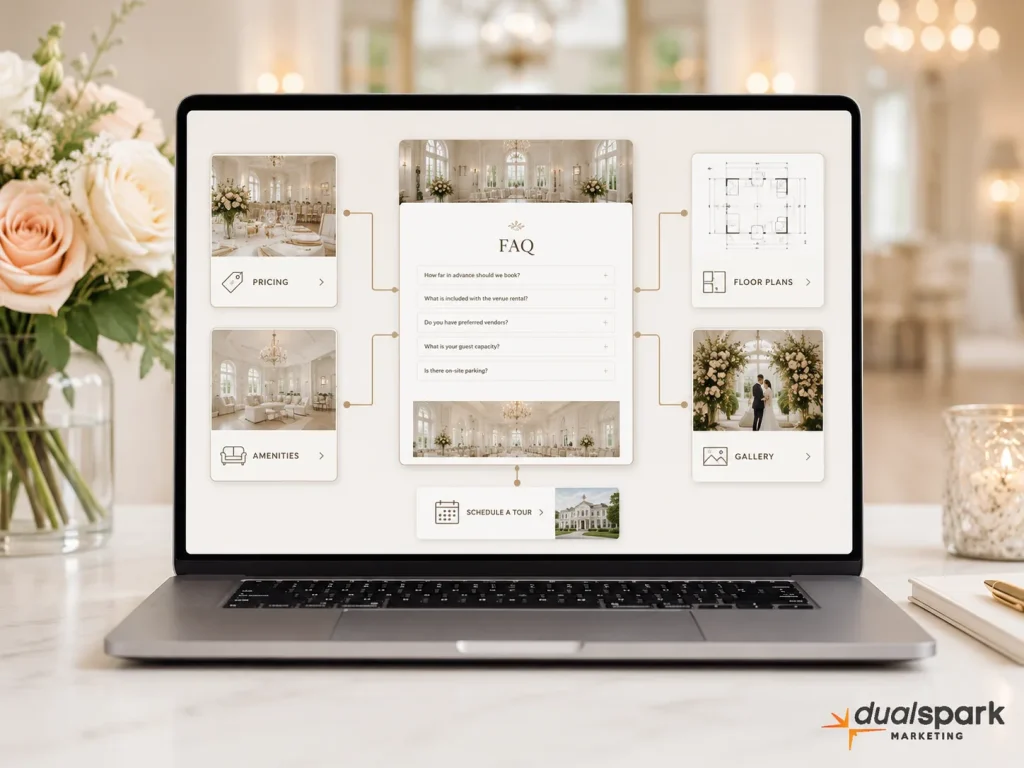
Your FAQ page should not operate as an isolated collection of answers. It should connect visitors to other useful pages throughout your website.
For example:
- A pricing answer can link to your pricing page
- A capacity answer can link to your floor plans
- An amenities answer can link to your amenities page
- A ceremony question can link to your indoor and outdoor spaces page
- A photo question can link to your gallery
- A vendor question can link to your preferred vendor page
- A tour question can link to your scheduling form
- A location question can link to your directions or contact page
These internal links help couples continue exploring your website.
They also help search engines understand the relationship between your pages and identify which pages contain the most important information.
Avoid adding a link to every sentence. Use links when they genuinely help the visitor find more detailed information.
FAQs Can Strengthen Important Service and Location Pages
You do not need to place every question on one large FAQ page.
You can also add relevant FAQ sections to individual pages.
For example, your pricing page could answer:
- What does the venue rental include?
- Is a deposit required?
- Do you offer payment plans?
- Are there additional fees?
- Do weekday weddings cost less?
Your location page could answer:
- How far is the venue from the city?
- Are hotels available nearby?
- Is transportation available?
- Where can guests park?
- What nearby attractions can guests visit?
Your indoor and outdoor spaces page could answer:
- What happens if it rains?
- Are the spaces climate controlled?
- Can couples use both ceremony spaces?
- How many guests fit in each area?
Page-specific FAQs help each page address its main topic more completely. Your primary FAQ page can then cover broader venue policies and link to those detailed pages.
Longer Answers Usually Provide More Value Than One Sentence Responses
Many wedding venue FAQ pages contain answers that are too short to be helpful.
For example:
“Do you allow outside vendors?”
“Yes.”
That answer technically responds to the question, but it leaves several details unclear.
A more helpful answer might explain:
“Yes, we allow couples to choose their own vendors, although certain services may need to meet our insurance and licensing requirements. We can also provide a list of trusted local vendors who already know our property and venue policies.”
This version answers the question while addressing the next concerns a couple may have.
Your answers do not need to become long essays. Most should provide a direct response followed by enough detail to remove uncertainty.
Two or three short paragraphs may be appropriate for complicated topics such as alcohol, catering, deposits, cancellations, weather plans, or vendor requirements.
Avoid Hiding Every Answer Behind “Contact Us”
Some venue policies depend on the event, date, package, or guest count. In those cases, asking couples to contact you may be appropriate.
However, using “contact us for more information” as the answer to nearly every question weakens the page.
Couples visit an FAQ page because they want answers.
You can still provide useful information without publishing every contract detail.
For example:
“Our rental rates vary based on the day of the week, season, and package selected. You can view our current starting prices and package details on our pricing page. Contact our team for availability and an exact proposal based on your preferred date.”
This answer provides useful direction while encouraging the couple to take the next step.
Your FAQ Answers Should Reflect Your Actual Venue Policies
Never copy another wedding venue’s FAQ page.
Even if the questions appear similar, the answers may not match your policies, packages, rental hours, or local requirements.
Copied content can create confusion and lead to inaccurate expectations.
Write every answer around the way your venue actually operates.
Before publishing the page, review the answers with the people who handle:
- Sales
- Tours
- Contracts
- Venue operations
- Catering
- Bar service
- Setup and cleanup
- Vendor coordination
Your website should give couples the same information they receive from your team.
Update the FAQ page whenever your policies, packages, pricing, or procedures change.
What Questions Should a Wedding Venue FAQ Page Answer?
The best questions depend on your venue, but most wedding venue FAQ pages should address several core subjects.
Pricing and Booking Questions
Couples often want to know:
- How much does it cost to rent the venue?
- What does the rental fee include?
- How much is the deposit?
- When are payments due?
- Is the deposit refundable?
- How far in advance can we book?
- Do you offer weekday or off-season pricing?
- Are there additional service fees?
Capacity and Space Questions
Couples may ask:
- How many guests can the venue accommodate?
- Do you offer indoor and outdoor ceremony spaces?
- Is there a separate cocktail hour area?
- Is the reception space climate controlled?
- Do you have a bridal suite?
- Do you have a groom’s suite or getting-ready space?
- Can we hold both the ceremony and reception at the venue?
Vendor Questions
Common vendor questions include:
- Can we bring our own caterer?
- Do we have to use preferred vendors?
- Can we choose our own photographer?
- Are vendors required to carry insurance?
- Do you provide a day-of coordinator?
- Can food trucks serve at the venue?
Alcohol and Catering Questions
Couples may want to know:
- Can we bring our own alcohol?
- Do you require a licensed bartender?
- Is there a bar on the property?
- Can we serve beer, wine, and liquor?
- Are there catering restrictions?
- Does the venue have a kitchen?
- Can vendors prepare food onsite?
Setup and Decoration Questions
Useful questions include:
- When can vendors begin setting up?
- Who handles cleanup?
- Are tables and chairs included?
- Can we move venue furniture?
- Are candles allowed?
- Can we hang decorations?
- Are sparklers or open flames permitted?
- Are there restrictions on confetti or flower petals?
Weather and Backup Plan Questions
Couples planning an outdoor wedding may ask:
- What happens if it rains?
- Is there an indoor backup space?
- When do we decide whether to move the ceremony inside?
- Can the venue accommodate the full guest count indoors?
- Are tents allowed?
- Does the venue provide heaters or fans?
Access and Guest Experience Questions
Couples may also ask:
- Is parking available onsite?
- Is the venue accessible for guests with mobility needs?
- Are restrooms available?
- Are hotels located nearby?
- Can guests leave cars overnight?
- Is transportation available?
- Are pets allowed?
- Is the venue family friendly?
Tour and Planning Questions
Your FAQ page can also answer:
- How do we schedule a tour?
- How long does a tour take?
- Who should attend the tour?
- Can we visit the venue more than once?
- Is a rehearsal included?
- When does the final walkthrough take place?
- Who will help us during the planning process?
You do not need to use every question listed above. Choose the questions that reflect the way your venue operates and the concerns your couples raise most often.
How Many Questions Should Your FAQ Page Include?
There is no perfect number.
A small venue with simple packages may answer 15 to 20 questions. A larger venue with multiple spaces, packages, and vendor policies may need 30 or more.
Focus on usefulness rather than reaching a certain length.
Your FAQ page should answer the questions that:
- Couples ask during initial calls
- Appear repeatedly in emails
- Come up during tours
- Cause confusion before contracts are signed
- Affect whether a couple qualifies for the venue
- Help couples feel ready to schedule a tour
You can organize a longer page into categories so visitors can quickly find the information they need.
How to Organize a Wedding Venue FAQ Page
A long list of unrelated questions can feel overwhelming.
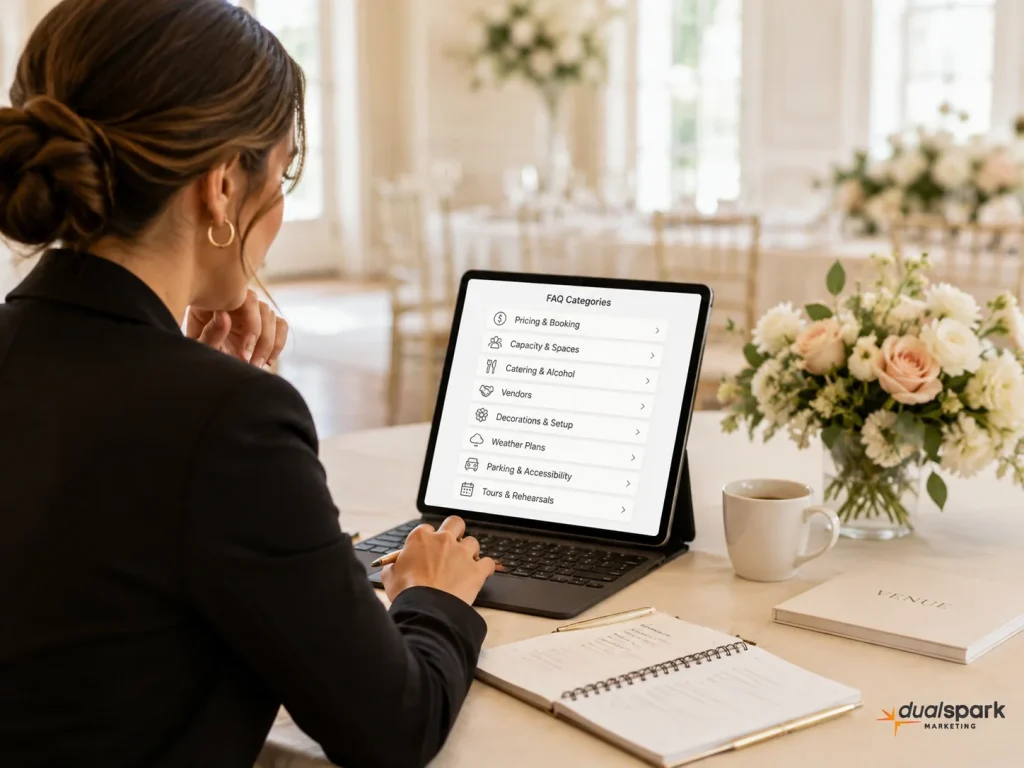
Divide your questions into clear sections such as:
- Pricing and Booking
- Venue Capacity and Spaces
- Catering and Alcohol
- Vendors
- Decorations and Setup
- Weather Plans
- Parking and Accessibility
- Tours and Rehearsals
Use clear headings so couples can scan the page.
Place your most important questions near the top. These usually include pricing, capacity, availability, what the rental includes, and how to schedule a tour.
You can also use expandable accordion sections to keep the page visually organized. Make sure the text remains available to visitors and search engines when you use this design.
Add a Clear Call to Action to Your FAQ Page
Your FAQ page should not end after the final answer.
Once a couple has reviewed your policies and understands what you offer, show them what to do next.
A strong closing call to action may invite them to:
- Schedule a private tour
- Request pricing
- Check date availability
- Call the venue
- Ask a question
- Download a pricing guide
“Schedule a Private Tour” often works better than a vague button such as “Submit” or “Learn More.”
The call to action should match the next step in your sales process.
Keep Your Wedding Venue FAQ Page Updated
An outdated FAQ page can create more problems than having no FAQ page at all.
Review the page whenever you change:
- Pricing
- Packages
- Capacity
- Rental hours
- Deposit requirements
- Payment schedules
- Vendor policies
- Alcohol rules
- Included amenities
- Setup procedures
- Cancellation terms
You should also review the page every few months and ask your team whether couples have started raising new questions.
Your FAQ page should grow and improve as you learn more about what couples need before booking.
Common Wedding Venue FAQ Page Mistakes
Giving Answers That Are Too Short
One-word answers rarely provide enough information. Give couples enough context to understand the policy and what it means for their wedding.
Using Vague Language
Statements such as “restrictions may apply” do not help unless you explain the main restrictions or direct visitors to a more detailed resource.
Copying Another Venue’s Questions and Answers
Your FAQ page should reflect your venue, not a competitor’s policies.
Avoiding Important Topics
Do not leave out difficult subjects such as pricing, alcohol, vendor rules, cancellation policies, or weather plans simply because they require longer answers.
Using Marketing Language Instead of Clear Answers
Couples want straightforward information. You can maintain a warm voice without turning every answer into a sales pitch.
Forgetting the Call to Action
Give couples an easy way to schedule a tour or request additional information after they finish reading.
Allowing the Page to Become Outdated
Assign someone to review the page whenever venue policies change.
Frequently Asked Questions About Wedding Venue FAQ Pages
Does an FAQ page really help a wedding venue rank higher on Google?
A well written FAQ page can support your wedding venue SEO by answering specific questions couples search for online. These searches often include phrases about pricing, capacity, catering, alcohol, rain plans, vendor rules, parking, and tour availability. When your website provides clear and original answers, Google receives more context about your venue and the services you offer.
An FAQ page will not improve rankings simply because it exists. The content needs to answer real questions, reflect your actual policies, and connect visitors to other useful pages on your website. You should also support the page with strong service pages, local SEO, original photos, reviews, internal links, and an optimized Google Business Profile.
Can a wedding venue FAQ page help generate more qualified inquiries?
Yes. A detailed FAQ page helps couples determine whether your venue fits their guest count, budget, preferred vendors, wedding style, and planning needs before they contact you. This can reduce inquiries from couples who are unlikely to book and help your team spend more time speaking with people who already understand what you offer.
Qualified couples also tend to ask better questions. Instead of contacting you for basic information, they may ask about available dates, package options, tour times, or contract details. This moves the conversation closer to a scheduled tour or signed agreement.
What questions should a wedding venue include on its FAQ page?
Your FAQ page should answer the questions couples ask most often during phone calls, emails, tours, and contract discussions. The strongest topics usually include venue capacity, rental hours, pricing, deposits, payment schedules, indoor and outdoor spaces, rain plans, catering, alcohol, vendors, decorations, rehearsals, parking, accessibility, setup, cleanup, and tour scheduling.
Do not add questions simply to make the page longer. Focus on the information couples need to decide whether your venue fits their plans. You can also review past emails and ask your sales team which questions they answer repeatedly.
How long should wedding venue FAQ answers be?
Each answer should be long enough to give couples useful information without becoming difficult to read. A simple question may only need a few sentences. More complicated topics, such as alcohol policies, cancellation terms, vendor requirements, or weather plans, may require several short paragraphs.
Begin with a direct answer, then explain any important details, requirements, exceptions, or next steps. Avoid one word answers when couples will still need to contact you for clarification. Complete answers provide more value to visitors and give search engines more useful context.
Should a wedding venue include pricing in its FAQ section?
Your FAQ page should provide meaningful pricing information, even when your final rate depends on the season, day of the week, guest count, or package. You may list starting prices, explain what the rental includes, describe deposit requirements, or direct couples to a dedicated pricing page.
Avoid answering every pricing question with “contact us for details.” Couples often want to know whether a venue is within their general budget before they schedule a tour. Giving them a helpful starting point can build trust and improve lead quality.
Should wedding venues use a dedicated FAQ page or add FAQs to other pages?
Most wedding venues benefit from using both. A dedicated FAQ page gives you space to answer broad questions about your policies, booking process, vendors, alcohol, deposits, rehearsals, and guest experience. It also creates one helpful resource your team can share with couples.
You should also add smaller FAQ sections to important pages. A pricing page can answer pricing questions, an amenities page can explain what the rental includes, and an indoor and outdoor spaces page can address capacity and rain plans. Page specific FAQs make each section of your website more useful and relevant.
Can FAQ content help a wedding venue appear in voice search and AI generated answers?
Clear FAQ content can make it easier for search engines and AI systems to understand your venue and use your information when answering detailed questions. Couples may search by asking which venues allow outside catering, include tables and chairs, offer indoor rain plans, or accommodate a certain number of guests.
Write your questions in natural language and begin each answer with a clear response. Avoid vague wording or answers that only tell visitors to call. The more accurately your website explains your venue, the easier it becomes for search tools to match your business with relevant questions.
Should wedding venues use FAQ schema markup?
FAQ schema can help search engines better understand the question and answer structure of a page. However, schema markup does not guarantee that Google will display enhanced search results, and it will not compensate for weak or copied content.
Use schema only when the visible page contains the same questions and answers included in the markup. Your primary focus should remain on creating accurate, helpful content for couples. Most modern website builders and SEO plugins can add FAQ schema without requiring manual coding.
How many questions should a wedding venue FAQ page include?
There is no required number of questions. A smaller venue with straightforward packages may only need 15 to 20 questions, while a venue with multiple spaces, packages, and policies may need 30 or more.
Organize longer FAQ pages into categories so visitors can quickly find the information they need. Common sections include Pricing and Booking, Capacity and Spaces, Catering and Alcohol, Vendors, Decorations, Weather Plans, Parking, Accessibility, and Venue Tours.
How often should a wedding venue update its FAQ page?
Review your FAQ page whenever you change your pricing, packages, capacity, rental hours, deposit requirements, payment schedule, vendor rules, alcohol policy, included amenities, or booking process. Outdated answers can create confusion and damage trust.
It is also helpful to review the page every few months. Ask your team whether couples have started raising new questions or misunderstanding any existing answers. Your FAQ page should continue to evolve as your venue and sales process change.
Can floor plans help out-of-town couples?
Yes, floor plans can be especially helpful for out-of-town couples. Many couples plan weddings from another city or state, and they may not be able to visit every venue right away. A floor plan helps them understand your space before they commit to a tour or travel plans.
Out-of-town couples want to know how the wedding day will flow, where guests will enter, where the ceremony and reception happen, whether the venue has a weather backup plan, and whether the layout works for family members, vendors, and guests. A floor plan helps answer those questions from a distance.
This can make your venue more competitive with couples planning destination weddings or weddings near family, beaches, historic districts, or popular travel areas.
Final Thoughts: Turn Your Floor Plans Into More Qualified Tour Requests
Wedding venue floor plans help couples understand your space before they schedule a tour. They answer guest count questions, explain wedding day flow, show layout options, and help couples picture how their ceremony and reception could work.
They also help your website perform better.
A strong floor plan page gives Google more context, supports long-tail searches, improves image SEO, and gives AI search tools clearer information about your venue.
Most importantly, floor plans help turn interest into action.
Photos may get couples excited, but floor plans help them feel confident. When couples can picture their wedding at your venue, they are more likely to request a tour and take the next step.
If your venue already uses floor plans during tours or inquiry conversations, do not keep them hidden. Turn them into helpful website content that works for your venue every day.