You booked more weddings this year. Your team handled more tours, hosted more events, and worked more weekends. That sounds like progress.
But did those extra weddings leave your business in a stronger position?
A wedding count cannot answer that question. If you filled your calendar with discounted packages, added services without charging for them, or accepted events with heavy staffing needs, you may have increased your workload faster than your revenue.
Wedding venue revenue per booking helps you understand the value behind each signed contract. When you track it alongside event costs, total revenue, and available dates, you can make better decisions about your pricing, packages, website, and advertising.
At Dual Spark Marketing, we encourage venue owners to connect marketing goals with business results. More bookings can support growth. Understanding what those bookings contribute helps you decide which kind of growth makes sense for your venue.
What Does Revenue Per Booking Mean for a Wedding Venue?
Revenue per booking measures the average amount your venue earns, or expects to earn, from each wedding in a defined group. You may also call it average booking value or average wedding contract value.
For a simple operational calculation:
Average revenue per booking = Total wedding revenue in the group ÷ Number of weddings in that same group
Suppose you host 30 weddings that generate $225,000 in venue revenue.
$225,000 ÷ 30 = $7,500 per wedding
That number gives your booking count context. You know how many weddings you hosted and how much revenue each wedding generated on average.
The phrase “in the same group” matters. If you divide revenue from weddings you hosted this year by contracts you signed this year for future dates, your calculation combines different groups and produces a misleading result.
Choose a reporting basis, label it clearly, and use it consistently.
Track Future Contracts and Completed Weddings Separately
Average signed contract value helps you evaluate new sales. Add the current contract values for bookings secured during a chosen period, then divide by those bookings.
Average completed wedding revenue helps you evaluate events you already hosted. Use the final revenue from those weddings, including agreed changes and refunds.
Keep cash collections in a separate view. A deposit shows money you received today. It does not represent the full value of the wedding, and receiving a final payment does not create another booking.
These views answer different questions: What are you selling? What did you deliver? What money has arrived?
How More Weddings Can Hide Weak Business Performance?
Every wedding uses part of your calendar, your property, and your team’s capacity. Your event count tells you how often you used those resources. It does not tell you how much value you received in return.
Consider this hypothetical comparison for the same venue:
| Measure | Year One | Year Two |
|---|---|---|
| Weddings hosted | 36 | 30 |
| Average revenue per wedding | $5,500 | $7,000 |
| Total wedding revenue | $198,000 | $210,000 |
In this example, the venue hosts six fewer weddings and generates $12,000 more in total wedding revenue.
That does not prove Year Two produced more profit. Event costs and other expenses still matter. It does show why counting weddings alone can lead you to the wrong conclusion.
The reverse can happen too. You might add ten weddings while average booking value falls enough to leave total revenue almost unchanged. Your team carries more work without a matching increase in revenue.
Keep wedding count in your reports. Give it financial context before you call an increase a success.
What Revenue Should You Include in Each Wedding Booking?
Start with the products and services your venue actually sells. Depending on your business model, those may include the venue rental, ceremony space, extra access hours, coordination, lodging, equipment rentals, or food and beverage services.
Count each charge once. If your package already includes ceremony access, do not add its listed standalone price again.
Use the price after discounts. A package advertised at $8,000 that you sell for $7,400 contributes $7,400 before any other eligible charges.
Separate amounts that do not represent venue earnings in your internal report, such as refundable security deposits and taxes you collect for remittance. Do not include the couple’s entire wedding budget. A photographer’s fee does not become venue revenue simply because the photographer works at your property.
If your venue collects money for outside vendors, review how your business records those arrangements with your bookkeeper. For marketing comparisons, distinguish the revenue and margin your venue retains from money you collect and pass along.
The goal is a consistent picture of your business, rather than an inflated contract total.
Why Should You Compare Booking Revenue With Event Costs?
Revenue per booking measures sales value. It does not measure profit.
A package can bring in more money while requiring enough additional labor, rentals, or supplies to leave you with less.
Here is a hypothetical example:
| Measure | Package A | Package B |
|---|---|---|
| Revenue from the wedding | $6,000 | $8,000 |
| Direct event costs | $1,500 | $4,200 |
| Amount left after direct event costs | $4,500 | $3,800 |
Package B generates $2,000 more revenue, but Package A leaves $700 more after direct event costs.
Neither remaining amount represents final business profit. You still need to cover ongoing expenses such as property payments, insurance, office payroll, and maintenance. You also need to account for marketing and sales costs without counting the same expense twice.
For operating decisions, track the amount each wedding leaves after the costs you incur to deliver it. Those costs might include event staff, cleaning, security, supplies, outside rentals, and payment processing.
Track owner hours too, even if your current cost report does not assign them a dollar value. A package that depends on repeated unpaid work may create a staffing problem as bookings grow.

How Do Discounts Affect Average Wedding Booking Value?
A discount reduces revenue immediately. Your workload and event expenses may stay almost the same.
Suppose you reduce a $7,000 rental to $6,300. If direct event costs remain $2,000, the amount left after those costs falls from $5,000 to $4,300.
You gave up $700 without removing any event work.
That trade may make sense for a date you would otherwise leave empty. It deserves more scrutiny when you apply it to a Saturday that already attracts strong demand.
Record the original quoted price, the final agreed price, the discount, and the reason you offered it. Then review patterns by date type and package.
Repeated discounts may point to unclear package value, inconsistent quoting, or marketing that attracts couples whose budgets do not fit your offer. Those problems call for different changes.
Also track extras you provide at no charge. An extra access hour may look like a small concession, but it can add staff time and reduce the time available for another event or property work.
How Should You Evaluate Different Dates and Wedding Packages?
Your venue does not sell identical opportunities every day of the week. A peak season Saturday and a quieter Thursday may attract different demand and require different offers.
Review average wedding booking value by date type, season, and package before changing your prices.
Compare Similar Weddings Before Drawing Conclusions
Separate Saturday weddings from weekday weddings. Compare the same season across years when you have enough history. Review venue only rentals separately from packages that include substantial services.
Also compare similar guest counts. A package with catering may produce more revenue as attendance rises, while a flat rental may stay the same.
Without these comparisons, a change in your booking mix can look like a pricing problem. Your overall average might fall because you added smaller weekday weddings while keeping Saturday rates steady.
Check the median booking value as well. The median is the middle booking value when you arrange the values from lowest to highest. It helps you see whether one unusually large contract pulled your average upward.
Consider How Much Calendar Space Each Booking Uses
A wedding weekend may occupy your property for three days. Another wedding may require one event day and a short rehearsal.
The weekend contract may produce more revenue per booking while leaving less room for other business.
For packages that block several dates, compare revenue and the amount left after direct costs across all the dates they occupy. Include setup and cleanup access when those periods prevent another booking.
Keep practical limits in mind. Some venues need recovery time between events. Your most valuable calendar plan must fit the staffing and service you can reliably provide.
For related ideas, see our guide to marketing weekday weddings and quieter dates without discounting.
How Can Your Website Support Stronger Booking Value?
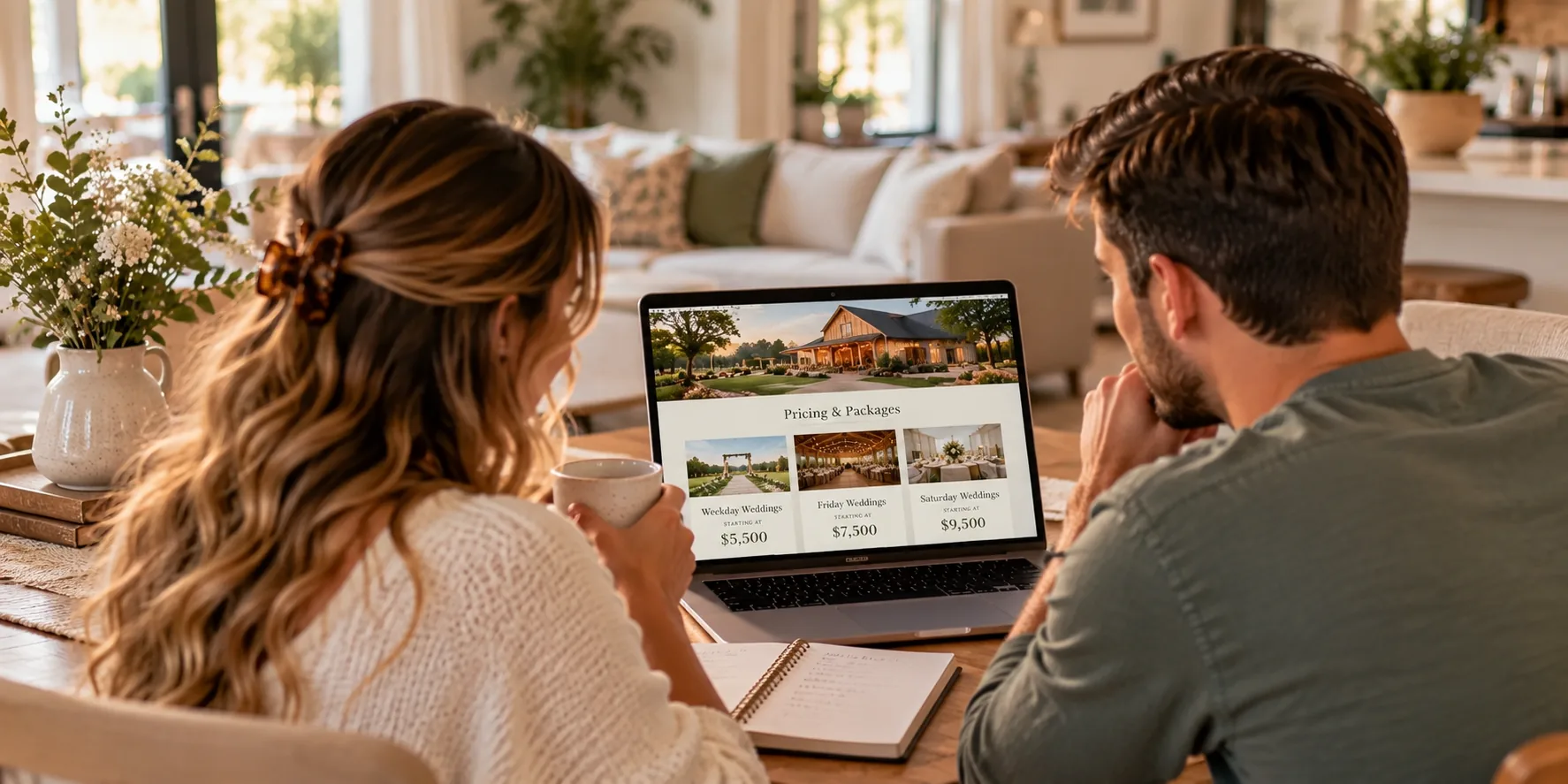
Your website helps couples decide what your venue offers and whether the price makes sense for their wedding. If your pages show attractive photos but leave package details unclear, couples may compare you mainly on the rental fee.
Give them enough information to understand the full offer.

Explain What Your Price Includes
Show couples which spaces they can use, how long they can access them, what furniture you provide, and which services your staff handles.
A getting ready suite offers more than another room. It gives the wedding party a place to prepare at the property. Included tables and chairs may simplify rental planning. An indoor ceremony option can help couples plan for weather changes.
Describe those benefits accurately and support them with real photos. Avoid suggesting that your venue includes services that couples must purchase separately.
Our article on answering wedding venue pricing questions before the tour explains how clear information can help couples assess fit before they visit.
Present Package Differences Clearly
If you offer several packages, explain what changes between them and who might benefit from each option.
A couple planning a short celebration may need your simplest package. Another couple may value extra access time because they want a relaxed setup schedule.
Make those choices easy to compare. Explain required charges alongside optional services so couples can estimate a realistic total.
Clear choices help your team discuss the wedding the couple wants, instead of trying to justify a price they did not understand.
Use Real Weddings to Show What Couples Can Purchase
Booking value gives you another way to evaluate the couples your marketing attracts.
A campaign that fills your calendar with smaller weddings may serve a useful goal. Another campaign may support larger packages or extended rentals. Judge both against the dates, services, and revenue goals you want to support.
Review the number of bookings, average booking value, total revenue, direct event costs, and marketing cost together. A campaign with one large contract may look impressive, but one booking gives you limited evidence about future results.
Keep your reporting consistent. Compare inquiries that entered during similar periods and give them a similar amount of time to book. Avoid treating a newly launched campaign as if it has had the same sales window as an established one.
Use your booking records to review which packages and date types each source supports. Then adjust your message accordingly. If you need weekday business, promote an offer that suits weekday celebrations. If you need stronger demand for a full weekend package, explain what that access allows couples to do.
Do not claim that every feature will increase contract values. Test whether clearer messaging attracts suitable inquiries and leads to bookings your venue can deliver profitably.
For the broader measurement process, read our guide to calculating wedding venue marketing ROI.
What Should You Track in a Booking Value Report?
You can start with a spreadsheet or your existing booking system. Use one record per wedding and assign a unique booking ID so you can connect inquiries, contracts, payments, and final event results.
Record these fields consistently:
- Contract signing date and wedding date
- Package, guest count, season, and day of the week
- Dates the booking blocks from other sales
- Base rental, selected extras, and discounts
- Current contract value and final completed event revenue
- Direct event costs and staff hours
- Amount collected, refunds, and cancellation status
- Original inquiry source and relevant campaign information
Keep payments and contract value in separate fields. Update the existing wedding record when a couple adds services, rather than counting the change as another booking.
For cancellations, maintain a separate record of retained fees, refunds, and released dates. Exclude canceled weddings from your active booking average and show their effects separately. If another couple books the released date, give that new wedding its own record.
Each month, review new signed contracts and completed weddings in separate groups. Compare similar dates and packages, then decide whether the numbers call for a pricing, sales, marketing, or operating change.
How Can You Increase Revenue Per Booking Without Pressuring Couples?
Start by improving the match between your offer and the weddings you can serve well.
You may find that your strongest package already includes useful services your website barely explains. You may discover that your team routinely gives away extra access time. You may have optional services that solve real planning problems but never appear in your proposals.
Address those gaps before adding more services.
Choose a few optional features you can deliver consistently. Explain their price, purpose, and limits. Ask couples about their plans before recommending them.
For example, extra setup time may help a couple arranging a detailed reception. It may offer little value to a couple whose planner can complete setup within the included hours.
Review your base pricing separately from upgrades. If your standard package no longer covers the work you include, more add ons may only hide the underlying problem.
Track each change through signed contracts and completed events. Check whether it improves total revenue and the amount left after event costs while keeping service manageable.

Build a Calendar That Supports Your Venue's Goals
A full calendar can represent strong demand. Revenue per booking helps you understand what that demand means for your business.
Use booking count to measure activity. Use average booking value to understand sales value. Review event costs, total revenue, cash collections, and calendar use to decide whether your bookings support the business you want to run.
You may need more weddings. You may need clearer packages, fewer unnecessary discounts, or marketing that better explains the value you already provide. Your own records can help you choose.
At Dual Spark Marketing, we help wedding venues connect their websites, SEO, and paid advertising with meaningful booking goals. Contact Dual Spark Marketing to discuss how your marketing can attract couples whose plans fit your venue, your packages, and your available dates.
Frequently Asked Questions About Wedding Venue Revenue Per Booking
How do I calculate average revenue per booking for my wedding venue?
Calculate average revenue per booking by dividing the total wedding revenue for a defined group of events by the number of weddings in that same group. If 24 completed weddings generate $180,000, your average equals $7,500 per wedding.
Choose your group before collecting the numbers. For completed weddings, use final event revenue after discounts, adjustments, and refunds. For future business, calculate average signed contract value separately using the current values of active contracts.
Do not divide payments received this month by weddings booked this month. Those payments may relate to events you sold months earlier. Keep taxes collected for remittance and refundable security deposits separate in your internal report. Apply the same rules each time so changes reflect business performance.
What is a good average booking value for a wedding venue?
A good average booking value supports your venue’s costs, calendar capacity, and financial goals. No single dollar amount fits every venue because rental models, locations, services, and event sizes differ.
Start with your own completed weddings. Review what each package earns, what you spend to deliver it, and how much remains to help cover ongoing expenses. Then assess whether the number of weddings you can realistically host supports your annual goals.
Compare similar dates and packages rather than judging your venue against an unrelated property’s advertised price. A venue only rental and a package that includes food, staffing, and lodging carry different costs. Set a target you can explain from your own numbers, then review whether your sales and marketing support it.
Should I accept fewer weddings if revenue per booking increases?
You should accept fewer weddings only when the overall financial and operating result supports that decision. A higher average booking value alone does not guarantee higher total revenue or profit.
Compare the total revenue you expect under each calendar plan. Then subtract the direct costs of delivering those weddings and consider the ongoing expenses you still need to cover. Review payment timing, staff capacity, and the number of dates each booking occupies.
Also consider the risk of depending on fewer contracts. One cancellation can have a larger effect when you host a small number of high value events. Before reducing booking volume, confirm that demand supports your revised offer. Keep a realistic plan for dates that remain open.
Can smaller weddings lower my average booking value but still help my business?
Smaller weddings can lower your average booking value while increasing total revenue and helping cover ongoing expenses. That can make sense when you host them on dates that would otherwise remain unused.
Evaluate each event’s revenue, direct costs, access needs, and effect on other bookings. A short weekday celebration may require fewer staff hours and leave your weekend calendar open. A smaller Saturday wedding may use the same valuable date and setup time as a larger event.
Your package structure should reflect those differences. When designing smaller wedding offers, consider guest limits, access hours, service levels, and date availability. Track them as a separate group so their lower contract values do not hide steady performance in your larger wedding packages.
How can I tell whether a wedding package upgrade is worth offering?
A wedding package upgrade is worth offering when couples value it and its price covers the added work and costs while leaving a worthwhile return. Extra revenue alone does not establish that value.
List the labor, supplies, vendor charges, setup time, storage, and cleanup the upgrade requires. Include tasks your team currently handles between events, such as cleaning or repairing rental items. Then compare those costs with the upgrade price.
Start with a limited offering and track how often couples choose it. Ask your staff whether it creates scheduling problems or service issues. A simple upgrade that couples understand may work better than a long menu. Review completed events before expanding, because your initial cost estimate may miss work that only becomes clear during delivery.
How should I handle cancellations when measuring wedding booking revenue?
Handle cancellations by updating your active booking totals and reporting cancellation income and refunds separately. A cancelled contract should not continue inflating the average value of weddings you still expect to host.
Keep the original contract value for your records, then document payments received, refunds issued, and any amount your venue retains. Track the cancellation date and whether you book the released wedding date again.
If a new couple books that date, create a new wedding record instead of treating the replacement as a continuation of the cancelled event. Review cancellation patterns alongside the original sales period and marketing source when useful. Follow your bookkeeper’s guidance for formal financial reporting; your operating report should clearly distinguish active weddings, completed weddings, and cancellations.
How can I increase wedding booking value without simply raising prices?
You can increase wedding booking value by selling services couples need, explaining existing package value clearly, and reducing unnecessary discounts or free extras. Start by reviewing recent proposals and completed events.
Look for services your team regularly provides without a consistent charge, such as extended access or additional setup work. Decide which services belong in your base package and which should carry a separate price. Make those choices clear before couples sign.
Next, improve how your website and proposals explain package differences. Recommend optional services based on each couple’s plans, rather than encouraging every couple to buy everything. Measure the result after direct costs. A higher contract total only helps when you can deliver the added services efficiently and maintain the experience you promise.
Should I track revenue per booking or tour to booking conversion rate?
You should track both revenue per booking and tour to booking conversion rate because they answer different questions. Conversion rate shows how often completed tours lead to bookings. Revenue per booking shows the average value of those bookings.
A strong conversion rate can coexist with weak booking value if your team relies on discounts. A high average contract value can coexist with weak total sales if very few couples book.
Review both measures for comparable groups and allow time for couples to decide. Then look at total revenue, event costs, and available dates before changing your offer. Our guide to tracking tour to booking conversion rate explains the sales measure in more detail.
Final Thoughts: Focus on What Each Wedding Contributes
Booking more weddings can help your venue grow, but a busy calendar does not tell you how well your business performs. Track revenue per booking alongside event costs, discounts, and the dates each wedding occupies. Those numbers help you understand which packages support your goals and where extra work brings too little return.
Use what you learn to improve your pricing, explain your value more clearly, and guide your marketing toward couples whose plans fit your venue. The goal is to build a calendar that generates healthy revenue while allowing your team to deliver the experience you promise.
At Dual Spark Marketing, we help wedding venues connect their websites, SEO, and paid advertising with clear business goals. If your marketing keeps you busy but you cannot tell whether it brings in the right bookings, contact Dual Spark Marketing. Let’s build a strategy that communicates your value, attracts qualified couples, and supports a more profitable wedding calendar.