Couples want to picture their wedding day before they schedule a tour. They want to know where the ceremony will happen, where guests will sit, where the dance floor will go, how cocktail hour will flow, and whether your venue can comfortably fit the wedding they have in mind.
Photos help, but photos do not always answer layout questions.
A strong wedding venue floor plan can help couples understand your space faster. It can show how your venue handles different guest counts, ceremony setups, reception layouts, indoor spaces, outdoor areas, vendor flow, and weather backup plans.
Floor plans also help your website perform better. They give Google more useful content to understand your venue, support long-tail wedding searches, improve image SEO, and give AI search tools clearer information about your space.
For wedding venues, floor plans should not sit hidden inside a PDF that only gets emailed after a couple asks. They should work as part of your website strategy. When you use them correctly, floor plans can help attract more qualified traffic, reduce confusion, and increase tour requests from couples who already understand how your venue fits their day.
Couples Want To Picture The Space Before They Book A Tour
Wedding planning is emotional, but it is also practical. Couples may fall in love with your photos, but they still need to know if your venue works for their guest count, timeline, ceremony style, reception layout, and overall flow.
That is why floor plans matter.
A couple may love your barn, ballroom, courtyard, chapel, or outdoor ceremony space, but they still need answers to questions like:
- Where would the ceremony take place?
- Where would guests sit during dinner?
- Is there room for a dance floor?
- Where would the DJ or band set up?
- Can cocktail hour happen in a separate space?
- Is there enough room for buffet tables or food stations?
- Where would the couple get ready?
- What happens if it rains?
- Can the venue comfortably accommodate 75, 125, or 200 guests?
When your website answers these questions visually and clearly, couples can understand your venue faster.
That matters because many couples compare several venues at the same time. If one venue makes the layout easy to understand and another venue leaves everything unclear, the helpful venue often feels more organized, more transparent, and easier to trust.
Floor plans also help couples self-qualify. If your venue is a perfect fit for 100 to 150 guests, a floor plan can help those couples feel more confident reaching out. If a couple needs space for 300 guests and your venue does not support that size, they can move on before taking up your team’s time.
That saves your team from weak inquiries and helps you focus on couples who are more likely to book.
A good floor plan does not need to be overly technical. It just needs to help couples answer one important question:
Can we picture our wedding here?
When your website helps them say yes, you make the tour request feel like the natural next step.
Floor Plans Help Answer Guest Count Questions
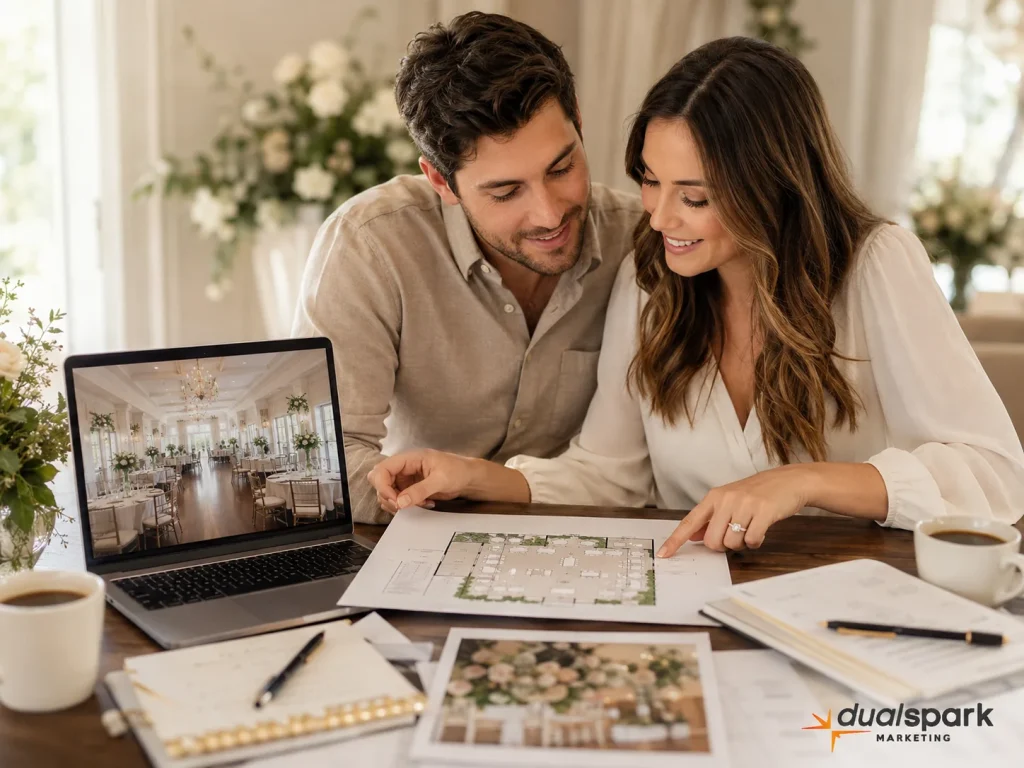
Guest count is one of the biggest questions couples have before they tour a wedding venue. They want to know if your space can hold their wedding comfortably, not just technically.
That difference matters.
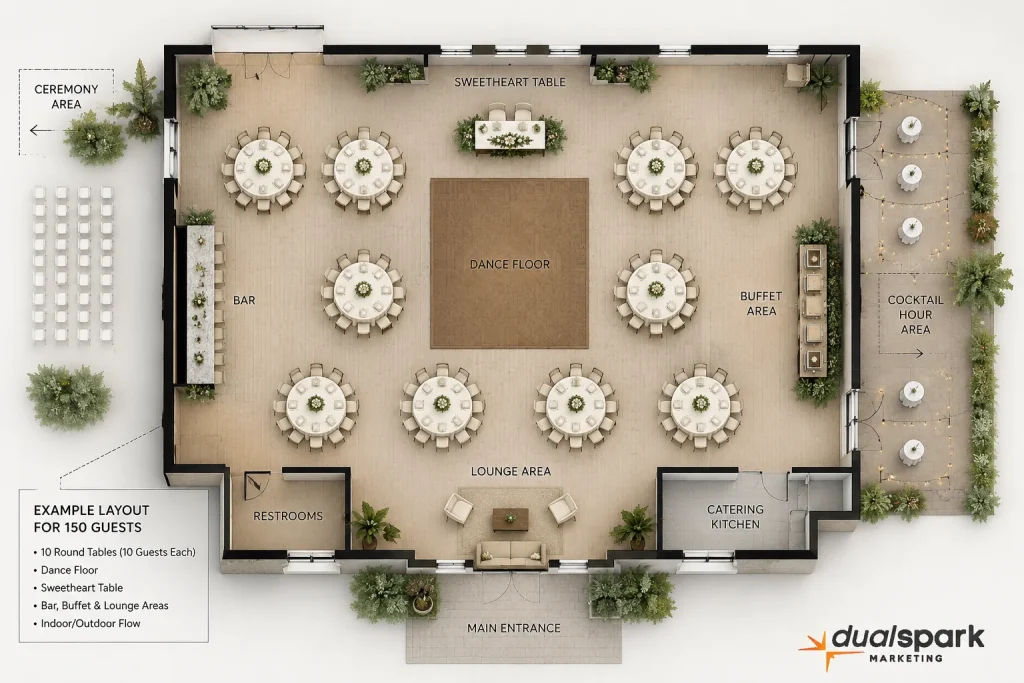
A venue may be able to fit 150 guests on paper, but couples still want to understand what that looks like in real life. They want to know if there is enough room for dinner tables, a dance floor, a sweetheart table, a DJ or band, gift tables, buffet stations, bar service, and guest movement.
A floor plan helps answer those questions faster than text alone.
Instead of only saying your venue can host a certain number of guests, you can show couples how the space works at different guest counts. This helps them picture the room and understand what changes as the wedding size grows.
For example, your website can show layouts for:
- 75 guests with an intimate reception setup
- 100 guests with ceremony and reception space
- 150 guests with a dance floor and buffet area
- 200 guests with adjusted table spacing and vendor setup
- Cocktail hour flows between indoor and outdoor areas
- Rain backup layout for outdoor ceremonies
These layout examples help couples make better decisions. A couple planning a smaller wedding can see that your venue will still feel warm and full. A couple planning a larger wedding can see whether the space gives guests enough room to move comfortably.
This also helps your team avoid confusion during the inquiry process. Without a floor plan, couples may assume your venue works for their guest count when it may not. They may also assume the space is too small, even though it actually works well with the right layout.
Floor plans remove that guesswork.
They also create stronger website content. When your page explains the guest count, seating arrangements, dance floor space, ceremony flow, and reception layout, it naturally provides Google with more useful information about your venue. That can help your website rank for searches by couples looking for a wedding venue that fits their exact guest count.
A strong floor plan page can help you show up for searches like:
- Wedding venue for 100 guests
- Wedding venue for 150 guests
- Wedding venue with indoor reception space
- Wedding venue with dance floor
- Wedding venue with outdoor ceremony and indoor reception
- Wedding venue with room for buffet and dancing
Couples do not only search by city. They search by need. Guest count is one of those needs.
When your website clearly explains how your venue handles different wedding sizes, you give couples more confidence and help search engines better understand what your venue offers.
Venue Layout Content Helps Google Understand Your Spaces
Google cannot walk through your venue the way a couple can. It depends on your website content, images, page structure, and local signals to understand what your venue offers.
That is why venue layout content matters.
When your website explains your ceremony areas, reception spaces, cocktail hour options, getting-ready rooms, parking flow, and guest movement, you give Google more context about your venue. A floor plan page helps connect those details in one place.
Instead of only saying you offer a beautiful wedding venue, your website can explain how the space actually works.
For example, your floor plan page can describe:
- Indoor ceremony layouts
- Outdoor ceremony layouts
- Reception table setups
- Dance floor placement
- Cocktail hour flow
- Bar and catering locations
- Bridal suite and groom suite access
- Vendor setup areas
- Guest entry points
- Rain backup options
This type of content helps search engines understand more than your location. It helps them understand the kind of weddings your venue can host.
That can support searches by couples who want specific features, such as an indoor reception space, an outdoor ceremony lawn, a barn reception layout, a covered patio, a private bridal suite, or flexible event space.
A floor plan page also helps you avoid thin website content. Many wedding venue websites rely heavily on photos and short descriptions. Photos matter, but they do not provide search engines with enough written context on their own.
When you pair strong visuals with clear layout descriptions, your website becomes more useful for couples and easier for search engines to understand.
Floor Plans Support AI Search And Planning Questions
AI search works best when a website gives clear, detailed answers to specific questions. Wedding venue floor plans can support that because they answer planning questions couples often ask before they reach out.
Couples may ask AI tools questions like:
- How much space do we need for 150 wedding guests?
- What should a wedding reception layout include?
- How should a wedding venue handle cocktail hour?
- What should we look for in a venue floor plan?
- How do we know if a wedding venue has enough space?
- What is the best layout for a ceremony and reception in one venue?
If your website has a detailed floor plan page, you give AI search tools more information to better understand your venue and the planning topics associated with it.
This does not mean your venue will automatically show up in every AI result. No one can promise that. But helpful, well-structured content gives your website a stronger foundation.
A floor plan page can answer questions about guest count, layout options, indoor and outdoor flow, rain plans, reception setup, and vendor space. Those details help AI tools understand your venue beyond the basic name, address, and photos.
The more useful your content is, the more chances your website has to support search experiences where couples ask detailed planning questions instead of typing short keywords.
Layout Pages Can Help Rank For Long-Tail Wedding Searches
Couples do not only search for “wedding venue near me.” They search for venues that fit their specific plans.
That is where long-tail searches matter.
A long-tail search is a more detailed search with stronger intent. These searches may not bring as much volume as broad keywords, but they often bring better traffic because the couple already knows what they need.
A floor plan page can help your website connect with searches like:
- Wedding venue with space for 100 guests
- Wedding venue with indoor and outdoor reception space
- Wedding venue with room for a dance floor
- Wedding venue with ceremony and reception in one location
- Wedding venue with bridal suite and groom’s suite
- Wedding venue with a rain backup plan
- Wedding venue with cocktail hour space
- Wedding venue layout for 150 guests
These searches tell you what couples care about. They want to know if your venue can handle their wedding size, flow, and setup.
A floor plan page gives you a natural place to answer those searches. You can explain how your venue works for different guest counts, where key moments happen, and how couples can use the space.
This helps your website attract traffic from couples who are not just browsing. They are trying to find a venue that fits their actual wedding plans.
Floor Plans Reduce Confusion Before The First Inquiry
Confused couples do not always ask for clarification. Many of them simply leave the website and keep searching.
If your website does not explain how your venue works, couples may make assumptions. They may think your space is too small. They may think it only works for one type of wedding. They may not realize that you have a rain plan, a separate cocktail-hour area, or flexible reception layouts.
A floor plan helps remove that confusion.
It gives couples a clearer picture of the space before they inquire. They can see how guests move through the venue, where the ceremony may happen, where dinner fits, and how the reception flows.
This helps couples feel more prepared before they contact your team.
It also helps your team spend less time answering basic layout questions. Instead of starting every conversation from zero, you can point couples to a page that already explains the main setup options.
That can make the inquiry process smoother, especially for couples who are comparing multiple venues.
When your website answers layout questions upfront, couples can reach out with better questions. They may ask about dates, tours, packages, and customization rather than whether the venue can accommodate their wedding at all.
How Floor Plans Help Couples Compare Venues
Couples often compare several wedding venues at the same time. They may have tabs open for five or ten venues, each with photos, pricing, reviews, and inquiry forms.
Your venue needs to make the decision easier.
A floor plan gives couples something practical to compare. It helps them see how your space works, not just how it looks.
Photos can show beauty, but floor plans show function.
A couple may compare:
- How many guests each venue can hold comfortably
- Whether the ceremony and reception can happen onsite
- Whether the venue has a weather backup plan
- How close are the getting-ready spaces to the ceremony area
- Whether cocktail hour has its own space
- Whether the reception layout leaves room for dancing
- Whether older guests can move through the space easily
- Whether vendors have enough room to set up
When your website explains these details clearly, your venue can feel more organized and easier to trust.
This matters because couples are not only choosing the prettiest venue. They are choosing the venue that feels like it can handle their day smoothly.
A clear floor plan can help your venue stand out from competitors who only show gallery photos and leave couples guessing.
What A Wedding Venue Floor Plan Page Should Include
A strong floor plan page should help couples understand your space without overwhelming them. You do not need to turn the page into a complicated architectural document. You need to show how the venue works for a wedding day.
Your floor plan page can include:
- A clear overview of the venue layout
- Ceremony layout options
- Reception layout options
- Guest count examples
- Dance floor placement
- Cocktail hour space
- Getting-ready room locations
- Restroom locations
- Parking and guest entrance details
- Vendor setup areas
- Catering or prep space
- Bar placement options
- Rain backup layouts
- Indoor and outdoor flow
- Photos that match each layout
- A tour request call to action
You can also include notes that explain how couples commonly use the space.
For example, you can explain that many couples host the ceremony outside, move guests to cocktail hour on the patio, and then bring everyone inside for dinner and dancing. That type of explanation helps couples picture the day in order.
The page should also include strong image optimization. If you upload floor plan images, use clear file names, alt text, captions, and descriptions. Do not name the file something generic like “image1.jpg.” Use wording that describes the image and supports the page topic.
A floor plan page works best when it combines visuals, plain-language explanations, and clear next steps.
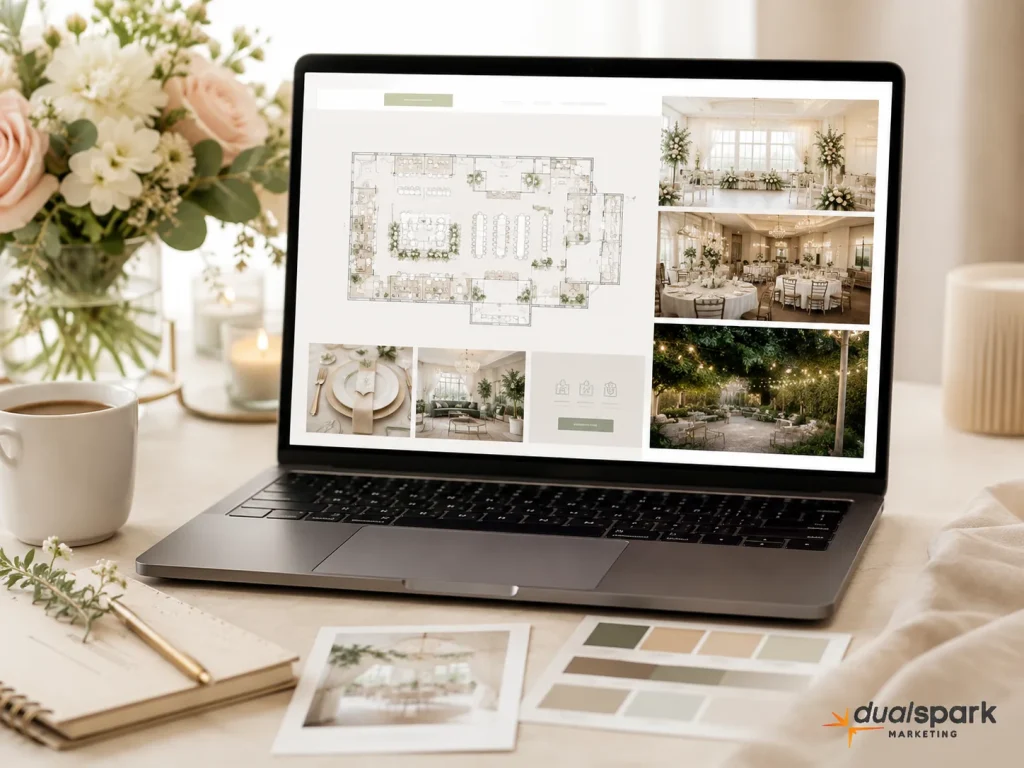
Why Photos Alone Are Not Enough
Wedding venue photos are important. They help couples feel the style, setting, and emotion of your venue.
But photos do not always answer practical questions.
A beautiful reception photo may show tables, flowers, and lighting, but it may not show how the whole room flows. A ceremony photo may show the aisle and arch, but it may not show where guests enter, where cocktail hour happens, or how the space changes if it rains.
That is why photos and floor plans work better together.
Photos create desire. Floor plans create clarity.
A couple may love the look of your venue, but they still need to know if it works for their guest count, timeline, vendors, and reception setup. If they cannot figure that out from your website, they may hesitate to reach out.
A floor plan helps turn inspiration into action.
It gives couples enough practical information to feel confident scheduling a tour. It also helps them ask better questions during the tour because they already understand the general layout.
Instead of trying to imagine everything from photos alone, couples can walk into the tour with a clearer picture of how their wedding could work at your venue.
How To Use Floor Plans To Increase Tour Requests
A floor plan page should not only educate couples. It should move them closer to taking action.
That means you need to guide visitors toward a tour request.
After you explain your layout options, guest count examples, and wedding day flow, invite couples to see the space in person. Floor plans can answer a lot of questions, but the tour brings the venue to life.
You can use calls to action like:
- Schedule a private tour to see how your wedding could flow through our venue.
- Want to see how your guest count would fit? Request a tour today.
- Let’s walk through the layout together and talk through your wedding vision.
- See the ceremony spaces, reception layout, and getting-ready areas in person.
- Ask us about layout options for your guest count and wedding style.
Your CTA should feel natural, not pushy. The goal is to make the tour feel like the next helpful step.
You can place tour CTAs in several spots:
- Near the top of the page after the intro
- After guest count examples
- After rain backup information
- Near layout photos
- At the bottom of the page
- Inside a short contact form section
Floor plans help couples understand the space. Your CTA should help them take the next step while they are already interested.
Common Mistakes Wedding Venues Make With Floor Plans
Many wedding venues either do not use floor plans online or use them in a way that does not help SEO or conversions.
Common mistakes include:
- Only sending floor plans after someone inquires
- Hiding floor plans inside a hard-to-read PDF
- Uploading floor plan images without alt text
- Using technical drawings couples cannot understand
- Showing one layout even though the venue has multiple setup options
- Failing to explain guest count differences
- Not showing ceremony and reception flow
- Not mentioning rain backup layouts
- Forgetting to add a tour request CTA
- Using outdated floor plans that no longer match the venue
The biggest mistake is assuming couples can figure it out on their own.
They should not have to guess how your venue works. Your website should make the layout clear, simple, and useful.
A strong floor plan page does not need to show every possible setup. It just needs to answer the biggest questions couples have before they book a tour.
Floor Plans Can Support Image SEO
Floor plans are also useful for image SEO. Search engines cannot fully understand an image without help from surrounding content and image details.
When you upload floor plans or layout graphics, you should optimize them the same way you optimize venue photos.
Use descriptive file names such as:
- wedding-venue-reception-floor-plan.webp
- barn-wedding-venue-layout-for-150-guests.webp
- outdoor-ceremony-rain-backup-layout.webp
- wedding-venue-cocktail-hour-floor-plan.webp
Then add alt text that describes what the image shows.
For example:
- Floor plan showing a wedding reception layout with round tables, dance floor, and sweetheart table.
- Outdoor ceremony layout with guest seating, aisle, and backup reception space.
- Wedding venue floor plan showing cocktail hour area, reception room, and guest entrance.
This helps search engines understand the image. It also helps accessibility because screen readers can describe the image to users who cannot see it.
Good image SEO will not make a weak page strong by itself, but it can support the overall page when paired with helpful written content.
Floor Plans Help Out-Of-Town Couples Make Faster Decisions
Many wedding venues attract couples who do not live nearby. Some couples plan from another city, another state, or even across the country.
Those couples need more information before they schedule a tour or book travel to visit your venue.
A floor plan can help them understand your space from a distance. It gives them a better sense of how the venue works before they commit time to an in-person visit.
This matters for destination wedding venues, rural venues, barn venues, historic venues, and venues near popular travel areas.
Out-of-town couples may need to understand:
- How guests will arrive
- Where the ceremony and reception happen
- How close the getting-ready spaces are
- Whether the venue works for their guest count
- How the day flows from one space to another
- Whether the layout works for older guests or family members
- Where vendors will set up
- Whether the venue has a weather backup plan
The more clearly your website answers those questions, the easier you make the planning process.
A floor plan can help out-of-town couples feel more confident before they inquire, schedule a tour, or ask about available dates.
Floor Plans Build Trust Before The Tour
Trust starts before the first phone call.
When your website gives couples clear answers, helpful visuals, and practical details, your venue feels more professional. Couples can tell when a venue has thought through the wedding day experience.
A floor plan shows that you understand the details that matter.
It shows couples that your team has handled weddings before, understands guest flow, and can help them plan more than just a pretty ceremony. It also shows that you are willing to be transparent about how the space works.
That can make your venue feel less risky.
Couples want to know they are choosing a venue that can support their day from start to finish. A floor plan helps prove that before they ever step onto the property.
This can be especially helpful for venues with flexible spaces. If your venue can be used in several ways, a floor plan helps couples understand those options without feeling overwhelmed.
FAQs About Wedding Venue Floor Plans And SEO
Do wedding venue floor plans help SEO?
Yes, wedding venue floor plans can help SEO when you use them as part of a helpful, well-written website page. Search engines need more than pretty photos to understand what your venue offers. A floor plan page gives your website clear content about guest capacity, ceremony spaces, reception layouts, cocktail hour flow, dance floor placement, getting-ready areas, vendor setup, and weather backup plans.
This type of content can help your venue connect with more specific searches from couples who already know what they need. For example, a couple may search for a wedding venue for 150 guests, a venue with indoor and outdoor space, or a venue with room for a ceremony and reception in one location. A strong floor plan page gives Google more context and gives couples better answers before they schedule a tour.
Should a wedding venue put floor plans on its website?
Yes, most wedding venues should put floor plans on their website if the layouts help couples understand the space. Many venues already use floor plans during tours, sales calls, or planning meetings, but they keep them hidden until after a couple reaches out. That can create unnecessary friction because couples want to know if the venue fits their wedding before they inquire.
Your floor plans do not need to look like complicated architectural drawings. They should be easy for couples to understand. A simple layout that shows ceremony areas, reception seating, dance floor placement, guest flow, getting-ready spaces, and rain backup options can make your website more useful. When couples can picture how their day could work at your venue, they are more likely to take the next step.
What should a wedding venue floor plan page include?
A wedding venue floor plan page should show how your space works for a real wedding day. It should not just display a blank room layout. It should explain how couples can use the venue from arrival through the final send-off.
A strong floor plan page can include ceremony layout options, reception layout options, guest count examples, dance floor placement, cocktail hour space, getting-ready room locations, restroom locations, parking and guest entrance details, vendor setup areas, catering or prep space, bar placement options, rain backup layouts, indoor and outdoor flow, and photos that match each layout.
The page should also include a clear tour request call to action. After couples understand the layout, you want to guide them toward seeing the venue in person.
Can floor plans help couples decide whether to schedule a tour?
Yes, floor plans can help couples decide whether your venue is worth touring. Couples often compare several venues at the same time, and they want to quickly understand which spaces fit their guest count, wedding style, and overall timeline.
A floor plan can answer practical questions before the first inquiry. Couples can see where the ceremony may take place, where dinner would happen, where the dance floor fits, how guests move between spaces, and whether your venue has a backup plan for weather. That clarity builds confidence.
When your website makes the space easy to understand, couples do not have to guess. They can picture their wedding more clearly and feel more comfortable requesting a tour.
Are photos enough for a wedding venue website?
Photos are important, but they are usually not enough by themselves. Photos help couples fall in love with the look and feel of your venue, but they do not always explain how the space functions.
A reception photo may show beautiful tables, flowers, and lighting, but it may not show the full room flow. A ceremony photo may show the aisle and arch, but it may not show guest entry, cocktail hour space, restrooms, parking, or where the reception happens after the ceremony.
Floor plans fill in those gaps. Photos create excitement, while floor plans create clarity. When you use both together, your website gives couples the emotional and practical information they need before scheduling a tour.
How can a wedding venue optimize floor plan images for SEO?
A wedding venue can optimize floor plan images by treating them like valuable website assets. Start with a descriptive file name before uploading the image. Instead of using a generic file name like “layout.jpg” or “floorplan-final.png,” use a file name that describes what the image shows.
For example, you could use names like wedding-venue-reception-floor-plan.webp, barn-wedding-venue-layout-for-150-guests.webp, outdoor-ceremony-rain-backup-layout.webp, or wedding-venue-cocktail-hour-floor-plan.webp.
You should also add clear alt text, a helpful title, a caption when it makes sense, and a description. The image should sit near written content that explains the layout. This helps search engines understand the image, supports accessibility, and gives couples more context.
Should floor plans be in a PDF or on a website page?
A downloadable PDF can be useful, but your main floor plan content should also live on a normal website page. PDFs can be harder to view on mobile devices, and they often create a weaker user experience when couples are quickly comparing venues.
A website page gives you more control. You can add headings, written explanations, optimized images, internal links, layout examples, guest count details, and tour request buttons. You can also update a web page faster when your layout options or venue policies change.
If you want to offer a PDF, use it as a bonus resource. Do not make it the only place where couples can understand your floor plans.
Can floor plans help with AI search?
Yes, floor plans can support AI search because they help answer detailed planning questions. AI search tools look for clear, useful content that explains a topic well. A floor plan page can give your website more information about guest count, ceremony flow, reception layout, indoor and outdoor spaces, rain plans, vendor setup, and wedding day logistics.
Couples may ask AI tools questions like how much space they need for 150 guests, what a reception layout should include, or how to compare wedding venues with indoor and outdoor space. If your website clearly explains those topics, it gives AI search systems more useful information to understand.
No agency can guarantee that AI search will feature your venue, but stronger content gives your website a better foundation.
How many floor plan examples should a wedding venue show?
A wedding venue should show enough floor plan examples to answer the most common questions couples ask. Many venues can start with two to five layouts. For example, you might show an intimate wedding layout, a standard reception layout, a larger guest count layout, an outdoor ceremony layout, and a rain backup layout.
The goal is not to overwhelm couples with every possible setup. The goal is to help them understand how flexible your venue can be. If your space works well for different guest counts or wedding styles, floor plan examples can make that clear.
Each layout should include a short explanation. Tell couples what the setup is best for, how many guests it can usually support, and what parts of the wedding day it helps with.
Do floor plans help wedding venues get better leads?
Yes, floor plans can help wedding venues get better leads because they help couples self-qualify before reaching out. If a couple can see that your venue fits their guest count, layout needs, and wedding style, they may feel more confident requesting a tour.
Floor plans can also reduce weak inquiries. If your venue is not the right fit for a certain guest count or setup, some couples can figure that out before contacting your team. That saves time and helps your staff focus on couples who are more likely to book.
Better leads usually come from better information. When your website answers important layout questions upfront, couples can reach out with more confidence and better expectations.
Can floor plans help out-of-town couples?
Yes, floor plans can be especially helpful for out-of-town couples. Many couples plan weddings from another city or state, and they may not be able to visit every venue right away. A floor plan helps them understand your space before they commit to a tour or travel plans.
Out-of-town couples want to know how the wedding day will flow, where guests will enter, where the ceremony and reception happen, whether the venue has a weather backup plan, and whether the layout works for family members, vendors, and guests. A floor plan helps answer those questions from a distance.
This can make your venue more competitive with couples planning destination weddings or weddings near family, beaches, historic districts, or popular travel areas.
Final Thoughts: Turn Your Floor Plans Into More Qualified Tour Requests
Wedding venue floor plans help couples understand your space before they schedule a tour. They answer guest count questions, explain wedding day flow, show layout options, and help couples picture how their ceremony and reception could work.
They also help your website perform better.
A strong floor plan page gives Google more context, supports long-tail searches, improves image SEO, and gives AI search tools clearer information about your venue.
Most importantly, floor plans help turn interest into action.
Photos may get couples excited, but floor plans help them feel confident. When couples can picture their wedding at your venue, they are more likely to request a tour and take the next step.
If your venue already uses floor plans during tours or inquiry conversations, do not keep them hidden. Turn them into helpful website content that works for your venue every day.