If you have ever researched SEO, you have probably heard advice like this:
“Your page needs at least 1,500 words to rank.”
“Longer content always performs better.”
“You need more words than your competitors.”
For years, word count was treated like a ranking rule.
But in 2026, that thinking is outdated.
Search engines have evolved. SEO is no longer about hitting a certain number of words. It is about satisfying search intent and creating a strong user experience.
In this post, we will explain:
- What word count ratios are
- Why they used to matter
- Why they no longer drive rankings
- What wedding venues should focus on instead
Let’s break it down in simple terms.
What Are Word Count Ratios?
Word count ratio refers to the idea that your content must be longer than other pages ranking on Google.
For example, if the top pages for “wedding venue in Tampa” have 1,200 words, you might think you need 1,500 or 2,000 words to compete.
This led to a belief that more words automatically meant better rankings.
But that is not how modern SEO works.
Why Word Count Used to Matter
Years ago, search engines relied more heavily on visible signals like keyword usage and page length.
Longer content often:
- Included more keywords
- Covered more related phrases
- Seemed more detailed
- Attracted more backlinks
Because of that, longer pages often ranked better.
But here is the important part.
Word count itself was not the ranking factor. Depth and relevance were.
Longer content simply had a better chance of being thorough.
Why Word Count No Longer Matters
Search engines today are much more advanced. Google understands context, meaning, and user behavior.
It no longer ranks pages based on length alone.
Here is why word count ratios are no longer important.
Google Focuses on Search Intent
Search intent means understanding what the user actually wants.
If someone searches for “wedding venue pricing,” they likely want clear pricing information. They do not want a 2,000 word essay about the history of weddings.
If your page answers the question clearly in 600 words, that may perform better than a 2,000 word page filled with extra fluff.
Quality beats quantity.
Google rewards pages that satisfy the search quickly and clearly.
User Engagement Matters More
Google looks at how users interact with your site.
Do visitors stay on your page?
Do they click to other pages?
Do they schedule a tour?
If your long article is boring or repetitive, visitors may leave quickly. That hurts engagement.
A shorter, well structured page that keeps users interested is often more powerful than a long page that drags on.

Fluff Content Hurts Experience
When people chase word count goals, they often add unnecessary content just to make the page longer.
That can lead to:
- Repetitive sentences
- Unhelpful filler paragraphs
- Keyword stuffing
- Hard to read sections
For wedding venues, clarity is more important than length. Couples want simple, helpful information. They do not want to scroll endlessly to find pricing or availability.
AI and Semantic Search Changed Everything
Modern search engines understand related terms and context.
You do not need to repeat the same keyword dozens of times. Google understands that “Jacksonville wedding venue” and “wedding venue in Jacksonville” mean the same thing.
Because of this, you can write naturally and focus on helpful content instead of stretching your word count.
What Wedding Venues Should Focus on Instead
If word count is not the goal, what actually moves the needle for rankings and bookings?
Here is what truly matters for modern wedding venue SEO.
Here is an infographic you can reference to.
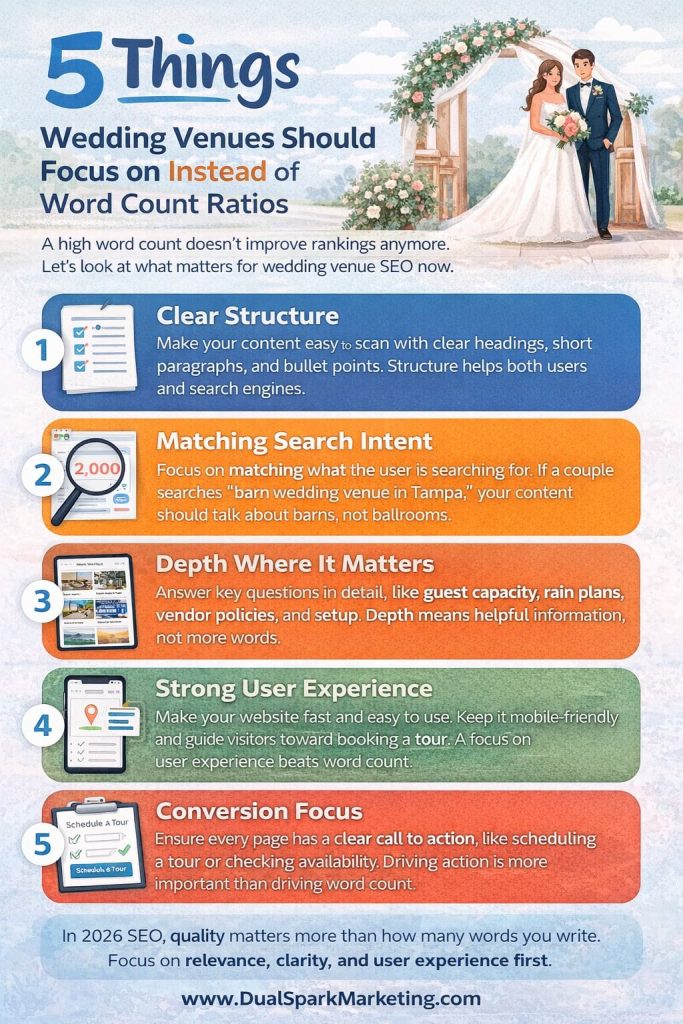
Clear Structure
Structure makes your content easier to read and easier to understand. When a couple lands on your website, they should not feel overwhelmed by long blocks of text. Clean headings, short paragraphs, and well placed bullet points help visitors scan quickly.
Search engines also use structure to understand your page. Proper headings tell Google what your page is about and how your information is organized. A clear layout improves both rankings and conversions. Instead of adding more words, focus on making every section easy to follow.
Matching Search Intent
Search intent means understanding what someone expects to see when they click your page. If a couple searches for “barn wedding venue in North Florida,” they expect to see barn photos, guest capacity details, and ceremony setup options.
If your page talks mostly about corporate events or indoor ballroom space, it does not match the search. Even if your content is long, it will not perform well. Relevance beats length every time. Make sure each page delivers exactly what the visitor is looking for.
Depth Where It Matters
Depth is not about writing more. It is about answering real questions clearly and fully.
For a wedding venue, depth might include:
- Guest capacity limits
- Rain plan details
- Parking and transportation
- Vendor flexibility
- Setup and cleanup timelines
These details help couples feel confident. When your content addresses practical concerns, visitors stay longer and are more likely to schedule a tour. Depth builds trust. Fluff builds frustration.
Strong User Experience
User experience is one of the most powerful ranking factors today. Google pays attention to how people interact with your website.
Ask yourself:
- Does your site load quickly?
- Is it easy to navigate?
- Does it work smoothly on mobile?
- Are calls to action visible?
A shorter page that loads instantly and guides visitors clearly will outperform a long page that feels slow and confusing. Experience shapes engagement, and engagement shapes rankings.
Internal Linking
Internal linking connects your pages together in a logical way. It helps both visitors and search engines understand your website.
For example, your homepage should link to your pricing page. Your blog posts should link to your gallery. Your location pages should link back to your main venue page.
These connections encourage visitors to explore more than one page. When people move through your site naturally, bounce rate decreases and engagement improves. Internal linking adds strength without adding unnecessary word count.
Conversion Focus
Your website is not just about traffic. It is about bookings.
Every page should guide visitors toward an action, such as:
- Scheduling a tour
- Checking availability
- Viewing pricing
- Downloading a brochure
If you write 2,500 words but never clearly ask for the next step, you miss opportunities. Strong calls to action and smart layout drive results more than page length ever could.
SEO should bring the right traffic. Conversion strategy turns that traffic into revenue.
The Real SEO Standard in 2026
In the past, marketers chased numbers like:
- 1,500 words
- 2,000 words
- More than competitors
Today, the smarter question is:
Does this page fully and clearly solve the visitor’s problem?
If the answer is yes, the exact word count does not matter.
For wedding venues, clarity and trust matter far more than hitting a word goal.
Final Thoughts
In 2026, SEO is no longer about writing more just to hit a number. It is about writing with purpose. Wedding venues that win online are not the ones with the longest pages, but the ones with the clearest message, the strongest structure, and the best user experience. When your website answers real questions, guides couples naturally, and makes booking easy, rankings improve as a result.
Dual Spark Marketing has created a wedding venue website platform built around strong local SEO structure, designed to drive more traffic, increase engagement, and generate more tour requests. We would love to show you how it can work for your venue.